Plastic pollution in Global South
17 Dec 2025 11:14:20
By Caroline Malagutti Fassina and Pedro Fidelman :
Considering the gradual and truly intentional reduction of the plastic supply chain as an environmental policy also means considering economic planning policies that impact the flows within its value chain.
PLASTIC has grown faster than any other industrial material in the last 65 years. Its cheap durability, initially an innovation, has become an environmental and public health problem of global proportions.
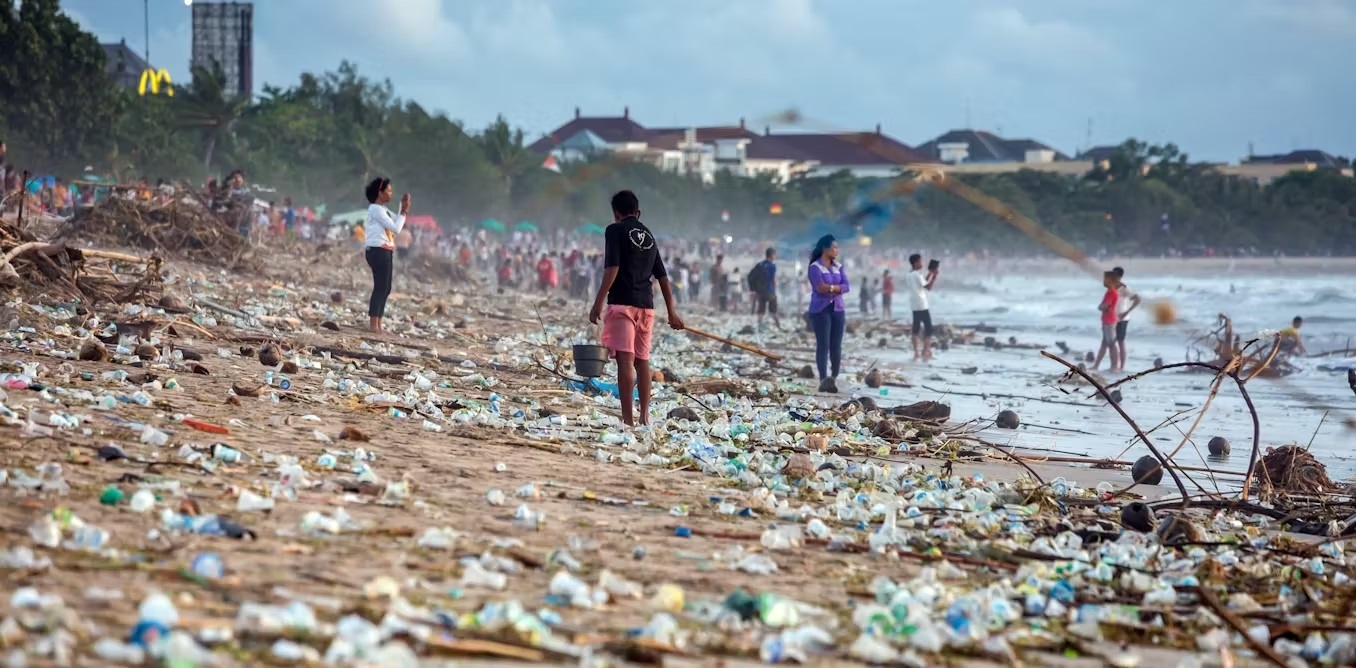
Without an end-of-life strategy, the world is conducting an uncontrolled experiment, with plastic accumulating in poor countries, rivers, and throughout the ocean.
Plastic isn’t manufactured in a neighbourhood. Often, it’s not even produced within a single country. It depends on a gigantic international supply chain. So-called primary plastics—liquid or gaseous chemicals used to make plastic products—cross oceans to supply factories around the world.
Since the 1950s, when the first plastics emerged, the complexity and scale of this supply chain have only grown.
Today, plastic is a global commodity, so ubiquitous that almost everything around us contains some piece of it.
Look around you: it’s easy to see why global demand for plastics more than tripled between 1991 and 2021.
Such a large increase in molecules synthesised in the laboratory—which do not exist in nature—would certainly bring challenges. Among them is the challenge of contaminating our own bodies and ecosystems.
In places with weaker regulations and/or institutional capacities – especially in countries of the Global South – these challenges transform into visible crises: plastics in the soil, in the water, on the streets, in fish, in breast milk.
Technological assessments and life cycle analyses show that, at all costs, we still do not have a truly efficient waste management system when it comes to plastic, not on the scale at which we have been producing, consuming, and discarding it, nor even considering broad scenarios of recycling and incineration.
International trade has played (and continues to play) a central role in the plastics value chain
worldwide.
The plastics industry itself reflects this complexity and scale: leading companies in the sector often do not own their own factories—they rely on extensive networks of third-party manufacturers, usually located in countries with cheaper labour.
The result is a long, complex, and difficult-to-trace chain. For decades, international trade and the oil lobby have sustained the economic dependence on 140 plastic commodities.
Considering the highly interconnected nature of this chain, a Brazilian study conducted by us, the authors of this article, began to highlight the role of certain ports—restricted and delimited territories of international trade—in this chain.
Many global value chains—not just the plastics chain—pass through a few ports scattered around the world. This means that a large part of the power and control of these chains is concentrated in a few port companies at these border crossings.
Even when these companies assume some social and environmental responsibility, they rarely cover the full extent and complexity of the impacts generated.
After all, supply chains enter and exit through ports, but spread throughout the world.
In most cases, these are multinational corporations with no commercial ties to the producers and consumers in the domestic part of the plastics supply chain.
The study proposes to investigate which ports, by functioning as funnels in this chain, are strategic points for the implementation of public policies to begin managing this crisis.
Therefore, considering the gradual—and truly intentional—reduction of the plastic supply chain as an environmental policy also means considering economic planning policies that impact the flows within its value chain.
It is a necessary orchestration (the planning of environmental policies alongside macroeconomic policies) and on a necessary scale (international), for policies that seriously seek, based on data, solutions to the climate and plastic crises.
The harmful growth in plastic production did not happen in isolation. It had—and continues to have—favourable trade agreements and incentives from governments around the world.
Because it is a refined petroleum product, plastic supply chains initially converge on oil extraction.
In other words, the oil lobby, with its heavily subsidised activities, also discourages the development of more circular products and business
models.
Redirecting these incentives could be a game-changer.
Investments in innovation and technology transfer for alternative, substitute, compostable, and biodegradable materials, in retail systems based on packaging reuse, can guide economies out of this crisis.
Along with tariffs on disposable or non-recyclable products, and fees on landfills and incineration, intervening in the “middle of the chain”—the midstream —is a turning point that has been overlooked, and it is where policies can act long before the plastic reaches the consumer.
Given the urgency, but also the complexity of the plastic crisis, the question cannot be whether or not to participate in the global oil supply chain. We cannot stop buying plastic in our daily choices.
The question on a collective scale is how to participate in a transition to new supply chains of plastic substitutes that also promote less disparity between economies.
Ultimately, it is not the end consumer in the South who should pay the price for a transition to other materials.
In studying this “how” we brought the port authorities to the table. This was so that, before we arrive at setting more refined operational goals, we could work with something applicable and testable today in the main ports of the supply chain.
The port midstream is strategic: it’s territorially limited, computerised, and monitored. So why not start there?
To even begin planning a way out of dependence on plastic, however, a two-dimensional perspective is essential—both to avoid a simplistic approach and one that disregards ongoing historical power imbalances.
First, the strategic vision. Some ports often influence the economies of entire regions and countries. And, therefore, they are also key players in environmental policies. With this vision, port agencies assume the role of strategic partners for interventions in specific supply chains and specific regions.
Secondly, the vision of justice. Justice, whether distributive, environmental, or climate-related, has a common direction: it is directed towards the poorest, most vulnerable, and most at-risk.
Simply imposing tariffs on certain plastics in Northern ports will only further reduce purchasing power and access to services in the South, and therefore the quality of life for that population in general.
In this sense, environmental policies acting on value chains should highlight multiple possible forms of intervention directed at diverse economies, taking the North-South dichotomy only as a historical backdrop to be considered, but not generalisable.
Without losing sight of these two dimensions—the strategic one and the one in favour of justice—the coordinated experimentation with this transitional pricing can (and should) begin.
(The Conversation)
n