Restoration of Samadhi Sthal of Gond King Bakht Buland Shah: Remembering legacy of Founder of Nagpur City
| Date :02-Dec-2025 |
By Prof Anoop Kumar :
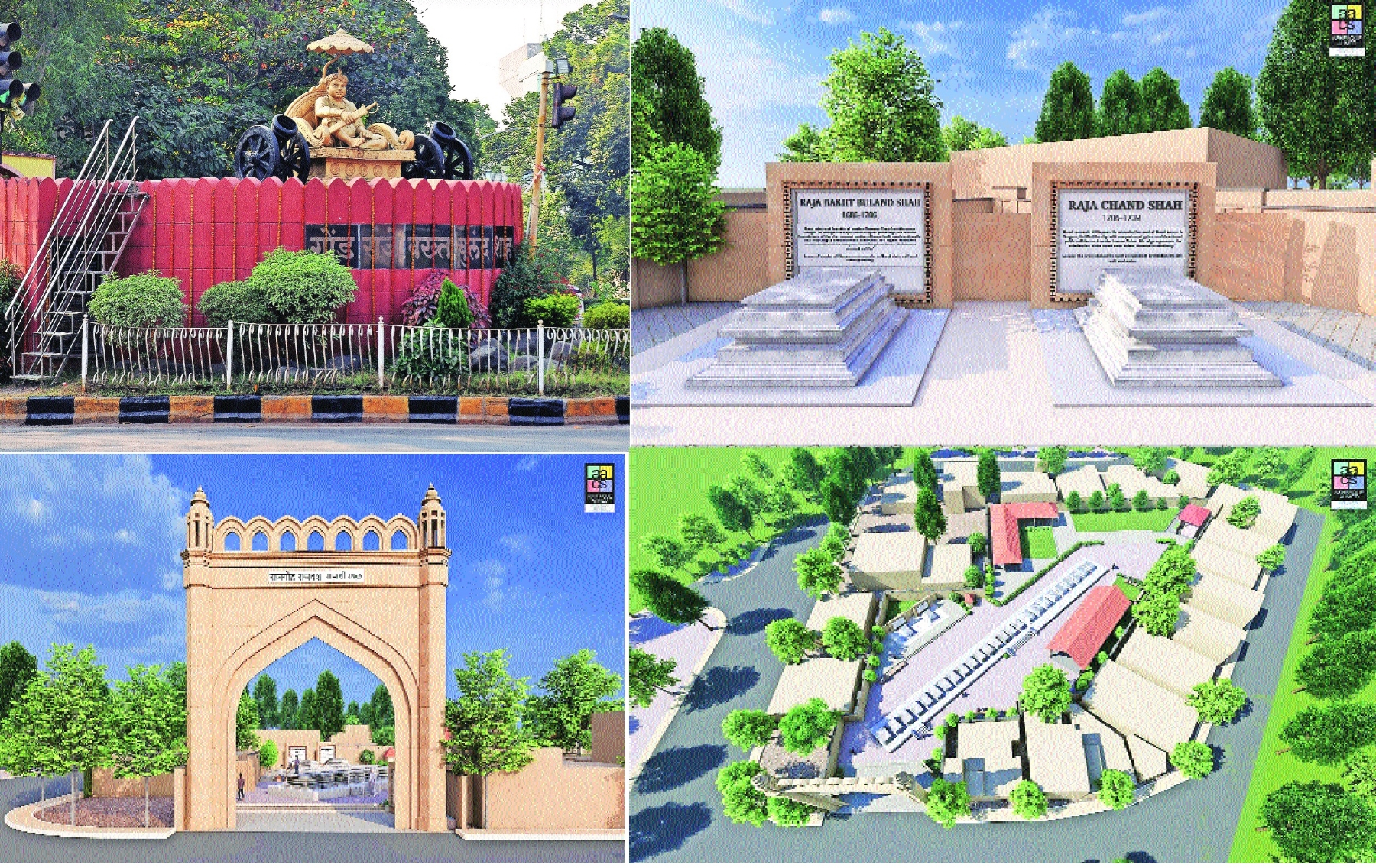
These are the pictures of the proposed and sanctioned work of the restoration of the Samadhi sthal of Gond King Bakht Buland Shah and his successors. These pictures have been provided by young architect Aseem Ahmed. These are part of 3D presentation made by Aseem.
IAS (Retd)
If one were to ask members of Generation G in Nagpur, “Who founded the city?”, most would likely respond: Bakht Buland Shah. The reason is evident—the grand and imposing statue of the Gond King, seated on his throne, stands prominently at Vidhan Bhavan Chowk in Civil Lines. This monument, honouring Nagpur’s founder Gond King Bakht Buland Shah, was installed in January 2008 after persistent demand from the city’s residents.
Yet, if the question shifts to “Who was Bakht Buland Shah, and what is his legacy?”, answers become scarce. And if one asks, “Where is the tomb of Nagpur’s founder?”, almost no one—from Generation G, X, Y, Alpha, or even senior citizens—would know the correct response.
Even I was unaware that, hidden within the bustling locality of Sakkardara, lies the largely forgotten and severely neglected Samadhi (mausoleum) of Gond King Bakht Buland Shah, now in a dilapidated state.
Bakht Buland Shah of the Deogarh dynasty (Deogarh is near modern Chhindwara) founded Nagpur in 1702 by consolidating 12 small and scattered hamlets into a cohesive urban centre. His reign was notable not only for territorial expansion but also for significant urban growth across central India.
Proposal for restoration
of Gond King Bakht
Buland Shah Memorial
The Nagpur Improvement Trust (NIT) recently placed before the Heritage Conservation Committee a proposal for the restoration and development of the memorial of Gond King Bakht Buland Shah.
In an extensive discussion, my colleague and Chairman of NIT, Sanjay Meena, explained that the initiative was prompted by eminent tribal activists of Nagpur, led by senior leader Maya Iwnate.
They had drawn attention to the long neglect of the Samadhi Sthal of King Bakht Buland Shah and other members of the Gond royal lineage.
Responding to these concerns, and following instructions from the Hon’ble Chief Minister Devendra Fadnavis, NIT prepared a comprehensive heritage restoration plan worth Rs 9.6 crore, designed by the renowned architectural firm of Nagpur-Ashfaq Ahmed & Sons, known for Tajbaug restoration.
This major heritage conservation initiative focuses on the Gond King Bakht Buland Shah Samadhi Sthal at Sakkardara—one of Nagpur’s most significant yet neglected historical sites. The complex marks the resting place of Raja Bakht Buland Shah, the Gond King who founded Nagpur in 1703, along with his heirs.
The project encompasses:
n Documentation and site clean-up
n Restoration of samadhis using locally sourced stone to preserve Gond-era authenticity
n Landscape development with enhanced green cover and improved pathways
n Visitor amenities including toilets, seating, and semi-open pavilions for information display
n Digital information points narrating the Gond dynasty’s legacy and Nagpur’s early history
The initiative seeks to revive the Samadhi Sthal with dignity, ensuring its cultural and architectural significance is safeguarded for future generations.
As per the Government-approved Heritage List, the site known as Raje Bakht Buland Shah Samadhi (memorial) is listed at Serial No. 52 and designated as a Grade-1 heritage site. The Superintending Engineer, NIT, sought permission for the restoration and beautification of the site through his letter dated April 29, 2025.
A meeting of the Heritage Conservation Committee (HCC), chaired by me on July 2, 2025, took up this subject. A detailed presentation was made to HCC by Architect Ashfaq Ahmed, his son Architect Aseem Ahmed, and one of their colleagues.
The proposal consisted of the restoration and beautification of 0.4 acres of land in Mauza-Nagpur, Khasara Nos. 573 & 586 at Sakkardara. After extensive deliberations, the following observations were recorded in HCC
n Evidence of ownership of the heritage site—whether it remains private property of the Gond descendants or has been transferred to NIT—must be presented to the HCC in the next meeting.
n Heritage experts of the HCC, including Prof Madhura Rathod of INTACH and the SE, ASI, observed that since the Gond Raja Samadhi Sthal is of considerable antiquity, the inclusion of a ‘Chhatri’ (canopy), which is not characteristic of Gond tradition, should be removed from the proposal and the modified proposal be resubmitted to the HCC.
In the subsequent meeting, NIT presented evidence of the voluntary transfer of land for heritage restoration by the current varasdar. Likewise, M/s Ashfaq Ahmed Architects submitted a revised design incorporating the removal of the Chhatris and compliance with other observations. Consequently, the crucial project related to the memorial of the founder of Nagpur was formally approved by the HCC.
The deliberations, however, sparked in me a deeper curiosity about Raja Bakht Buland Shah. With the assistance of material provided by historian Dr Shubha Johri, member of the HCC, this article has been prepared.
(The author is Professor of Practice, IIM, Nagpur, and Chairman, Heritage Conservation Committee, Nagpur.)