Kaushiki dishes out soulful extravaganza
21 Dec 2025 10:10:00
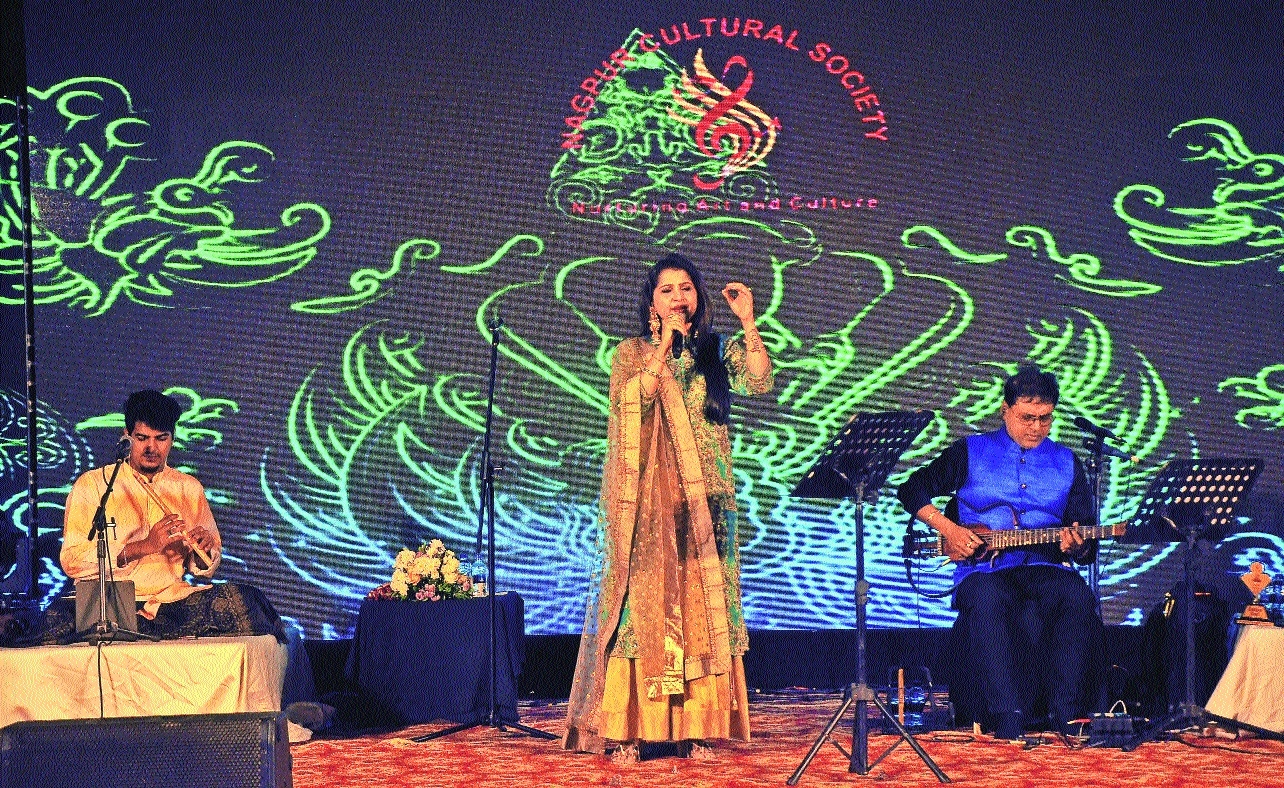
IN ZONE: Kaushiki Chakraborty (centre) performing at Madhurima, accompanied on the flute by Shadaj Godkhindi (left), and Sanjoy Das on rthe guitar (right), along with others. (Pic by Anil Futane)
Staff Reporter :
The soft glow of coloured lights inside Hotel Centre Point set the tone for an evening where time seemed to slow down and soulful music took precedence over everything else. By Saturday evening, the audience settled in anticipation, waiting for the first note as Kaushiki Chakraborty took the stage. When she finally began to sing, the space transformed into a zone for classical extravaganza, where emotions flowed freely.
Opening with a soulful exploration of Raag Yaman, Chakraborty allowed the
music to unfold at its own
pace.
Her patient pace drew
the listeners in an almost trance-like state. An accomplished exponent of the Patiala gharana,
she moved confidently with both discipline and talent. Pieces such as ‘Salona Sa Sajan’ and ‘Mausamon Ko Rok Lo Na’, a song composed with her brother,
highlighted her ability to balance classical grammar with personal expression. The audience responded with sustained
attention that deepened as the evening progressed.
The concert also traced her musical lineage. She sang ‘Sajan Kab Aaoge’, a composition by her father, Padma Bhushan awardee Ajoy Chakraborty, and followed it with ‘Aaoge Jab Tum O Saajna’, composed by Ustad Rashid Khan, whom she fondly refers to as her uncle. These moments carried a sense of continuity, linking personal memory with classical tradition. Her rendition of the Marathi song ‘Sundar Te Dhyan’, made famous by Lata Mangeshkar, was introduced with a brief recollection of meeting the legendary singer.
Chakraborty spoke of her nervousness, the warmth she received, and the quiet encouragement that stayed with her long after those meetings.
As the evening unfolded, renditions of Naina Tere Kajrare Hai and Yaad Piya Ki Aaye further revealed her range across
classical and semi-classical forms.
The programme drew to a close with the bhajan ‘Tum Aaj Aana Bhagwan’, leaving the hall in a reflective silence before applause broke through.
Supporting her throughout the recital was an accomplished ensemble. Murad Ali’s sarangi added depth and resonance, while guitarist Sanjoy Das brought in a contemporary texture. Vaibhav Wavikar on drums and percussion bridged Indian classical rhythms with jazz influences, and flautist Shadaj Godkhindi offered lyrical ease. Anay Gadgil’s keyboard work provided subtle harmonic support, while tabla player Khurram Ali anchored the performance with precision and restraint.
Towards the end, Chakraborty paused to speak about music itself. She observed that the purity of music does not lie in its structure, but in its source, and spoke about the need to support and empower young classical musicians.
Traditions, she suggested, survive only when each generation is given the freedom and encouragement to create its own musical voices and icons. The thought found resonance in a hall filled with listeners who had come not just to hear music, but to connect with it.
The musical concert, Madhurima, was organised by the Nagpur Cultural Society to mark its first anniversary. Though conceived as a celebration, the evening felt less like a milestone event and more like a thoughtful pause, an opportunity to listen closely, to reflect, and to be reminded of why classical music continues to matter.