From safety on streets to drug epidemic Young Nagpur voters eye municipal reforms
23 Dec 2025 11:48:52
By Simran Shrivastava :
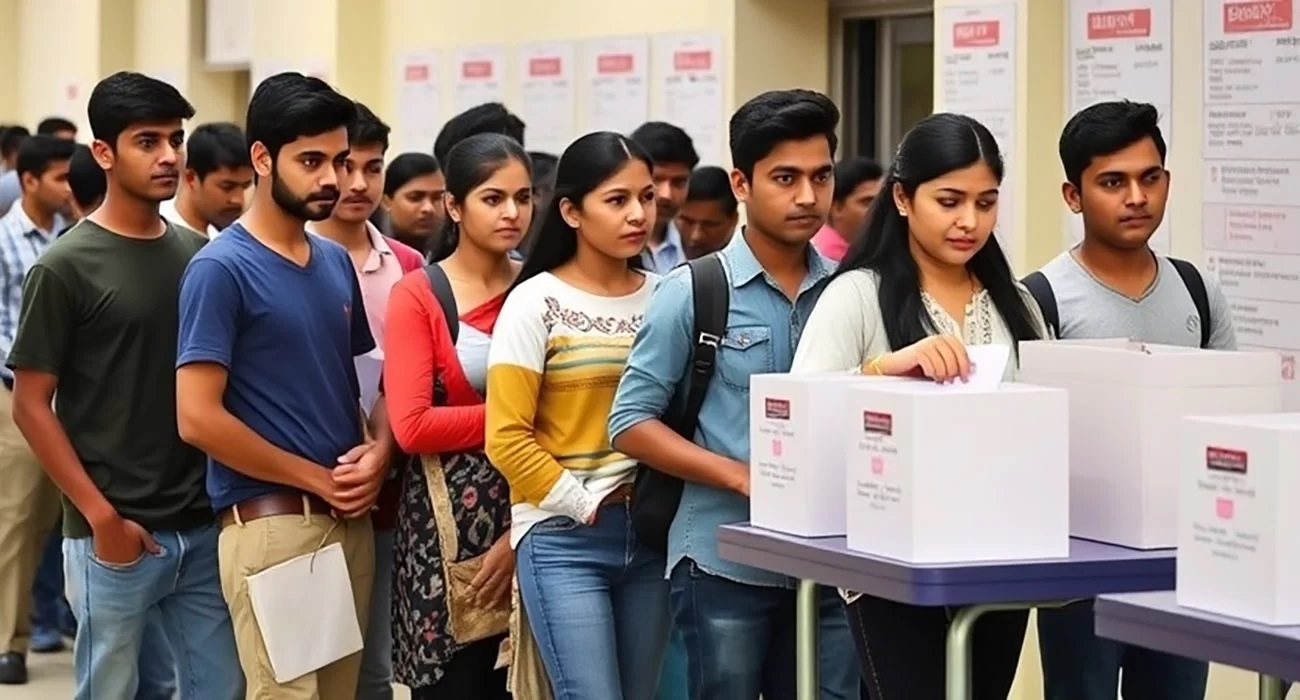
For years the cohort of students, competitive examination aspirants, and early-career professionals were viewed as politically disengaged, more vocal on campuses and digital platforms than taking pains to participate in the election process, especially exercising their franchise. However, conversations with young voters reveal that experience-driven engagement with local governance is on the rise. As the Nagpur Municipal Corporation (NMC) elections approach, participation among the city’s youth is being encouraged by the pressures of everyday urban life.
In interactions with young voters, ‘The Hitavada’ found that their renewed engagement with the NMC elections stems from a growing realisation that municipal decisions govern the most intimate aspects of their lives -- safety on the street, the condition of roads, access to clean water, public order, and the social environment in which they come of age.
For Shiwali Deshpande, 21, a law student, electoral participation is anchored firmly in obligation rather than enthusiasm. She speaks candidly about her limited familiarity with the technical workings of municipal administration, but refuses to allow that gap to justify disengagement. Voting, she asserts, is a fundamental responsibility of citizenship. What unsettles her more deeply is the episodic nature of civic education.
Awareness, she observes, is treated as a seasonal necessity, arriving in bursts during election campaigns and receding immediately after. The consequences of this discontinuity, she says, are visible on the streets -- rising crime and a near-collapse of traffic discipline. Reckless driving, she laments, has ceased to shock and has instead become routine. Among young voters, this framing of voting as duty rather than choice signals a maturing civic consciousness.
A sharp anxiety is voiced by Omkar Joshi, an MBA student, whose relationship with the city is defined by its night-time absences. He describes a nocturnal vacuum of authority, where traffic regulation dissolves after dark at critical corridors such as LIC Square, Wardha Road, Hingna Road, and Pardi Road. Once enforcement retreats, disorder asserts itself with speed and inevitability, he says.
The risks, however, extend beyond vehicles. Omkar speaks of stray dogs not as a peripheral inconvenience but as a serious urban threat, particularly for young people travelling late at night on two-wheelers or bicycles. Attacks, he notes, have become frighteningly common. His participation in the local body election is driven by a desire to see the city become safer, especially in terms of road accidents and night-time mobility.
Sahil Meshram, 22, a sociology student, turns the lens inward, as he draws attention to the social consequences of prolonged civic neglect. He speaks of alcohol and drugs circulating with alarming ease among young people he knows, no longer confined to the margins but woven into everyday routines.
This, he argues, is not a failure of individual morality but a structural lapse. In the absence of preventive systems, community engagement, and sustained oversight, destructive patterns find space to entrench themselves. Sahil says he votes with the expectation that the younger generation can be shielded from what he describes as a growing drug epidemic.
Divya Rathi, a UPSC aspirant and literature student, articulates her expectations in the language of care and responsibility. Civic development, she argues, cannot be reduced to surface-level beautification. Roads must protect lives before they please the eye. Her concerns extend to water safety, personal security, and the uneven vulnerability of the city’s peripheral areas, especially after dark.
Taken together, these voices form a portrait of a generation engaging with civic politics through lived vulnerability. Their concerns are precise, experiential, and stripped of ideological excess. Analysts argue that even a modest mobilisation of young voters could influence outcomes in several wards. And this is what precisely a mature democracy needs, an informed voters who can choose wisely.