DCP Lohit Matani: policing with purpose
28 Dec 2025 10:01:29
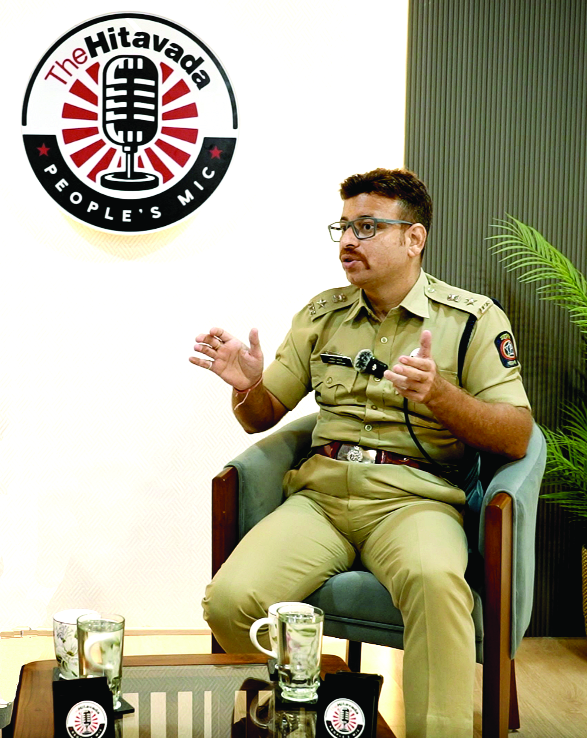
By Aasawari Shenolikar :
“Never argue with an idiot. He will bring you down to his level and then beat you with his experience.” One of his professors at IIT often quoted this line, and he has always implemented this philosophy in real life. Lohit Matani DCP (Traffic), smilingly, admits that it has helped him immensely in dealing with the many challenges that come his way on a daily basis.
“Reducing deaths on the roads is our main target,” he says at the outset of a candid conversation on The Hitavada’s The People’s Mic, with Vikas Vaidya, Principal Correspondent, The Hitavada. The numbers, he points out, are shocking. “If you look at the statistics, deaths due to road accidents are almost four times higher than murders in a city.
This holds true for Nagpur as well.”
Accidents, he emphasises, are largely preventable. “Most accidents occur because of human error-drunken driving and rash driving-being the primary causes.” And that is why, he along with higher ups in the department, came up with a few projects to prevent not only drunken driving but to tackle other issues too.
For dealing with traffic violations, especially drunken driving, under Operation U-Turn, the Traffic Police has worked extensively and have identified several accident-prone spots across the city where such behaviour is rampant. “Our focused intervention has yielded encouraging results,” he says, and since its inception, many violators have been apprehended and given a dressing down. The stern talks and actions have definitely borne some positive results. For even though Maharashtra continues to top the chart in road accident fatalities, Nagpur has registered a 25 per cent reduction in deaths over the past year.
“This clearly indicates that Operation U-Turn has been very effective.”
The Traffic Department, while actively involved in the duties allotted to them, also play a critical role in assisting accident victims. Matani repeatedly stresses the importance of the golden hour. “If timely help is provided, lives can be saved.” And while addressing the query of how he measures success, he avers, “If I am able to save even one life, I would consider my tenure successful.” By that measure, his stint has been more than fruitful-90 lives have been saved so far, at the time of recording the podcast.
This, he believes, defines the true purpose of his profession. Recalling a question often asked during UPSC interviews-Why do you want to join the civil services?-Matani reflects, “Most candidates say they want to serve the country. But interviewers often counter by saying that even a businessman, an entrepreneur, or a teacher serve the nation in their own way.” And that is why a police officer’s job is different, because the satisfaction lies in directly influencing lives. “When we save someone or help them lead a better life, that sense of fulfillment is unparalleled.”
Public engagement, he says, is crucial for quicker problem resolution.
Drawing comparisons with foreign countries, he observes, “You rarely see traffic police manning intersections abroad. People follow rules because civic sense is deeply ingrained in them. In India, the moment there is no police presence, traffic discipline collapses. Here, presence on the ground is what matters.”
The e-challans, he admits, have limited deterrence. “Many people simply ignore them. In fact, there are cases where the penalty amount exceeds the cost of the vehicle.” A physical intervention, he feels, has a far stronger impact.
“When a drunken driver is confronted by a policeman, he is more likely to think twice before repeating the offence. An e-challan in the inbox does not have the same effect.”
Traffic personnel, however, often face hostility. “It is common for violators to say, ‘I know the DCP, I know the CP,’ and threaten the constable on duty.” On being asked what does he do when he is confronted with such a situation, he laughs out loud, and says his clear instruction to his team are, ‘Jitni badi gaadi, utni jaldi zabt kar lo.’
He candidly admits that this is a nuisance that the officers have to face, sometimes, several times in a day. Apologies and acceptance of fault, he adds, ultimately work in the violator’s own interest.
Closely linked to modern policing is cybercrime, a division which he heads. The modern, ever-evolving changing scenario in cybercrime is flabbergasting, even for those experienced to deal with it. He rues the fact that innocent citizens are conned and they approach the police only after losing lakhs. Digital arrests is the latest scam, and the cyber cell is on their toes helping those affected. However, he feels that those in the cyber crime department do not look at themselves as the ‘real police’. Most want to return to active police duty as soon as they can.
One change Matani would like to see is a shift in mindset. “Cybercrime personnel must see themselves as integral to policing and not merely as officers awaiting a transfer.”
He speaks with pride about Nagpur’s cyber team. “They are often more experienced than the criminals, and we have successfully solved many cases with remarkable speed.”
In the present times when social media is a part and parcel of everyone’s life, cybercrime is only expected to rise. “Vigilance is the key, and we must stay a step ahead,” he says, expressing confidence in his team’s preparedness.
On being asked about the innumerable cases that he has had to deal with, have there been many that have tested him emotionally and professionally.
“Oh yes,” he responds, and acknowledges the difficulty of understanding the human psyche. “When heinous crimes-such as the rape of a minor-occur, the pressure is immense. From the family, society, the media. Working under such circumstances is extremely challenging.”
He also voices concern over public expectations of instant results. “We do not have a magic wand. The magnitude of crime is enormous.
Our officers work round the clock, often at the cost of their family life.” Depression, he admits, is not uncommon among police personnel and needs urgent attention.
An often-overlooked aspect of policing, he notes, is crowd science and crowd management. “Managing a crowd can sometimes be more complex and critical than handling the crime itself.”
Under the guidance of the top brass, several reforms have been introduced-making the police more approachable, streamlining grievance redressal, and creating online platforms for two-way communication. “The objective is to make life easier for citizens,” he says.
For this and much more follow the conversation with DCP (Traffic) Lohit Matani on The Hitavada’s People’s Mic. Watch the full podcast on YouTube @TheHitavada1911. n