Oppn protests new ‘anti-worker’labour codes in Parlt Complex
| Date :04-Dec-2025 |
NEW DELHI :
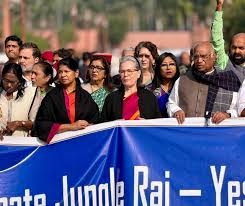
SEVERAL Opposition MPs,
including Congress President
Mallikarjun Kharge and former
party chiefs Sonia Gandhi and
Rahul Gandhi, protested in
Parliament House complex on
Wednesday against the new
labour codes and demanded
their scrapping.
MPs of the Congress, DMK,
TMC, Left parties, among others, participated in the protest
in front of the Makar Dwar of
Parliament.
Slamming the Centre, Kharge
accused the Modi Government
of being “anti-labour, anti-worker and pro-cronies”.
In a post on X after the protest
by the Opposition, Kharge said
the Opposition parties protested against the Modi Government
in Parliament premises, expressing strong objection about the
newly implemented labour
codes.
“Some of the serious concerns
in the New Codes are -- threat to
job security. Layoff threshold
raised from 100 to 300 workers
i.e. more than 80% of factories
in India can now lay off or
retrench workers without
Government approval, reducing job security.
Expansion of
FixedTermEmployment (FTE)
will endmanypermanentjobs.
Companiescannowhireworkers on short-term contracts,
avoiding long-term benefits,”
the Congress chief said.
“Coupled with State-determined overtime limits, this
effectivelypermitsmuchlonger
workdays, increasing fatigue
and safety risks even when
labelled‘consensual’,” he said.
“Workers must wait 60 days
before striking, plus a 14-day
cooling-off period. This prevents quick action against
unsafe or unfair conditions.
Requiring one union with 51%
membership to be the sole
negotiator sidelines smaller
unions and reduces representation for diverse worker
groups,” Kharge said.
He pointed out that standingorderswillnotapply tounits
with fewer than 300 workers.
“Basic rules on working
hours, leave, and termination
will not be mandatory. This
mayincreasearbitrary‘hireand
fire’practicesinmedium-sized
units,” theCongress chief said.
Alleging that thecodesweakened safety and welfare of
workers, Kharge said that by
raising the definition of a factory to 20 workers (with power) and 40 workers (without
power) where violations and
unsafe conditions are most
common, they fall outside the
law’s safety net.