Modi breaks protocolto receive friend Putin
| Date :05-Dec-2025 |
NEW DELHI :
RUSSIAN President Vladimir
Putin on Thursday night kickstarted a nearly 27-hour visit to
India to further shore up a nearly eight-decade bilateral partnership that remained in firm
footing notwithstanding fractious geopolitical environment
and tensions.
In reflection of the importance India attached to the visit, Prime Minister Narendra
Modi broke protocol and
received Putin at New Delhi’s
Palam airport with a hug and
accorded him a warm welcome
to India after a gap of four years.
The two leaders warmly hugged
and greeted each other before
leaving the airport together in
the same vehicle. They also
briefly watched and applauded a cultural performance as
part of the welcome ceremony.
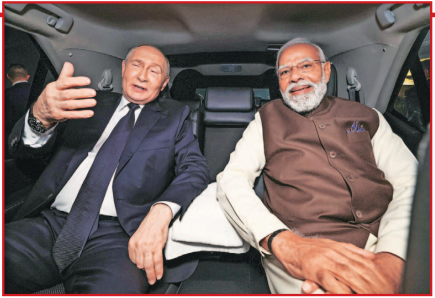
The two leaders left the airport in the same car, nearly three
months after they travelled
together on a vehicle in the
Chinese city of Tianjin following the Shanghai Cooperation
Organisation (SCO) summit.
Lok Kalyan Marg was decked
up with India-Russia flags and
special lighting on Thursday
evening as Prime Minister
Narendra Modi led Vladimir
Putin inside his official residence for a private dinner, shortly after the Russian President
landed in New Delhi for a twoday State Visit.
“Delighted to welcome my
friend, President Putin to India.
Looking forward to our interactions. India-Russia friendship
is a time tested one that has
greatly benefitted our people,”
PM Modi posted on X along with
his photographs with Putin.
In July 2024, Putin had also
hosted PM Modi at his official
residence in Moscow’s NovoOgaryovo. New Delhi has been
lined with banners welcoming
the Russian leader, marking the
beginning of an engagement
that carries significant diplomatic weight. The conversation
between the two leaders is
expected to set the tone for the
23rd India-Russia summit talks
on Friday that is expected to
produce a number of key outcomes.
Boosting defence ties,
insulating India-Russia trade
from external pressure and
exploring cooperation in small
modular reactors are set to be
the focus of the summit meeting between the two leaders that
is expected to be closely
watched by Western capitals.
The Russian leader’s visit to
New Delhi has assumed greater
significance as it is taking place
against the backdrop of rapid
downturn in India-US relations.
Following the summit, the two
sides are expected to seal several agreements including in
areas of trade.
On Friday morning, Putin will
be accorded a ceremonial welcome at the Rashtrapati Bhavan
before the summit.
Modi also hosted a working
lunch for the Russian leader and
his delegation at Hyderabad
House, the venue for the summit. Putin will also visit Rajghat
in the morning, according to
people familiar with the matter. After the summit, Putin is
set to launch the new India
channel of Russian state-run
broadcaster, following which
he will attend a state banquet
to be hosted in his honour by
President Droupadi Murmu.
The Russian leader is expected to leave India around 9 PM
on Friday. In the summit talks,
New Delhi is expected to press
for addressing the increasing
trade deficit caused by India’s
procurement of large volumes
of Russian crude oil.
The Russian President’s trip
to India is taking place at a time
when India-US relations are
going through possibly the
worst phase in the last two
decades after Washington
imposed a whopping 50 per
cent tariff on Indian goods,
including 25 per cent levies for
New Delhi’s procurement of
Russian crude oil.
The impact of American
sanctions on India’s procurement of Russian crude oil is likely to be discussed at the summit. Kremlin spokesperson
Dmitry Peskov on Tuesday said
New Delhi’s purchase of crude
oil from Russia may decline for
“a brief period” in view of
Western sanctions, but, at the
same time, he said Moscow is
taking steps to enhance the
supplies.
At the summit, Putin is
expected to apprise Modi about
the latest US efforts to bring an
end to the Ukraine conflict.
India has been consistently
maintaining that dialogue and
diplomacy is the only way forward to end the war.
Following the Modi-Putin
talks, the two sides are expected to ink a plethora of agreements, including one on facilitating the movement of Indian
workers to Russia, and another on logistical support under
a broader framework of
defence cooperation.
It is learnt that under the
trade basket, Indian exports to
Russia are expected to significantly increase in areas of pharma, agriculture, food products
and consumer goods.
The move comes amid concerns in New Delhi over a ballooning trade deficit in favour
of Russia. India’s annual procurement of goods and services from Russia amounts to
around USD 65 billion, while
Russia’s imports from India
stand at around USD 5 billion