‘Weaning youth away from Macaulay mindset’
06 Dec 2025 12:55:15
By Vijay Phanshikar :
At the glittering fashion show where countless college students showcased their attires and themes, the climax came when the chief of the institution came onstage. He appreciated the artistic presentations of all participants and groups that showed fashions from different cultures. ‘The members of the jury would do their job of selecting winners, all right. But I am announcing a special Director’s Award for the group that presented its show based on a theme from the epic Mahabharat.
This unexpected turn of events evoked a thunderous applause from the huge gathering of students from different institutions.
The chief then added a few remarks about India and its tradition and culture and art -- and appealed to one and all to start understanding how India of ancient times had so much to offer by way of a fine civilisation that spanned literally thousands of years and mesmerised the world with
its finesse and excellence.
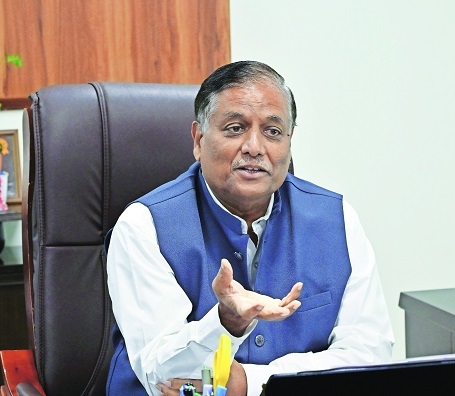
The institution that hosted the event was the All India Institute of Medical Sciences (AIIMS), and the chief was Dr Prashant P Joshi, Executive Director and Chief Executive Officer (CEO).
When the AIIMS celebrated its Foundation Day, Dr Joshi stood up once again to highlight the importance of the Indian culture, tradition and history, during his speech.
“Why should we fall prey to ‘mcdonaldisation’ of our minds ?”, Dr Joshi asks, making a pun on the name of a foreign-origin snacks and coffee store chain.
“We must avoid such food, and adhere to Indian dishes. I say this from two angles -- one, as a medical doctor since certain foods do not suit our body-constitution; and two, as a proud Indian who knows the worth and value of food emerging from our cultural tradition and agricultural geography.”
Junk food alone is not Dr Joshi’s target. He also targets junk thoughts that take us away from India’s cultural value-system. He feels sorry that young generations of Indians are rarely introduced to Indianness. Most are goaded to follow foreign-kind of life-style. Himself very adept in English language, Dr Joshi does not appreciate insane dominance of English as a symbol of colonial mindset or Macaulian influence. “India’s basic and native language is Sanskrit. Other languages and dialects emerge from Sanskrit. Yet, unfortunately, many, many of us treat Sanskrit as a ‘dead’ language. This is very wrong. We must promote Sanskrit as a treasure-house of our culture and history,” Dr Joshi insists.
Macaulian mindset is something that Dr Prashant Joshi despises as a matter of his personal belief system and patriotic sentiment.
He feels very happy and energised that Prime Minister Narendra Modi has insisted upon erasing the Macauly mindset from our midst and has given a 10-year dead-line to achieve that national goal.
“At the AIIMS Nagpur, we often invite speakers who exhort students on Indian values and history. One of the guest-speakers -- Shahajiraje Angre -- spoke on various aspects of Chhatrapati Shivaji Maharaj. His was not just a kingdom, but possibly the greatest chapter of India’s history. The students enjoyed the lecture thoroughly. Another guest-speaker -- Rashmi Sawant -- spoke on Swami Vivekananda and his contribution to Indian culture in modern times,” Dr Joshi adds.
“Educational values and principles that Swami Vivekananda preached and promoted are the need of the hour even today. Good, value-based education as promoted by Swamiji is essential for character-building. He showcased to the world what India would always mean to larger humanity.
I consider Swami Vivekananda as one of the greatest youth icons the world ever had. I make every possible effort to communicate to my students and other young people the right interpretation of the ideals of Swami Vivekananda,” Dr Prashant Joshi says, encapsulating his career-long experience as a top-notch teacher of medical sciences.
How do the young people respond to such idealistic view?
Dr Joshi says, “They respond very positively. I am glad, they have an open mind on such a subject. If told properly, the young people welcome any ideation. Their open-mindedness is the foundation on which I try to promote the Indic ideation -- of course in a palatable manner.”
Dr Joshi speaks energetically about the story of India’s Independence, the horrors of Partition, or how in post-Independence India the rulers named streets after despotic rulers and ignored Shivaji Maharaj. He insists upon the students to understand the greatness of the Mauryan empire and the Chola empire of South India.
“All these stories will enrich the young people’s personalities. With the help of such stories, we should try to erase the Macaulian influence about which the Prime Minister speaks with such intensity,” he concludes.