‘We must build stronger digital ecosystem to reduce cyber security breaches’
08 Dec 2025 14:10:50
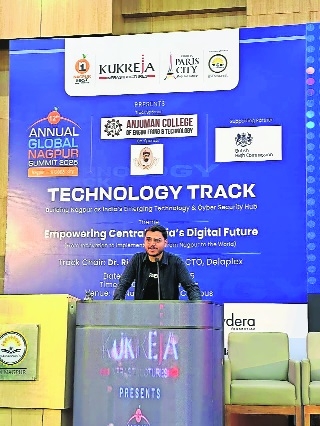
Business Reporter :
ALI Raheman, Co-founder, Qloud Technologies OU, Estonia & Founder, Magpie Protocol, Dubai, UAE said, “We must build a stronger digital ecosystem, we must minimise unnecessary permissions, reduce exposure, and adopt more resilient, non-user-facing security models to reduce cyber security breaches”.
He was speaking on the concluding day at the Global Nagpur Summit 2025 Technology Track organised by Nagpur First Foundation at IIM Nagpur, MIHAN Campus on Sunday.
He explained that there were two primary vulnerabilities consisting of third party permissions (TPPs) and user-facing authentication that form the root of almost every attack.
He explained that computer systems grant extensive execution rights to third-party apps and software components, thereby creating a permanent attack surface. This makes systems susceptible to malware, rootkits, backdoors, and supply-chain exploits.
He further emphasised that any access mechanism visible to users such as passwords, certificates, or cryptographic keys is automatically visible to attackers. This exposure enables brute-force attacks, impersonation, and potentially even quantum-level decryption in the future.
“What users can access, hackers can too,” highlighting the inherent weakness in traditional access-based security models.
“We need to rethink and redesign our computing foundations,” he concluded.