8th Tribal Literature Festival inaugurated at Indira Gandhi National Museum
| Date :12-Feb-2025 |
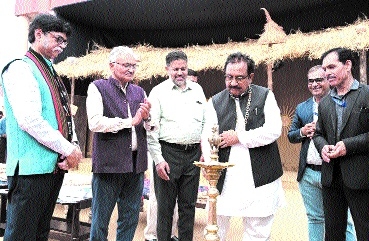
Minister for Tribal Affairs of MP Kunwar Vijay Shah inaugurating 8th Tribal Literature Festival at Indira Gandhi National Museum.
Staff Reporter :
Minister for Tribal Affairs Kunwar Vijay Shah said that instead of gifting bouquets, we should opt for books or plants as they symbolise growth and knowledge. Plants, in particular, are foundation of our existence. Tribal Literature Festival has been organised at Indira Gandhi National Museum since 2017 and has been increasing in scale and importance every year
The grand ceremony of 8th Tribal Literature Festival was inaugurated at Indira Gandhi National Museum. The festival was inaugurated by Minister for Tribal Affairs of Madhya Pradesh Kunwar Vijay Shah. The distinguished guest Professor Chandra Charu Tripathi, Director of NITTTR Bhopal and Professor Sarit Kumar Chaudhary, Vice Chancellor Alipurduar University inaugurated the function. On the occasion, the museum’s representative Dr Suryakumar Pandey and Programme Coordinator Sudhir Srivastava also attended the inauguration.
Lighting of the ceremonial lamp marked the beginning of the inaugural ceremony followed by a traditional welcome for dignitaries with shawls, bouquets, and mementos.
In his speech, chief guest Kunwar Vijay Shah said that such events must be sustainable.
He said, “The glory of this event is owed to esteemed guests and your participation. Instead of gifting bouquets, we should opt for books or plants as they symbolise growth and knowledge. Plants, in particular, are foundation of our existence.” Programme Coordinator Sudhir Srivastava mentioned that Tribal Literature Festival has been organised at Indira Gandhi National Museum since 2017 and has been increasing in scale and importance every year. Professor Sarit Kumar Chaudhary emphasised that the festival should be taken to a national level to further enrich India’s tribal literary heritage.
The festival presented three insightful panel discussions, which were on various aspects of tribal storytelling, culture and globalisation.
“Tribal Filmmaking: Inclusive Narratives and Voices” Chairperson: filmmaker Rajesh Badal Speakers: Dr Bindu A (Advocate, Kerala), Dr Shanta Naik (Karnataka), Dr Debjani Mukherjee, Mukesh Darbar (Madhya Pradesh).
The session discussed how cinema can become a tool to preserve and voice voices of tribals and how these indigenous narratives could be brought to mainstream media.
“Globalisation: Tribal Literature and Their Culture”, Chairperson: Prof Sarit Kumar Chaudhary Speakers: Dr Ganga Sahay Meena, Mahadev Toppo, Shrikant Nandkumar, Dayaram Rathodia, Mangla S Garwal. Discussions focused on how globalization affects tribal cultures and languages and how it is important to retain indigenous knowledge systems while opening up to modern influences.
“Myths, Folktales, and Epics: The Foundation of Tribal Literature”, Chairperson: Shri Mahadev Toppo.
Speakers: Vasant Nirgune, Indumati Lamani, Dr Indu V Menon, Janardan Gond, Dr Rajesh Rathwa, Shailendra K Sharma, Dr K S Mallan.
The session highlighted rich oral traditions of tribal communities, emphasising importance of myths, folklore, and epics in shaping their literary and cultural identities. Beyond discussions, the festival offered a sensory feast with an array of tribal experiences: Tribal Food Festival, attendees got to savor authentic tribal cuisine, featuring diverse traditional dishes prepared by members of various indigenous communities.
A great book exhibition was conducted with some great tribal literature collection from the institutions and publishing houses of Bhopal.
Folk dance performance, cultural events brought life to the evening session. Artists from Rajasthan presented their performances on Kalbelia and Ghoomar dance, mesmerising the spectators. The 8th Tribal Literature Festival was infact a significant step forward in promoting tribal literature, folklore, and cultural heritage. In the wake of growing participation and expanding reach, the festival stands to become a national platform in celebrating indigenous voices. The event not only celebrated richness of tribal literatures but also reinforced the need to preserve and promote their identity in an increasingly globalising world.