293-million-yr-old secrets of prehistoric oceans unveiled at Gondwana Marine Fossil Park
| Date :18-Feb-2025 |
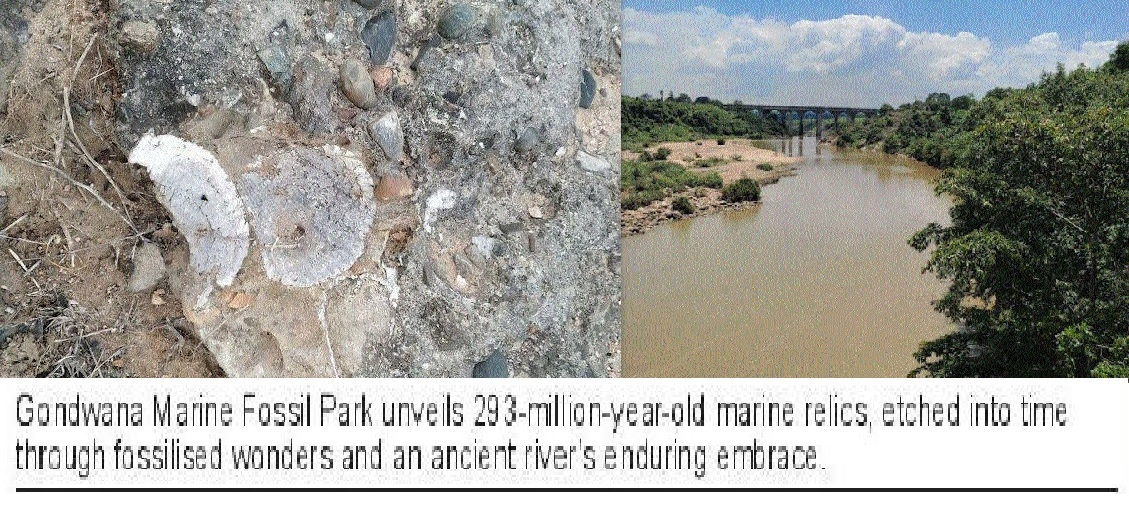
Gondwana Marine Fossil Park unveils 293-million-year-old marine relics, etched into time through fossilised wonders and an ancient river’s enduring embrace.
The Hitavada State Bureau
Manendragarh/Raipur,
C’garh Govt envisions global recognition for its unparalleled natural heritage
Enshrined within the breathtaking landscapes of Chhattisgarh, beyond its famed tourist hotspots, lies an ancient treasure trove that offers an unparalleled glimpse into Earth’s prehistoric past. The Gondwana Marine Fossil Park, located in the Manendragarh-Chirmiri-Bharatpur district – also known as MCB – stands as Asia’s largest marine fossil site, unearthing secrets that date back an astounding 293 million years.
Long before the subcontinent emerged in its present form, this region was submerged beneath a frigid ocean—now immortalised through fossilised remnants embedded within its terrain.
Far more
than a relic of the past, this park is a beacon of India’s geological legacy, poised for international recognition as a hub of scientific tourism.
Under the leadership of Chief Minister Vishnu Deo Sai, the Chhattisgarh Government remains steadfast in its mission to unveil this extraordinary heritage to the world, transforming it into a premier centre for research and exploration.
Discovered in 1954 by geologist S K Ghosh during coal mining operations, the Gondwana Marine Fossil Park is not only unique in its vast expanse but also holds the distinction of being India’s sole marine fossil site accorded the status of a National Geological Monument. Its fossil records showcase a remarkable array of marine creatures—bivalves, gastropods, brachiopods, crinoids, and bryozoans—belonging to the Talchir Formation, offering insights into the early Permian period.
Scientists hypothesise that this region was once engulfed by rising sea levels triggered by glacial melting, leading to the entrapment of marine life. As the waters receded over time, these ancient organisms became encased within rock formations, their skeletal remains fossilising over millions of years. Strikingly, similar fossil records have been discovered in Brazil’s Paraná Basin, Australia’s New South Wales, Antarctica’s Alexander Island, and South Africa’s Karoo Basin—solidifying this site’s role in decoding the geological history of the Gondwana supercontinent.
In the wake of escalating climate change and anthropogenic disruptions, the fragile fossilised ecosystem faces significant threats. Recognising its invaluable scientific and ecological importance, the Chhattisgarh government has embarked on an ambitious preservation initiative.
In August 2021, an expert team comprising scientists from the Birbal Sahni Institute of Palaeosciences, the Chhattisgarh State Biodiversity Board, and the Forest Department conducted a comprehensive survey to assess its conservation needs. Subsequently, in March 2022, the Chhattisgarh Forest Department officially designated it as the State’s first Marine Fossil Park.
At the behest of Chhattisgarh Government, substantial efforts are underway to enhance the park’s infrastructure, ensuring its accessibility for both research scholars and nature enthusiasts. With Rs 41.99 lakh sanctioned for its beautification and development, the park is poised to evolve into a world-class centre for palaeontological studies and eco-tourism.