Bhopal disaster survivors urge Govt to halt incineration of Union Carbide waste
| Date :18-Feb-2025 |
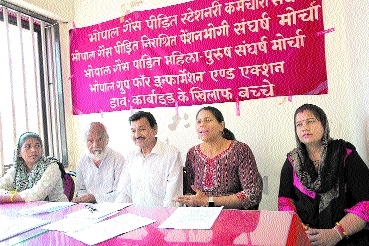
Leaders from four organisations representing survivors of the 1984 Union Carbide disaster in Bhopal addressing a press conference to voice their urgent concerns.
Staff Reporter :
Leaders from four organisations representing survivors of the 1984 Union Carbide disaster in Bhopal conducted a press conference to voice their urgent concerns regarding the planned incineration of 337 metric tons of hazardous waste from the abandoned Union Carbide plant at a facility in Pithampur. The organisations called on the Government to explore legal avenues to prevent potential environmental and public health damage.
The leaders presented documents indicating that the Madhya Pradesh Pollution Control Board (MPPCB) issued a show cause notice to the Pithampur facility in December 2024 for multiple violations of the Water Protection Act of 1974.
They also highlighted concerns about the excessive amount of diesel fuel required for the incineration process and the significant quantity of hazardous ash that would be generated. Citing the valid concerns of Pithampur residents and those in surrounding areas, the organisations suggested that the Government should arrange for the transport of the hazardous waste to the United States, drawing a parallel to the 2003 case involving waste from a Unilever thermometer plant in Kodaikanal, Tamil Nadu.
Rashida Bee, President of the Bhopal Gas Peedit Mahila Stationery Karmchari Sangh and a Goldman Prize recipient, emphasised the potential for severe pollution due to the excessive use of diesel fuel. “Official documents show that when 10 tons of hazardous waste from Union Carbide was incinerated in 2015, some 80,000 liters of diesel was used,” Bee stated. “This was more than 30 times the diesel used for hazardous waste from another source from 2010-2012.
Burning excessive amounts of diesel will not only cause severe pollution but, through massive dilution of emissions, it will falsely indicate low or undetectable levels of Dioxins and Furans.”
Balkrishna Namdeo, President of the Bhopal Gas
Peedit Nirashrit Pensionbhogee Sangharsh Morcha, drew attention to a document released by the Ministry of Environment and Forests (MOEF) that projects the incineration of Union Carbide's hazardous waste at the Pithampur facility would produce over 900 tons of residue containing significant amounts of heavy metals hazardous to health. "The Pithampur facility plans to isolate this massive amount of residue with polythene sheets in their landfill," Namdeo explained. "There is every likelihood of these heavy metals causing toxic contamination of groundwater around the facility."
He also referenced a January 2025 groundwater sampling report by Pithampur Bachao Samiti, which indicated the presence of Dichlorobezene and Trichlorobenzene, contaminants previously found in Bhopal groundwater.
Rachna Dhingra of Bhopal Group for Information & Action presented documents recently obtained through the Right to Information Act, revealing that the MPPCB issued a show cause notice to the Pithampur Waste Management facility operator for violating the Water Prevention Act of 1974. Dhingra stated, "The MP Pollution Control Board has given a show cause notice to the operators of Pithampur Waste Management facility operator for violating the Water Prevention Act, 1974 shows that seepage from the landfills was already contaminating the groundwater in the vicinity of the facility. More significantly these reports from August and December 2024 point out that that the facility lacks statutory protection facilities such as “storm drains, sump and circulation system.”
Nawab Khan, President of Bhopal Gas Peedit Mahila Purush Sangharsh Morcha, advocated for the waste to be sent to the US, stating, “Back in 2003 the Tamil Nadu Pollution Control Board compelled Unilever to carry about 300 tonnes of its hazardous waste from Kodaikanal to New York.
The waste was disposed of safely in a closed-loop facility with zero emissions. Instead of causing a slow-motion Bhopal in Pithampur, why does not the MP Pollution Control Board follow the precedent set by their Tamil Nadu counterpart?” Khan further questioned, “If the US Government can send back our citizens in shackles, can’t our government take the legally valid route and send Union Carbide’s poisonous waste to the USA?”
The situation remains tense as the clock ticks down on a four-week deadline set by the Madhya Pradesh High Court on December 3, 2024, for authorities to dispose of the waste . Recent protests in Pithampur, including self-immolation attempts, underscore the public's apprehension regarding the potential health and environmental consequences of the incineration.