‘Political support gives momentum to eradication of any disease’
| Date :02-Feb-2025 |
By Vaishnavi Pillay :
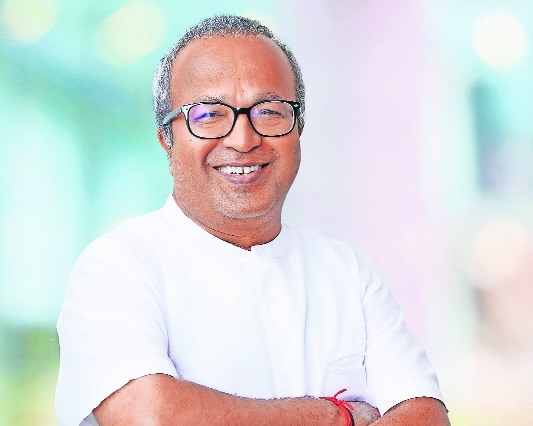
“I am much relieved that the Central Government has prioritised the fight against tuberculosis. Once fight against a disease receives political support, various elements fall into place. I also express immense pride that several improvements in India’s health sector have taken place at a faster pace than the global average,” exclaimed Dr Devendra Khandait, Deputy Director and Country Lead for State Health Systems at the Bill and Melinda Gates Foundation.
Dr Khandait hails from Bhandara
in Vidarbha region, and now works for the foundation which has been working in India for more than two decades, concentrating on four key areas - health and nutrition, agriculture, financial services, and urban sanitation.
During a conversation with ‘The Hitavada’ at the International Symposium on Tribal Health at AIIMS, Nagpur, Dr Khandait explained that while the Gates Foundation operates globally and focuses on global health priorities, they also consider regional contexts, like in Southeast Asia and Africa. Their philosophy remains consistent such as working on neglected, under-attended, or difficult-to-solve health problems.
The foundation’s work in India began
with a focus on HIV prevention, their work expanded to broader health systems, including maternal and child health, nutrition, immunisation.
“In India, we align with the Indian Government’s goals instead of setting separate independent goals. We support efforts to reduce maternal, neonatal and infant mortality, the prevalence of TB, and malnutrition,” he noted.
Gender equality is also a priority for the Gates Foundation and he said that economic empowerment is a key factor for overall development and improved health and nutrition outcomes .
He emphasised that Gates Foundation’s role in India is like the story of the squirrel in the Ramayan and the credit for reduction in TB prevalence in India goes majorly to the efforts of the Indian Government and State Governments.
Khandait said that the foundation’s traditional approach avoids creating dependencies. “We aim to improve technical capacity of health systems so they function effectively even after our involvement ends. We are conscious that no dependency is created because of assistance,” he remarked.
Regarding building resilient systems, Khandait used polio as an example. “Polio eradication gained momentum when political leadership prioritised it and no disease can be eliminated without it becoming a Jan Andolan. The political leadership puts the weight behind it,” he stated.
Expressing his satisfaction that the Indian Government has prioritised tuberculosis, he said that once a disease figures in political thinking, various elements like improved diagnostics, drug availability, patient identification, detection and retention rates fall into place.
Dr Khadnait expressed immense pride in India’s progress over the past 20 years, noting positive changes in immunisation and vaccination rates, and introduction of new vaccines.
Finally, he mentioned the successful eradication of polio in India, which defied predictions that India would be the last country to achieve this milestone. India eliminated polio much before than the world expected.