Shefali Vaidya on symbolism of motifs in Indian art, crafts
| Date :01-Mar-2025 |
By Anshul Kadu :
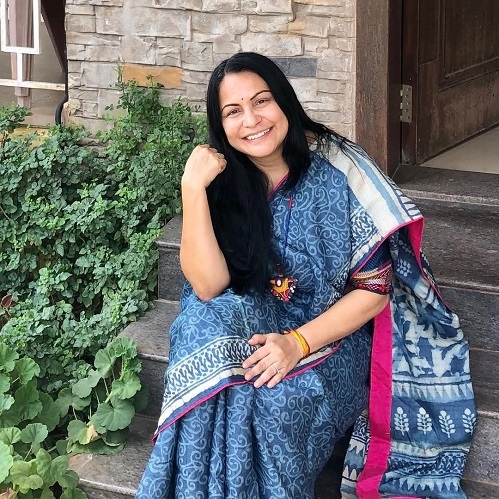
“In the Hindu view of art, people have the freedom to diverge to exercise their individual creativity, but they ultimately converge to the main entity of their art,” opined Shefali Vaidya, a renowned writer, newspaper columnist, and social media influencer, at the ongoing ‘National Conference for Indian Knowledge System with Science and Engineering Perspective’, on Friday. Organised by Visvesvaraya National Institute of Technology (VNIT), Nagpur, the conference features talks of experts from various fields with focus on the connection between Indian-origin knowledge and modern science.
In her talk titled ‘Prakriti, Akriti, and Sanskriti’, Vaidya spoke of the symbolism of motifs in Indian art and crafts. She explored various Hindu symbolisms across different Indian art and crafts over the years and how, albeit being different in art style, they conveyed the same meaning.
Taking ‘lotus’ as an example, she imparted, “Hindu view of art is multidiciplinary. You go to the temples in Thanjavur, Tamil Nadu and you will see a beautiful lotus carved on the wall. Next, you go to Buddhist monasteries of Spiti, Himachal Pradesh and you will find beautiful painting depicting Guru Rin Po Che coming out of a beautiful thousand-petaled lotus. Then, you go to Maharashtra for a wedding and you will spot a lotus designed in Ajanta style on Paithani sarees. Then, you go to watch a Bharatnatyam dance and you’ll observe that the starting mudra looks like blooming lotus. These all are lotus; they are styled differently and are present in different art forms, but they are ultimately lotus. This is the continuity of Indian art.”
Vaidya, similarly, provided examples of peacocks, Nav Naari Kunjara (elephant made up of 9 women with Shri Krishna riding), and Gandaberunda (double-headed eagle), underlining the continuity of Indian art across different art forms over centuries and the sublime and mystic meaning that they conveyed because of which they gained pan-India attention in the times when there was no “WhatsApp”.
While elucidating her claim with the help of the example of usage of peacock acorss art forms, Vaidya accentuated that albeit vast differences in the depiction of peacocks across various places, they are still depicted as peacocks. “You have the freedom to diverge, but then you converge,” she stated, “Listeners of Indian classical music must have observed. Every singer follows the ragaas broadly, but he has the freedom to diverge and converge. Art is also like that. Hindu view of art is also like that. People have the creativity, but finally when they produce a work of art, you should know what it is a peacock.”
In an interview with ‘The Hitavada’ during the event, Shefali Vaidya said, “All art forms that
ultimately originated from India were Hindu art forms (before the Turkic invasions). Even when they were being used by Buddhists,
Jains, and others (Hinduism-derived religions).”
Questioned about the rumours surrounding her entry into politics, she humourosly remarked, “They are rumours, as you have stated.” Vaidya was rumoured to contest from South Goa for 2024 Lok Sabha Elections, which, subsequently, was proven incorrect. Her aforementioned reply doesn’t suggest otherwise.