‘Films should connect to land, people’
02 Mar 2025 10:42:30
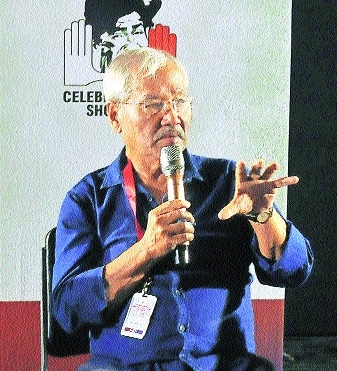
Recipient of 12 National Film Awards Padma Bhushan Jahnu Barua making
a point. (Pic by Anil Futane)
By Shashwat Bhuskute :
“Our country is incredibly rich in culture and history, but we are losing this connection. Young filmmakers need to be rooted in their heritage,” advises Jahnu Barua to the new breed of fimmakers
Some filmmakers entertain, some have a message to share and some challenge the very fabric of the society. Very few manage to do all three with such precision and emotional depth as Jahnu Barua. A filmmaker of immense talent, he has spent decades crafting stories that reflect human resilience, social change and the shifting landscapes of culture and morality.
In a candid conversation with ‘The Hitavada’, recipient of 12 National Film Awards Padma Bhushan Jahnu Barua revealed his journey, childhood dreams, personal struggles, filmmaking, storytelling and shared his views on the evolving state of cinema.
From an early age, Jahnu Barua knew he wanted to tell stories, but there was a challenge, he would stammer.
“It was a big hurdle for me,” he recalled. “But inside, I had this dream that one day I would be able to share my stories. That challenge was always inside me, and it multiplied as I grew older.”
Cinema, for Barua, was never just about making films, it was about the power of storytelling. “It was always on my mind, even when I was young,” he said.
Barua’s films often explore themes of human struggle, social disharmony and resilience. But do they come from personal experiences? “I used to observe a lot. Growing up in my village, I saw different kinds of people, characters, and I noticed the disharmony. I felt there was something missing, some kind of ideal life. I always dreamt of a better world where people would live in peace and harmony,” he explained. This deep sense of longing for a more just and compassionate society became the foundation of the filmmaker’s cinematic voice.
Despite numerous accolades, including prestigious national and international awards, he never sought validation through trophies. “I never thought I would win awards.
I just followed my passion,” Barua admits.One of his most acclaimed works, ‘Maine Gandhi Ko Nahi Mara’ , sought to humanise Mahatma Gandhi rather than portray him as a saintly figure. “In India, Gandhi has always been introduced in a very awkward way,” the filmmaker explained. “He is presented almost like a God, but he was a human being, a great thinker, a visionary, but still a man. The problem is that we have a habit of turning people into untouchable figures rather than understanding their ideas.” Barua believes that the younger generations have lost connection with Gandhi’s real teachings. “Had India truly embraced his values, self-reliance and non-violence, our country would have been different today. My film was an attempt to remind people of what we have forgotten.”
As a filmmaker from Assam, he acknowledges that regional cinema struggles to reach wider audiences.
“Our country is incredibly rich in culture and history, but we are losing this connection. Young filmmakers need to be rooted in their heritage,” Barua advised. “Today, many people are neglecting our traditions, and that is dangerous. We must remain connected to our land and our history.”
When asked what advice he would give to a young filmmaker, the filmmaker replied, “Know your roots, and always tell stories that matter. We have so much richness in our values, traditions, and history,” he said, adding that, every film one makes should be connected to its land and people.
With ongoing social and political issues affecting the Northeast, has the filmmaker considered making a film about these struggles? “A filmmaker has limitations,” the Padma Bhushan recipient admits. “A film can be a voice, but it alone cannot change the system. Real change requires leadership, both political and cultural.”
However, Barua believes in speaking up. “As citizens, we must raise our voice when things go wrong.”
Despite his success, he has remained largely independent of Bollywood. “I do not mind making a Hindi film,” he said. “But the way things happen in Bollywood today, I don’t fit in.”
Currently, he is in pre-production for a new film, set to begin shooting in March. “We have been neglecting our families, and as a result, the whole world is suffering,” he explained. “The concept of family is essential to human society. It has evolved through generations of trial and error, but today, it is breaking down. Divorce rates are rising, and people are struggling to maintain relationships. This film is a reminder of why family matters.”
While he has not yet decided on a release strategy, he confirms that it will be widely shown.
His recent role as Uncle Ken in ‘Paataal Lok’ has garnered a lot of attention. “I never wanted to be an actor,” the filmmaker laughs. “It happened accidentally. But now, in public places, people do not know my name, they just call me Uncle Ken!”
If there’s one thing this conversation makes clear, it is that his work is far from over. Whether in Bollywood, Assamese cinema, or independent storytelling, his voice remains one of the most important in contemporary Indian cinema.
And for the sake of meaningful cinema, it is a collective hope that Jahnu Barua continues to tell his stories.