EV charging booths remain ‘unplugged’
| Date :04-Mar-2025 |
By Anshul Kadu :
Most of the 45 EV charging booths installed at metro stations are unusable as they are marred by technical glitches, accessibility issues
Despite the booming electric vehicle (EV) market in the city, Maha Metro’s ambitious initiative to provide free charging infrastructure at its metro stations across the city is largely falling flat. Of the approximately 45 charging booths installed across 25 metro stations for both two-wheelers and four-wheelers, a significant number of those remain unusable, marred by technical glitches and accessibility issues.
“Malfunctioning” charging booths is the common sight greeting EV users at many stations, a stark contrast to the initial promise of convenient charging for people and commercial establishments along side the metro route. While Maha Metro’s Senior Deputy General Manager (Corporate Communications), Akhilesh Halve, asserts that 18 of the 25 metro stations have functioning charging facilities, ground reality paints a different picture. Even at these “functional” locations, not all booths are operational, leaving EV owners frustrated and stranded.
The project, a collaboration between Maha Metro and Energy Efficiency Services Limited (EESL) for installation and maintenance, seems to be struggling with consistent upkeep. Technical problems and improper location are the primary reasons cited by Halve for the 7 metro stations with non-functional booths. He further stated that Maha Metro plans to relocate some of these booths within the same stations to improve accessibility so that citizens can make use of the facility.
However, even the operational booths often remain ‘unplugged’, highlighting a deeper issue of underutilisation. “People prefer charging at home,” says Rahul Mohod, an electric car owner. “Although charging facility at metro stations is free, home charging is becoming increasingly convenient, especially when compared to the past expenses of petrol.”
Security concerns also deter potential users. Rehman, a regular commuter, recounts an incident where his charger was switched with another while his vehicle was left unattended.
“Who can guarantee that someone won’t tamper with my vehicle or charger?” he questions, highlighting the need for better security measures.
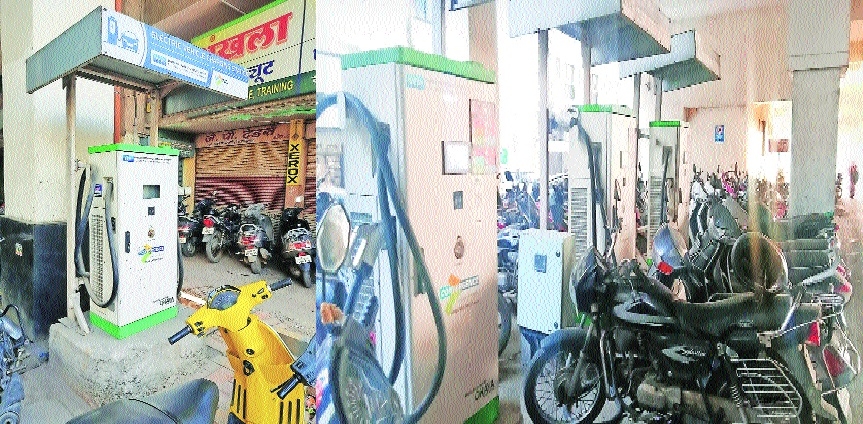
Accessibility is another major hurdle that limits usage of public facility. At Ujjwal Nagar Metro Station, Anjusha, an electric two-wheeler commuter, regularly faces the challenge of vehicles parked directly in front of the charging points. “There’s simply not enough space,” she laments.
“I have often found the booths completely blocked by stationary vehicles.”
The lack of dedicated parking enforcement around the charging booths exacerbates the problem. Without clear regulations and enforcement, the spaces are easily occupied by non-charging vehicles, rendering them useless for their intended purpose.
While the growth of EVs in Nagpur signals a rising demand for charging infrastructure, Maha Metro’s current offering falls short. Ground realities raise questions about the effectiveness of the maintenance and operational strategies.
The situation demands urgent attention from Maha Metro and EESL. Addressing the technical issues, improving security, enforcing parking regulations, and raising public awareness are crucial steps to ensure that these valuable charging facilities are utilized effectively.
So the question arises, the investment of public funds that went into creation of the charging utility turning out to be white elephant?