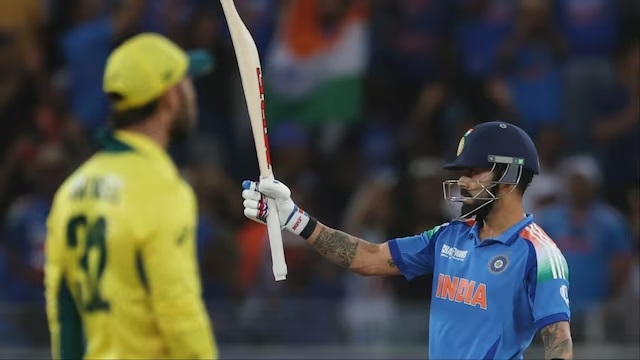
Chasemaster Virat takes India into final
05 Mar 2025 10:46:43
■ By R Kaushik :
DUBAI
AS RUN-CHASES go, this was
pretty close to perfect. The target was challenging without
being daunting, the conditions
bowler-friendly but not as
skewed as they had been in the
three previous games at the
Dubai International Cricket
Stadium. India had the master
of the chase, yes, but also a middle order brimful of belief and
confidence, all of which translated to a comfortable four-wicket over perennial bugbear
Australia on Tuesday night.
Their first victory over Australia
in a knock-out fixture of an ICC
50-over event since 2011 catapulted Rohit Sharma’s men to
Sunday’s final of the Champions
Trophy, where they await the winners of Wednesday’s second
semi-final in Lahore between
South Africa and New Zealand.
Steve Smith had little hesitation in opting to bat on a dry track
that actually played better than
it looked or was anticipated.
The
Aussies had bolstered their spin
resources by bringing in leggie
Tanveer Sangha for pacer
Spencer Johnson, perhaps
expecting the surface to behave
like it had on Sunday when India
defeated New Zealand, but this
was by far a better batting strip
and Australia’s 264 all out was a
little below par under the circumstances.
It was still the highest score at
this venue in this tournament,
and India had to bat well to scale
it down even if batting wasn’t as
tricky as in the previous games.
Shubman Gill chopped Ben
Dwarshuis on and Rohit failed
to cash in on let-offs when 13 and
14 and at 43 for two, India wobbled just a little bit.
Fortunately, they had the class
of Virat Kohli and the consistency of Shreyas Iyer to fall back
on.
Kohli has revelled in runchases in the past and it was no
different this time as he quickly
hit his stride, running with usual alacrity between the stumps.
Iyer is something of a ‘roll’ player who scores runs in clutches
and he extended his good form
with another knock in the 40s
while helping his former captain
put on 93 for the third wicket.
India have great depth and versatility in batting and even after
Iyer fell, missing a cut off a
straight ball from Adam Zampa,
there was no sign of panic. Kohli
should have fallen for 51 but
Glenn Maxwell shelled a sitter at
short extra-cover; even though
there was no century and Kohli
didn’t exactly haul his team over
the line, his 84 was a wonderful
compilation that calmed nerves
in the dressing room even though
Smith used his thin resources
superbly.
Axar Patel helped Kohli add
44, after which Kohli and KL
Rahul put on 47 when Kohli fell
against the run of play, holing out
to long-on. But India had Hardik
Pandya at No. 7 and even though
he played a host of dots, he caught
up with three sixes, including
two in Zampa’s final over to
ensure that the result was a mere
formality.
India should have had a wicket with the first legal delivery of
the day but Mohammed Shami
put Travis Head down on his followthrough. The left-hander
launched into a series of aggressive strokes until falling in Varun
Chakravarthy’s first over, but he
had done enough in Smith’s company to set the foundation for a
competitive score.
Smith was the glue that held
the innings together, much like
Kohli for India later on, though
it was left to Alex Carey, enterprising and innovative, to bolster the rate of scoring with a
splendid half-century that threatened to take Australia close to
280. The best dot ball in ODIs,
especially, is the one that brings
a wicket and India kept plugging
away. Shami cleaned up Smith
with a full toss and Glenn
Maxwell perished in the next over
to Axar, emphatically thwarting
Australia’s designs of a roaring
finish.