Sword of Nagpur’s first Bhonsle king up for auction in London
| Date :28-Apr-2025 |
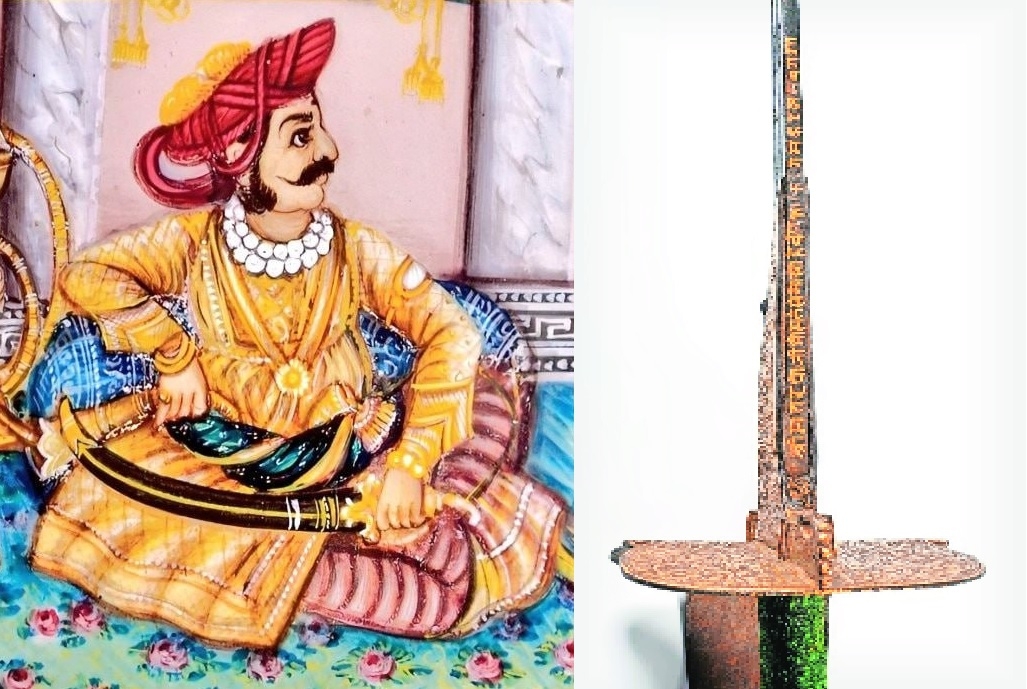
Raje Raghuji Bhosle (*Source: https://maharajaofnagpur.in/) {right } The sword bearing the name of Raje Raghuji Maharaj-I, is up for auction by Sotheby’s in London on April 29.
Staff Reporter :
The sword bearing the name of Raje Raghuji Maharaj-I, is up for auction by Sotheby’s in London on April 29.
The sword may have been taken by some British official discretely and sold or gifted to someone else later, which has now reached the auction house, says Raje Mudhoji Bhonsle.
A Basket-Hilt Sword (Khanda) with the name of Raje Raghuji Bhonsle (First), founder of the Nagpur Bhonsle Kingdom, is up for auction by Sotheby’s, a British auction house. The auction is scheduled to be held on April 29 and the auction house estimates the price of the sword to be between 6000 and 8000 GBP, nearly Rs 7 lakh to Rs 9 lakh in the Indian currency. This is for the first time that any item linked to Nagpur’s Bhonsle Kingdom has appeared on international auction site.
The news created quite a flutter in Nagpur. The website of the auction house describes the sword as 124 cm long, slightly curved ‘European-style’ single-edged blade with two fullers and imitation maker’s mark towards the forte. The spine of the sword is in gold inlaid with Devnagari script. The blade is set in a traditional ‘basket’ style hilt that is fully overlaid with worked gold. The grip of the sword is covered in green woven cloth. The inscription in Devnagari script on the spine suggests that it was made for Raje Raghuji Maharaj. The inscription also proudly mentions Raje Raghuji Bhonsle-I as ‘Sena Saheb Subha’.
Shrimant Dr Mudhoji Raje Bhonsle issued a press release and stated that they are taking all efforts to bring the sword back to Nagpur. The statement also speculated the reasons of how the sword may have reached England. “The Bhonsle forces under the leadership of Raje Mudhoji Bhonsle (Second) alias ‘Appasaheb Maharaj’ were engaged in war against the British between years 1853 and 1864. During that time, the British looted the treasure of Bhonsle’s and the sword might have been taken during those loots,” stated Raje Dr Mudhoji Bhonsle in a press release. “Another possibility is that the sword might have been taken by some British official discretely and sold or gifted to someone else later, which has now reached the auction house,” added the King of Nagpur.
Raje Raghuji Maharaj (First), who laid the foundation of Bhonsle Kingdom in Nagpur, was adept in use of five weapons including sword and hence he was called ‘Panch-Hatyari’. Raje Raghuji Bhonsle, who was a nephew of Chhatrapati Shivaji Maharaj Bhonsle, founder of Maratha Empire, focussed on conquering Central India after the death of Chhatrapati Sambhaji Maharaj. He conquered 36 forts in 36 days to establish Chhattisgarh. He was the last Bhonsle king to defeat the British in India at the historic battle of Sitabuldi fort. He renovated the historic Ram Temple in Ramtek. He established the Nagpur Kingdom in the year 1736, and was coronated in the year 1738.
As per the details on Sotheby’s website, the sword being put up for auction was in collection of Philippe Missillier Collection. The auction house further mentioned that long straight blade, the one belonging to Raje Raghuji Bhonsle, appears to be European in origin, as the design and material used in it were common in the Western world which had quite an advanced industry. Indian imitations of European blades are still found in the Wallace Collection.
Swords mounted with European blades were then made in centres including Solingen in Germany and in Venice and Genoa and they were commonly known as ‘firanghi’ (Frankish). They were sought after in Indian courts owing to their light weight and sophistication.
William Hawkins, travelling in India from 1608-13, reported that Jahangir had 2,200 swords with German blades in his treasury (William Foster (ed.), Early Travels on India, 1583-1619, Oxford University Press, 1921, p.103).