‘A leader creates happy experiences despite odds’
| Date :30-Apr-2025 |
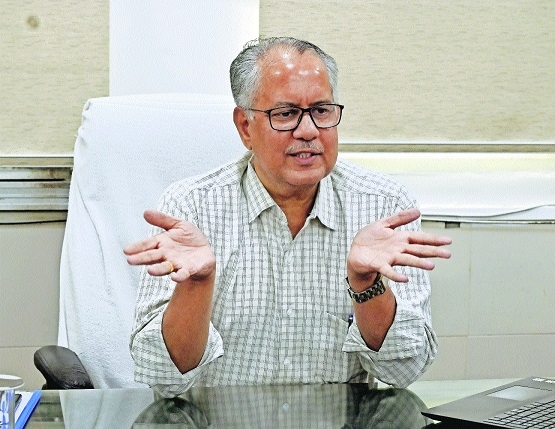
As Dr Atul Vaidya dons the new leadership role
as Director of LITU, he engages in the process
of enhancing its own capabilities for a fully
student-centric agenda.
By Vijay Phanshikar :
The two domains are, obviously, different, but the manner in which Dr. Atul Vaidya has eased into the coveted position of Vice Chancellor of the Laxminarayan Institutte of Technology University (LITU) demonstrates his consummate leadership quality so well ingrained into his personality. For, the transition from heading the internationally-acclaimed National Environmental Engineering Research Institute (NEERI-CSIR) to heading an equally world-renowned LITU was like traversing through perimeters of different zones. Going by what the LITU has made possible in these early stages of Dr. Atul Vaidya’s Directorship, it can be said safely that the institution is engaged in the process of enhancing its own capabilities for a fully student-centric agenda.
The transition, thus, from a college in a general university system to a university with its own vision and mission is a fine mix of both, continuity and change -- with a strong cultural paradigm to mark the process. “The effort now is all the more pronounced to make the LITU as strongly humanistic as academic. The ‘student’ is our purpose, and to be the ‘best’ is the aim.
So, alongside strong academics, we are laying a lot of stress on introducing the students to finer understanding of humanities, arts -- that lead to human refinement. We believe that a good chemical engineer must also be a good human being,” Dr. Vaidya says with a quiet confidence shorn of any bravado, any propagandism, in an exclusive interview with ‘The Hitavada’.
Of course, LITU’s systems are over-stretched with severe faculty crunch, thanks to earlier restrictions on recruitment. “Ideally, we need 105-strong faculty, though our sanctioned strength is 80. But we are terribly short of that number, too. We have only 35 members of current faculty -- a way short of what is basically required. Thankfully, we are acquiring nod from the Maharashtra Government to fulfill our requirements on all counts. I am sure, in the next some time, our university will start operating at optimum strength at all levels,”
Dr. Vaidya says.
Then Dr. Vaidya adds one interesting point. He says, if the need be, he would himself conduct classes so that the faculty crunch is addressed to some extent. “I feel, I will be able to engage classes in any subject, enabled as I am with an ability to offer conceptual teaching through small, relatable examples,” he adds.
Until the moment he joined the LITU three months ago, Dr. Atul Vaidya was a scientist and Director of the NEERI, one of the premier research institutions in the wide portfolio of the Council of Scientific and Industrial Research (CSIR).
There, an altogether different set of norms operated. Now, in the university set up, norms are at
a different level. “However, the leadership calling has many common points of reference and context, no matter the domain, no matter the speciality. As a leader, you stand alone. But if the technical background is sound and if one does not allow anybody to take one for granted -- meaning adopting a serious approach to the task and the goal -- then leadership becomes a happy experience, despite challenges, despite shortcomings,” Dr. Vaidya adds with an ever-present faint smile on his face.
Dr. Vaidya is, however, conscious of the difference between the leadership of a scientific and an academic institution. “But if your intentions are correct, clear and clean, then the success quotient gets raised automatically. For, in that case, your transparency, your openness, becomes your shield, your strength,” Dr. Vaidya reflects.
These reflections, these musings -- as if he is talking to himself as well -- bring out the spiritual dimension of Dr. Atul Vaidya’s personality. Ask him about the spirituality embedded in his persona, and Dr. Vaidya nods in agreement. ‘It is spirituality that makes all the difference,” he then adds.
He then wanders into the thought about how inseparable science and spirituality are, how the observer and the observed are one singularity. He then talks avidly about the spiritual dimensions of scientific personages such as Prof. Albert Einstein or Dr. A.P.J. Abdul Kalam. He also delves into the subject of how many great scientists pursued arts as their second calling besides science. Each of those assertions achieve one effect: one senses the power of Dr. Vaidya’s fine approach to life in general and academics and scholastics.
But Dr. Vaidya is conscious that there are no yardsticks by which to measure leadership performance. “Each one has to create one’s own yardsticks, own norms, own standards -- and establish those, making those synonymous with those of the institution,” Dr. Vaidya says. Certainly, he says all this in simple expressions. But considering deeply, all these expressions lead to an invariable inference that the process of working in a domain where there are no yardsticks and establishing those as institutional metaphors must be a complex process.
One also, of course, realises that heading a new university with an old institutional history is not all about saying nice things. For, the task involves a no-nonsense assessment of what the institution has and what is needs to have.
Dr. Atul Vaidya, too, has undertaken such an exercise. He is conscious that the LITU has to raise the standards of its industrial research, get as many research projects as it can, add value to its reputation through consultancy assignments, be able to evolve a culture of offering industrial application of the academic side of chemical engineering, and attracting greater numbers of PhD scholars(naturally through credible research subjects).
Another need Dr. Atul Vaidya lays emphasis upon is of acquiring for the institution and its faculty and students greater international exposure. “Yes, I know that LITU is already known everywhere as an institution of merit and higher learning in chemical engineering. But that is not enough. I aim at placing the LITU on the global map -- which will be achieved together with the help of faculty, former students, and the Government’s support,” he concludes, ending the session full of fine diction.