MP-Maharashtra join hands for world’s largest groundwater recharge project
| Date :11-May-2025 |
By Bhavana ‘Aparajita’
Shukla
Salt pan in Vidarbha could see turnaround through intake of fresh water to bring about change
in ground water
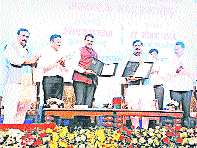
characteristic IN A significant development that stands to address the long pending issue of resolving salt pan in Vidarbha, the Governments of Madhya Pradesh and Maharashtra inked a pact for Tapti Basin Mega Recharge Project’ on Saturday. In a joint press conference, Chief Ministers of both the States, Dr Mohan Yadav and Devendra Fadnavis, termed it as the world's largest groundwater recharge initiative. It aimed at ensuring sustainable water management for both the States. The two leaders credited leadership of Prime Minister Narendra Modi for pushing the long-pending project.
An Memorandum of Understanding (MoU) was signed in Bhopal on Saturday after a meeting of Inter-State Control Board and same would infuse water to recharge the ground aquifers in salt pan belt of Vidarbha and neighbouring Jalgaon district of Khandesh. The plan envisages construction of a dam at Kharia Ghuti ghat in MP region.
At the meeting, Maharashtra also raised the issue of Jamghat that is envisaged to address further drinking water needs of Nagpur city.
Another issue that of Dangurli Barrage also came up for discussion.
Fadnavis said the project would provide MP with irrigation for 1.31 lakh hectares and Maharashtra access to water to
irrigate 2.34 lakh hectares, particularly in saline regions of Akola, Jalgaon, Amravati and Buldhana. The two CMs also outlined a move to petition the Central Government to designate it a national scheme as the project cost is pegged at Rs 19,244 crore. CM Yadav outlined plans to develop three Tapti River streams to maximise agricultural irrigation, ensuring optimal utilisation of water reserves. The initiative will harness 31.13 TMC (Thousand Million Cubic Feet) of water, with Madhya Pradesh receiving 11.76 TMC and Maharashtra securing 19.36 TMC. Notably, the project requires 3,362 hectares of land but will not disrupt any villages, eliminating the need for rehabilitation.
The MoU envisages advancing Tapti and Kanhan river projects in a way that balances environmental conservation, agricultural needs and industrial expansion.