Cabinet decides to launch Mukhyamantri Shiksha Gunvatta Abhiyan in all Government schools
15 May 2025 11:58:01
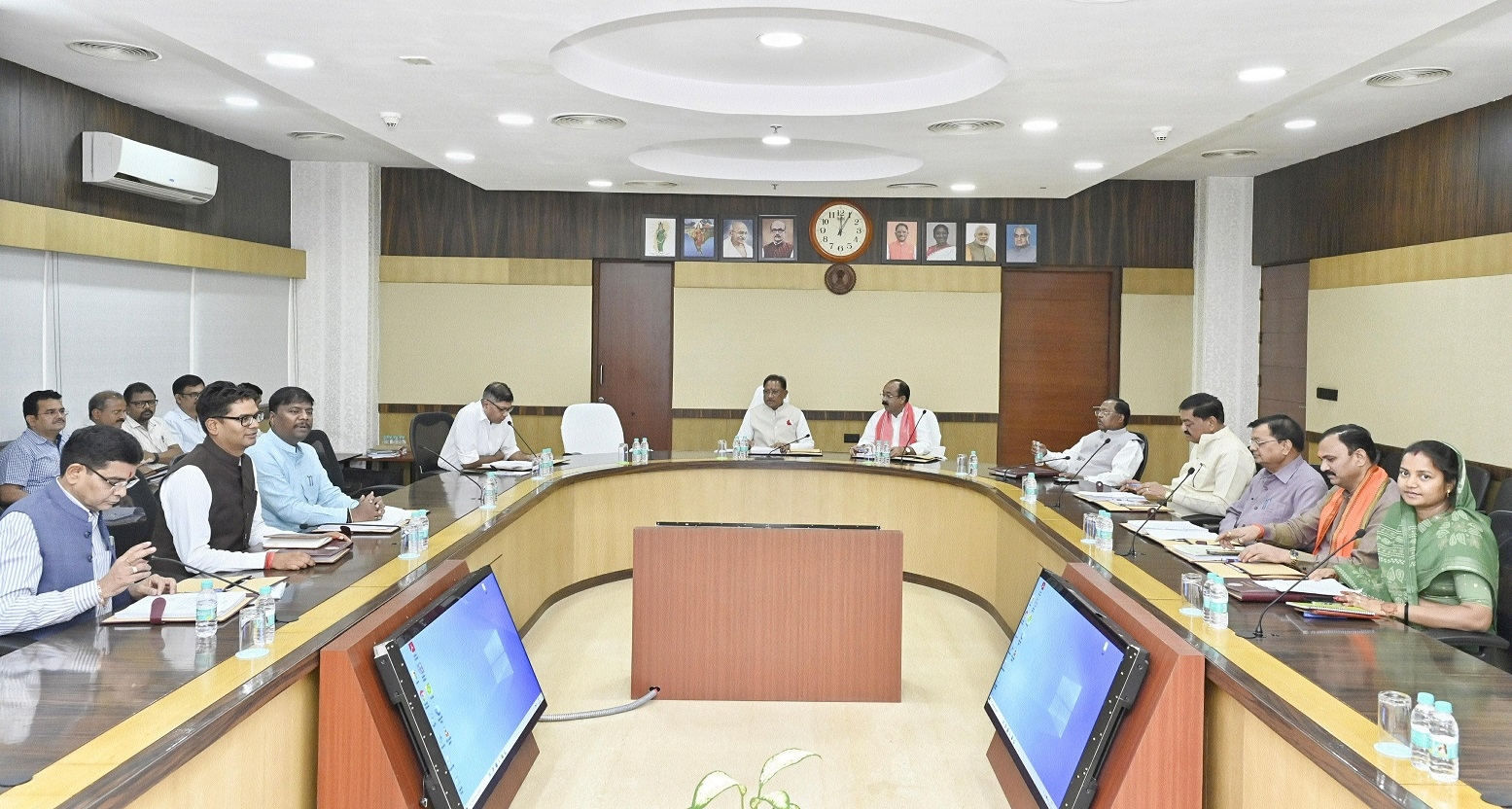
Chief Minister Vishnu Deo Sai chairing the cabinet meeting at Mantralaya, Nava Raipur Atal Nagar on Wednesday.
Staff Reporter
RAIPUR
Artists to get Rs 5,000 pension now
The Cabinet meeting held under the chairmanship of Chief Minister Vishnu Deo Sai on Wednesday resolved to implement the Mukhyamantri Shiksha Gunvatta Abhiyan in State’s Government schools, aligning with the National Education Policy, to enhance the quality of education.
Briefing the media at Mantralaya, Nava Raipur Atal Nagar, Deputy Chief Minister Arun Sao stated that the “Mukhyamantri Shiksha Gunvatta Abhiyan” would be undertaken across the state to elevate the standard of education in government schools.
He elaborated that the campaign would place particular emphasis on several key areas to improve educational quality, increase parent-teacher engagement, and boost academic achievements. The School Education Department of the Chhattisgarh Government will issue detailed guidelines regarding this initiative.
Under the campaign, schools will undergo social audits, and grading will be based on the quality of education provided.
Regular monitoring of underperforming schools will be conducted by officials from various departments and public representatives.
Model schools will be identified, and teachers from schools needing improvement will participate in educational tours to these exemplary institutions. Active parental involvement will be fostered through parent-teacher meetings (PTMs). Furthermore, classroom teaching methodologies will be refined to enhance students’ academic outcomes, Sao explained.
In another significant decision, the Cabinet decided to provide substantial relief to financially disadvantaged artists and litterateurs in the state’s literary and artistic fields.
In accordance with the announcement made during the Chhattisgarh Legislative Assembly’s budget session, the monthly financial assistance (pension) for artists has been increased from Rs 2,000 to Rs 5,000.
To facilitate this, the Cabinet approved a proposal to amend the Financial Assistance Scheme Rule-1986, which is administered by the Culture Department. This amendment aims to provide financial support to artists and litterateurs facing livelihood challenges. The scheme, initiated in 1986, initially set the minimum assistance at Rs 150 and the maximum at Rs 600. This was later increased to Rs 1,500 in 2007 and subsequently to Rs 2,000 in 2012.
However,
there had been no increase in the past 12 years. Currently, 162 artists in the state receive this
pension.
Presently, each artist receives an annual pension of Rs 24,000, which will rise to Rs 60,000 following the amendment. This will increase the total annual expenditure from Rs 38.88 lakh to Rs 97.20 lakh, resulting in an additional annual burden of Rs 58.32 lakh on the state treasury. Furthermore, the Cabinet approved amendments to the Chhattisgarh Industrial Land and Building Management Rules, 2015, with the aim of further stimulating industrial development in the state and ensuring greater transparency in the land allotment process. These amendments will enhance clarity and transparency in the allocation of industrial areas, land banks, and other land parcels, enabling industrial investors to better understand and benefit from the land allotment process.
The Cabinet also sanctioned several crucial amendments to the State’s Industrial Development Policy 2024-30 to promote industries and encourage investment in Chhattisgarh. These changes will make the state’s industrial policy more employment-focused, comprehensive, and beneficial for businesses.
The proposed amendments are expected to generate new employment opportunities within the state and provide a boost to modern agriculture and the toy industry. The new policy will facilitate employment for youth, and companies employing residents of Chhattisgarh will be eligible for grants from the State government. Following these amendments, high-tech farming methods will be promoted, including hydroponics and aeroponics. Farmers will benefit from new technologies such as automation and the Internet of Things. Training and sports facilities for youth will be improved, and sports academies and private training centers will be encouraged in the state, offering better training and career prospects.
The establishment of quality universities will also be supported.
Automobile repair and service centers will be approved in all development block groups. The tourism and hotel industry will receive a boost through amendments in the new Industrial Policy, with the minimum investment limit for building hotels and resorts in the Bastar and Surguja divisions being reduced to stimulate tourism in these regions and create local employment opportunities. The textile industry will receive double incentives, with investment in the sector now eligible for up to 200 percent incentive. This will also benefit individuals engaged in sewing, embroidery, and knitting.
Chhattisgarh is poised to become a logistics hub following this amendment.
A new logistics policy will be introduced to streamline freight and trade across the state, benefiting traders and improving market access. Special benefits will be extended to persons with disabilities, with a revised definition ensuring access to a wider range of schemes.
The state will also focus on establishing a Global Capability Centre, offering a special package for the defense and aerospace sector, increasing infrastructure grants for private industrial parks, and encouraging the development of plug-and-play factories. In an effort to enhance Ease of Living in the state, the first three units in urban areas lacking private CBSE-recognized schools (Classes 1 to 12 with a minimum capacity of 500 students) and urban areas without mini malls with multiplexes (and those within a 10 km radius of development block headquarters, excluding urban areas) will be designated as thrust sectors, he added.