No role of Trump in ceasefire deal: Misri
Date :20-May-2025
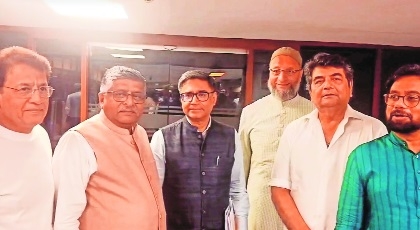
AIMIM chief Asaduddin Owaisi, BJP’s RPN Singh, Ravi Shankar Prasad, Arun Govil and Foreign Secretary Vikram Misri, after a meeting of the committee, in New Delhi on Monday. (PTI)
NEW DELHI :
India, Pakistan conflict was always in conventional domain and no nuclear signalling by Pak, Misri to Parlt panel
FOREIGN Secretary Vikram Misri told a parliamentary committee on Monday that the conflict between India and Pakistan was always in the conventional domain, and there was no nuclear signalling by the neighbouring country, sources said.
The sources said Misri reiterated the Government’s stand that the decision to stop military actions was taken at a bilateral level, as some Opposition members questioned US President Donald Trump’s repeated assertions about his administration’s role in stopping the conflict.
Some MPs, the sources said, asked if Pakistan used Chinese platforms in the conflict. Misri said it did not matter as India hammered Pakistani air bases.
To questions about Turkey’s adversarial stand against India, he said the country had traditionally not been a supporter of India.
The meeting of Parliament’s Standing Committee on External Affairs, chaired by Congress MP Shashi Tharoor, was attended by a number of lawmakers, including the TMC’s Abhishek Banerjee, the Congress’ Rajeev Shukla and Deepender Hooda, AIMIM chief Asaduddin Owaisi, and the BJP’s Aparajita Sarangi and Arun Govil.
In response to inquiries about whether India suffered any aircraft losses during the operation, the Government stated that such details fall under operational secrecy and cannot be disclosed publicly.
Members also sought clarification on an X post by US President Donald Trump, in which he implied that his intervention helped broker a ceasefire between India and Pakistan. Sources said the Government firmly denied any such role, stating that the ceasefire was a bilateral decision between New Delhi and Islamabad. According to Misri, Trump did not coordinate with India or seek permission to make public statements, sources said.
“He simply wanted to step into the spotlight,” the panel was reportedly told. There were also questions raised regarding External Affairs Minister S. Jaishankar’s earlier statement, which some interpreted as contradictory to the Government’s military position. The Foreign Secretary clarified that the minister’s comment referred specifically to the first phase of Operation Sindoor, when India conducted strikes on nine terror camps on the night of May 6–7. Misri, according to sources, said that Pakistan had been informed about those strikes after they occurred, and that Jaishankar’s statement was being misrepresented.
During the meeting, Misri also offered a frank assessment of India’s diplomatic position with Pakistan.
He stated that relations have remained poor since 1947 and are unlikely to improve in the foreseeable future.
Panel unanimously condemns trolling of Foreign Secy: PARLIAMENT’S Standing Committee on External Affairs on Monday unanimously condemned the trolling of Foreign Secretary Vikram Misri and praised him for his professional conduct.
Misri was briefing the parliamentary panel, chaired by Congress MP Shashi Tharoor, on the India-Pakistan military conflict in the aftermath of the Pahalgam terror attack.
Tharoor told reporters after the three-hour meeting, which he said was attended by a record 24 members, that the committee unanimously expressed solidary with Misri in the face of the “unwarranted attacks” he had faced online after the two sides agreed to stop military actions.
His and his family having been at the receiving end of trolls’ vitriol, Misri’s role drew support from the committee for his good service for the nation. The committee wanted to pass a formal resolution but the Indian Foreign Service officer requested against it, the Congress MP said.
One member said the panel was unanimous in its condemnation of the trolling of Misri.
The Foreign Secretary faced heavy trolling on social media in wake of India and Pakistan reaching an understanding on May 10 to halt all military actions. However, he had received support from political leaders, former bureaucrats and defence veterans.