58 reasons to rejoice: State’s UPSC success, digital advancement
| Date :22-May-2025 |
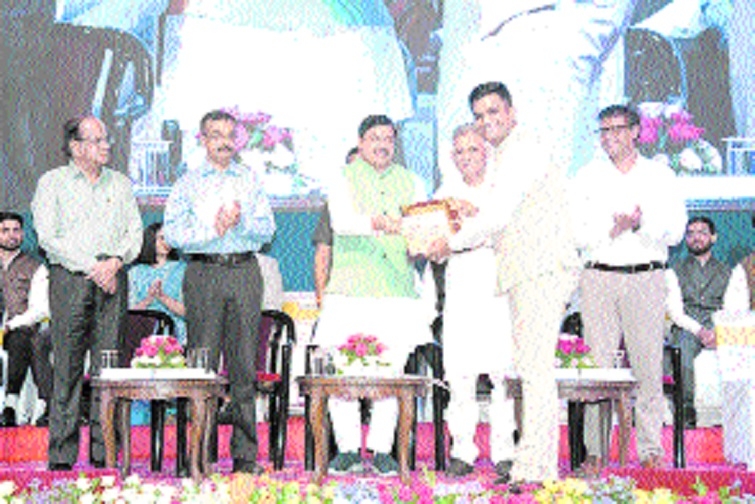
Chief Minister Dr Mohan Yadav honouring the participants selected in the UPSC Civil Services Examination 2024 in the Kushabhau Thakre Auditorium.
Staff Reporter :
The State has reached an important milestone in its human capital development by recognising 58 individuals who passed the UPSC Civil Services Examination 2024. A celebration event at the Kushabhau Thakre Convention Center, CM Mohan Yadav and Higher Education Minister Inder Singh Parmar honoured this achievement.
The occasion included the introduction of E-Gyan Setu, a digital program aimed at offering online learning resources for fields like medicine, engineering, and business, utilising platforms such as YouTube and a network of 10 digital studios.
The successful candidates consist of a diverse range, featuring 15 young women, which shows an increase in gender inclusivity. More than 53% of the award recipients received their education in public institutions, showcasing the effectiveness of the public education system.
Success stories, such as Ayushi Bansal’s 7th position achieved through determination and Rishabh Chaudhary’s success without formal coaching, showcase effective self-learning and diverse preparation techniques. E-Gyan Setu aims to improve educational equality by providing accessible materials.
The UPSC Civil Services Exam is a respected entry point to the All India Services and Central Civil Services. Achievement showcases the educational power and human capital growth of a region. Individuals who succeed in this demanding process play an essential role in influencing Contd from page 1
policy and governance. The 58 successful candidates from the State demonstrate its educational atmosphere and dedication to developing human capital.
The awards ceremony and launch of E-Gyan Setu demonstrate the state’s proactive backing for young individuals aiming for public service.
The presence of high-ranking officials emphasised the State Government’s commitment to recognising talent and inspiring future candidates to value
public service. The awardees comprised 15 young women, accounting for
around 25.8% female representation, highlighting a positive trend in
women’s involvement in national competitive tests. The increasing
achievements of women lead to a more varied bureaucracy and motivate other young women.
At the ceremony, CM Mohan Yadav introduced E-Gyan Setu, a digital project aimed at making study materials accessible via online courses, video tutorials, and various resources on platforms such as YouTube. This approach seeks to connect with students in distant regions without access to conventional tutoring.
E-Gyan Setu encompasses medicine, engineering, and business sectors, showcasing a wide perspective on human capital development. Digital studios across 10 districts facilitate the production of localised content and tackle inequalities in resource
access.
The project seeks to establish an equal opportunity environment for candidates.
Notable success stories feature Ayushi Bansal (7th rank), exemplifying determination; Madhav Agrawal (16th rank), highlighting scholastic achievement; Romil Dwivedi (27th rank), with familial ties to public service; and Rishabh Chaudhary (28th rank), who excelled independently without coaching. These profiles emphasise various routes to achieving UPSC success.
Statistics indicate that more than 53% of successful candidates received their education from government institutions, confirming the effectiveness of the public education system. The achievements of candidates with various academic backgrounds, such as Yatish Agrawal (Sanskrit) and Vivek from Chanderi (Hindi medium), showcase inclusivity.
Rishabh Chaudhary’s accomplishment underscores the increasing
significance of self-directed learning and digital tools, in accordance with E-Gyan Setu.
The felicitation and E-Gyan Setu
inauguration demonstrate the State’s dedication to empowering the youth.
The achievement of candidates from public institutions and varied backgrounds, along with the promise of digital education, is essential. Ongoing emphasis on these initiatives will assist the state in cultivating future leaders.