Rare coins tell tales of queens
| Date :25-May-2025 |
By Vaishnavi Pillay :
We are all familiar with coins that bear the names of kings, etched into metal as symbols of power, legacy, and empire. But not many know the stories about the rare and remarkable instances when women - queens, consorts, and even king’s mothers - left their mark in coins in India.
Ashok Singh Thakur, Chairman of the Indian National Trust for Art and Cultural Heritage (INTACH), explained to ‘The Hitavada’ that each coin is more than a monetary artifact, it is a miniature monument to the
influence, status, and sovereignty of queens.
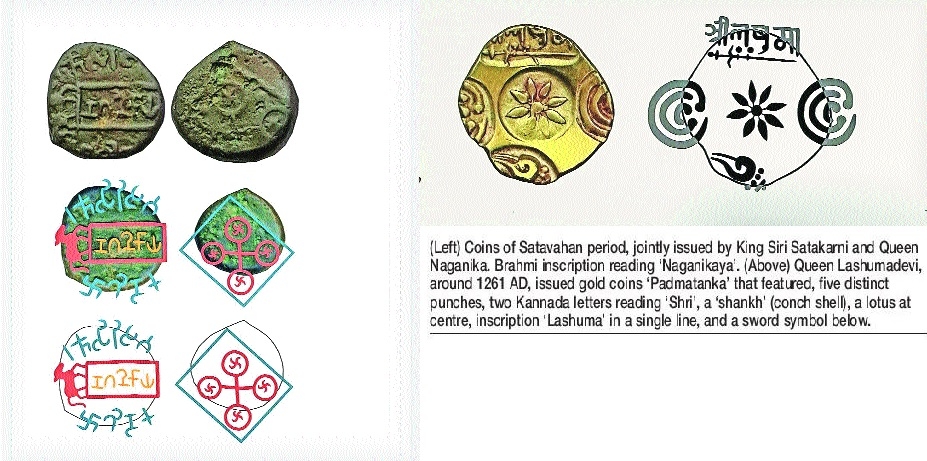
“One of the earliest known instances of a queen’s name appearing on Indian coinage dates back to the Satavahan period in ancient India,” stated Thakur and added that around 100–50 BCE, Queen Naganika, consort of King Siri Satakarni, was featured in coins, jointly issued by King Siri Satakarni and Queen Naganika, making it the first joint coinage in Indian numismatic history and the earliest known Contd from page 1
coins to to bear the name of an indigenous queen.
The coins are notable for their vertical Brahmi inscription reading ‘Naganikaya’.
They feature a prominent pillar topped with a horse effigy, believed to symbolise the Ashwamedha Yagya, a Vedic ritual. “From the Naneghat inscription, it was indicated that Queen Naganika continued to rule in her own right after the death of King Satakarni,” stated Thakur. On the reverse of the coin appears the ‘Ujjaini symbol’, a distinctive mark associated with the Satavahan period, further identifying the coin’s origins.
Thakur also highlighted another unique tradition from the Satavahan period, the inclusion of the king’s mother’s name on coins. “These royal women were not officially titled as queens in all cases, but rather honoured as mothers of reigning kings, which was significant in a society where individuals were typically identified by their father’s name,” he explained.
The appearance of mothers’ names on coins reflected the important social status and influence royal women held at the time.
These coins, typically minted in silver, were known as ‘dram’ and stand out as rare and progressive in the context of early Indian coinage.
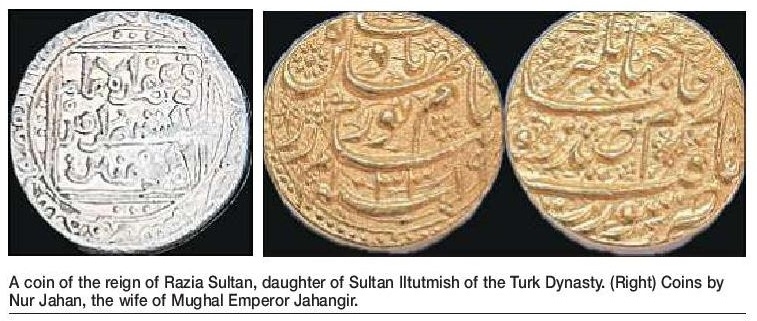
“Another instance comes from the Delhi Sultanate period, during the reign of Razia Sultan (1236–1240 AD), daughter of Sultan Iltutmish of the Turk Dynasty. She was entrusted with the throne, and coins minted during her reign were made of silver, known as ‘tanka’,” mentioned Thakur.
Thakur continued that Nur Jahan, the wife of Mughal Emperor Jahangir, also issued coins in her own name, although she was never officially declared a sovereign queen. These coins, minted in silver and gold (mohar), featured inscriptions such as “Ba Hukm-e-Shah Jehangir” (By the order of Emperor Jehangir), signifying that while she ruled with his authority, her individual identity and power were recognised.
Noor Jahan’s coins are a rare instance in global numismatic history where a woman, without a formal royal title, had currency issued bearing her name.
In the region of Deogiri (later known as Daulatabad), another queen, Lashumadevi, around 1261 AD, she issued gold coins known as ‘Padmatanka’, which bore her name inscribed in Devanagari script as ‘Lashuma’.
“These coins featured, five distinct punches, two Kannada letters reading ‘Shri’. a ‘shankh’ (conch shell), a lotus in the centre, the inscription ‘Lashuma’ in a single line, and a sword symbol below,” explained Thakur. These coins were uniface and weighed around 3.79g to 3.84g.
All these coins, though few and far between, provide undeniable proof of matrilineal honour and female agency in an otherwise male-dominated historical narrative.