Bastar, a model of cultural revival, inclusive devpt: CM
26 May 2025 12:09:19
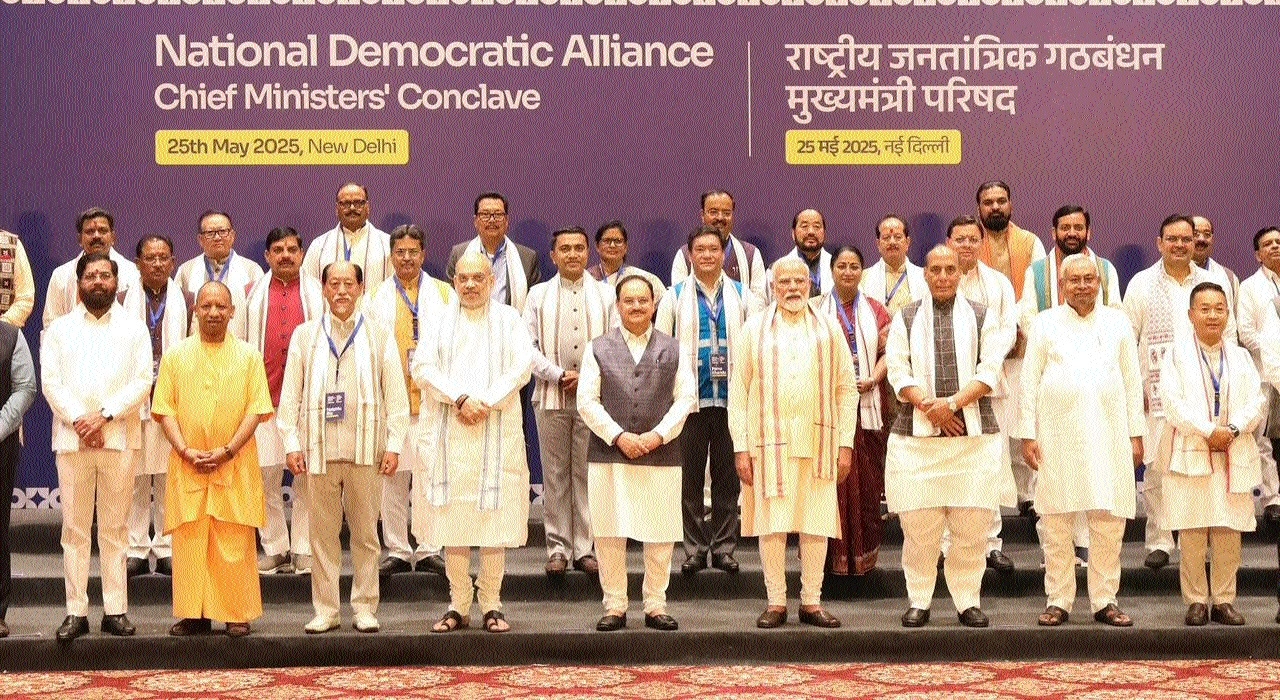
Prime Minister Narendra Modi along with Union Health Minister J P Nadda, Defence Minister Rajnath Singh, Home Minister Amit Shah and Chief Ministers of the states posing for a group photograph.
Our Correspondent
BASTAR,
The Chhattisgarh Government received special appreciation for its development model and innovative initiatives at the Chief Ministers’ Conclave chaired by Prime Minister Narendra Modi.
The presentation by Chief Minister Vishnu Deo Sai on the Bastar Olympics and Bastar Pandum captivated the attention of Prime Minister and other participating Chief Ministers. Chhattisgarh Deputy Chief Ministers Vijay Sharma and Arun Sao also attended the conclave.
Chief Minister Sai highlighted the State’s efforts towards good governance, stating that Chhattisgarh has institutionalised transparency and efficiency by creating a dedicated Department of Good Governance and Convergence. He noted that schemes in the state are closely monitored through digital tools like the Atal Monitoring Portal, ensuring timely grievance redressal and real-time performance tracking.
“Our goal is not just to launch schemes but to ensure they are implemented honestly and effectively on the ground,” the Chief Minister said while addressing the conclave at The Ashok Hotel in New Delhi.
A key focus of the meeting was the effective implementation of the Central Government’s flagship schemes. CM Sai shared that programmes such as the Pradhan Mantri Awas Yojana, Ujjwala Yojana, Ayushman Bharat, and Jal Jeevan Mission have been successfully delivered at the grassroots in Chhattisgarh through Gram Sabhas, public outreach, and technology-led interventions.
The highlight of the session was a special presentation on the Bastar Olympics and Bastar Pandum, two major socio-cultural initiatives. Referring to PM Modi’s call of “Kheloge India, Jeetoge India,” the Chief Minister said that Chhattisgarh had turned this vision into a grassroots reality. He explained that the Bastar Olympics is not merely a sporting event but a social movement that has replaced guns with javelins, arrows, and balls in the hands of the youth. The event saw participation from 1.65 lakh athletes across 32 development blocks in 7 districts, conducted over 40 days across three levels - block, district and division.
The competition featured 11 traditional tribal games, including archery, running, kho-kho, kabaddi, and tug-of-war. Participants were divided into four categories: junior, senior, surrendered Naxals, and differently-abled. Particularly noteworthy was the enthusiastic participation from remote villages, especially by women and persons with disabilities.
During his presentation, CM Sai shared the inspiring story of Punem Sanna, a wheelchair athlete from Dornapal, a region once affected by Naxal violence. Today, Sanna is a medalist and a role model for youth across the region. It is noteworthy that PM Modi had earlier appreciated the Bastar Olympics during his ‘Mann Ki Baat’ broadcast, calling it “a celebration of Bastar’s soul.”
The Chief Minister also presented the success of the Bastar Pandum festival, which has not only preserved the region’s tribal heritage, traditions, and folk arts but has also brought them national recognition. The cultural event witnessed participation from 47,000 performers, 1,885 village panchayats, and 1,743 cultural troupes across 32 blocks in 7 districts.
Held in three phases, the festival featured folk dance, music, local markets, and traditional food competitions. The government awarded Rs 2.4 crore in incentives to participants, reinforcing community engagement and pride. The initiative has strengthened unity across generations - youth, women and elders, becoming a symbol of peace, celebration, and progress in previously conflict-ridden areas.
The Chief Ministers’ Conclave had shortlisted select states to showcase their best practices. Chhattisgarh’s Bastar model stood out as a remarkable example of public participation, cultural integration, and development-driven transformation that could be emulated in other states as well.