Takes flight Nagpur Police bolster social media monitoring
28 May 2025 11:36:31
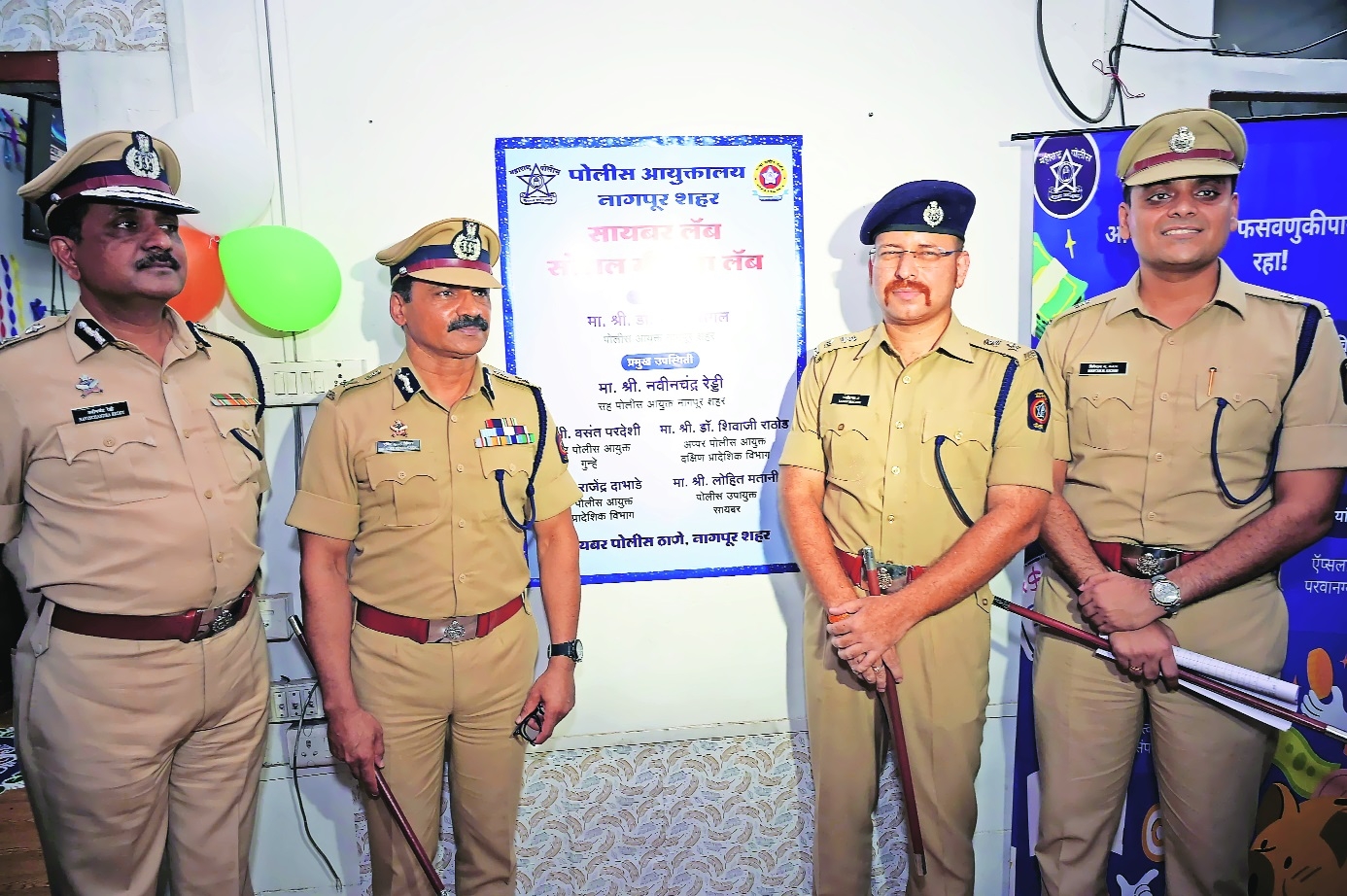
Commissioner of Police Dr Ravinder Kumar Singal at the Cyber Police Station, with Joint CP Navinchandra Reddy and DCP (Cyber) Lohit Matani during the launch of ‘Garuda Drushti’. (Pic: Satish Raut)
Staff Reporter :
In a major step towards strengthening cyber surveillance and public safety, the Nagpur City Police on Tuesday launched ‘Garuda Drushti’, an advanced social media monitoring tool designed to track, analyse, and respond to anti-social content in real time. The tool was officially inaugurated by Commissioner of Police Dr Ravinder Kumar Singal at the Cyber Police Station, with Joint CP Navinchandra Reddy and other senior officials in attendance.
Developed during the CyberHack Event 2025, ‘Garuda Drushti’ aims to address the growing challenge of misinformation, hate speech and potential threats spreading via social media platforms.
While digital platforms like Meta, YouTube, Twitter (X), WhatsApp, Telegram, and Instagram connect millions, they also pose risks to public harmony and national security. ‘Garuda Drushti’ empowers law enforcement agencies to counter these challenges through real-time keyword and image-based search capabilities. The tool, developed by city-based engineer Shreyas Kawale, can identify posts related to crime, violence, terrorism, or political sensitivity by scanning relevant hashtags, images (even when no text metadata is present) and user activity.
In addition to monitoring, ‘Garuda Drushti’ incorporates AI-driven automated intelligence features that classify online content based on parameters such as religious sentiments, political activities, and VIP-related threats. It generates daily intelligence reports and enables quick reporting of objectionable posts through official social media complaint channels. For posts found to violate legal norms, the tool coordinates with digital platforms under Section 79 of the IT Act for takedown procedures.
‘Garuda Drushti’ reflects city police’s progress: CP
Speaking at the launch, CP Dr Ravinder Kumar Singal underlined how ‘Garuda Drushti’ reflects the city police’s progress in cyber security. He highlighted that three problems were posed during the CyberHackathon, and three practical solutions, including ‘Garuda Drushti’, were developed and implemented. Joint CP Navinchandra Reddy noted that the social media monitoring team plays a key role in maintaining social harmony by preventing the spread of inflammatory and illegal content.
DCP (Cyber) Lohit Matani said that the Nagpur Police has also started engaging with students through cyber clubs established in schools and colleges, reaching out to over 1.5 lakh people in the city to spread awareness and involve youth in cyber vigilance.
While proposing vote of thanks DCP Zone 5 Niketan Kadam said, “With open-source tools and cutting-edge technology, the police are now better equipped to detect threats, prevent crime and ensure law and order in an increasingly digital world.”
Facial recognition to identify suspects
One of the most innovative aspects of the tool is its AI-powered facial recognition system, which can match publicly shared images with suspect profiles. This not only enhances the accuracy of investigations but also allows tracking of criminal networks and missing persons across digital platforms. If a photograph is obtained from CCTV footage or shared online, the tool can trace the source and link it to digital identities. Supporting the broader cyber infrastructure, the newly launched Cyber Lab in Nagpur includes several high-end tools provided by Maha Cyber. These include CDR Analysis tools for studying call detail records and identifying social networks and geolocation data; Cellebrite UFED and Cellebrite Premium for mobile data extraction; and the Gargoyle Investigator MP for detecting malicious software and conducting forensic analysis of computer systems.
Bot farming for faster data retrieval
Right now, the system uses four bots - automated programmes that collect data from social media. These bots search within a 5-kilometre area, but it takes about 24 hours to get the results. This is because only a few bots are working at the same time, which slows things down.
To speed things up, the system can reduce the search area and focus on a shorter time range of social media activity. For example, if the search area is reduced to 1 kilometre, the results can be ready in just 1 to 2 hours, since there’s less data to go through.
To fix the delays and make the system faster, the team is working on building a large group of around 2,000 bots. Once these
bots begin running, the system will be able to handle more searches at the same time. This means that even a 5-kilometre search could give results in about an hour which make the system much quicker and more efficient.