Cheriyal Artists Ganesh, Vanaja bring Telangana’s folk art to Orange City
29 May 2025 11:26:55
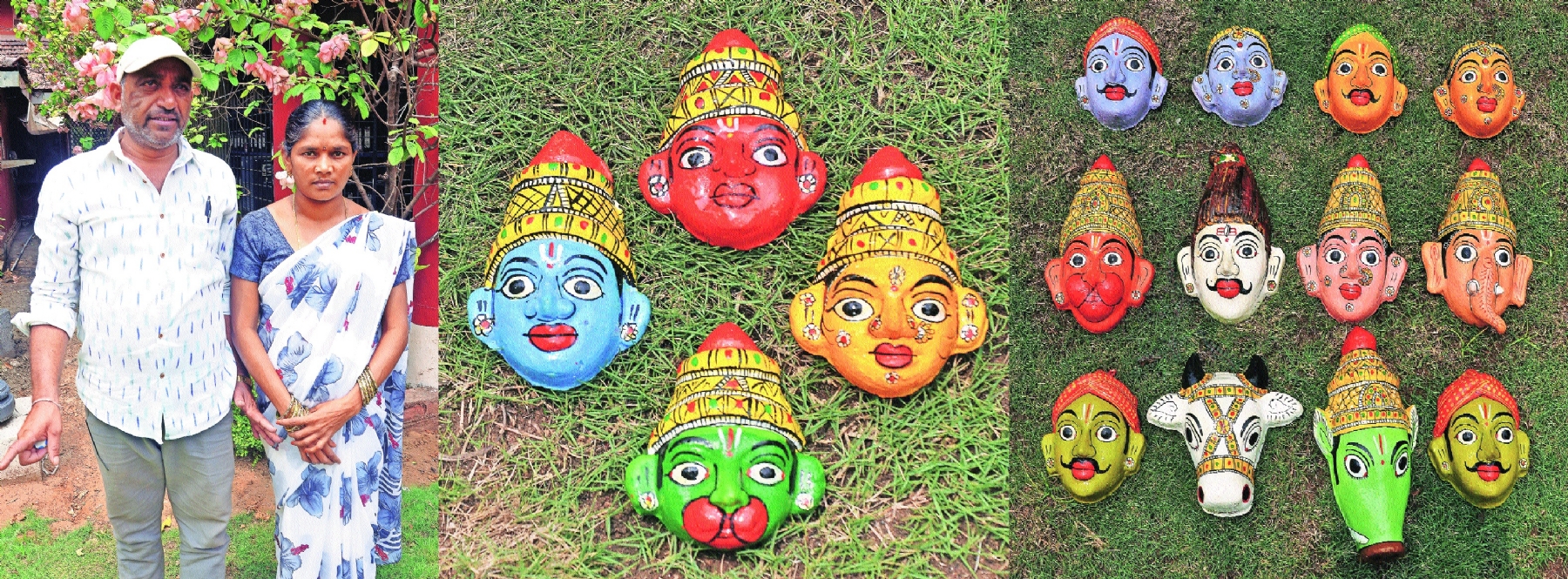
(Above) Cheriyal marks of Lord
Ram, Sita, Laxman and Hanuman
created by
Cheriyal artists
from Telangana
(left) Nagilla
Ganesh and his
wife Vanaja Ganesh.
(Pics by Anil Futane)
By Vaishnavi Pillay :
About 100 kilometres from Hyderabad, lies the village of Cheriyal in Telangana. From this village comes Nagilla Ganesh and his wife, Vanaja Ganesh, both devoted practitioners of the centuries-old art of Cheriyal painting and mask-making that once served as storytelling aids in local theatre.
“This is not just an art form. It is our family tradition, passed down through generations for over 400 years, After marriage, I began teaching my wife how to paint and make Cheriyal masks, and I believe now the art
has found new energy in her hands,” said Nagilla Ganesh.
“I did not know much when I got married, but after I started learning I travelled to different cities, met people, conducted workshops. I feel good about it and understand now how important it is for women to earn,” expressed Vanaja. Her journey is remarkable in its own right, from a curious observer to a cultural ambassador for women in folk arts.
The Cheriyal art form, which began as scroll paintings used by village storytellers, has evolved over time. “Earlier, it was just painting. Then it became part of plays. Masks were made for each character, Lord Ram, GoddessSita, Raavan, Lord Krishna, Arjun, the whole Ramayan and Mahabharat could be told through masks,” he explained.
As a child, Ganesh spent several years in Gadchiroli, Maharashtra, where his father worked.
It was there, in a small village, that he first learned to read and speak Marathi, and picked up Hindi through school and everyday life. “I was just six then. I studied Marathi from Class I to V. Later, we returned to our village vut those early years gave me a foundation in Hindi and Marathi,” he recalled.
Ganesh is the only one among his siblings, four brothers and one sister, who continued the family tradition of Cheriyal art. But theirs is not the only family with such roots. Back then, we were called the Nakashi families.There used to be around 400 such families, spread across Telangana,” he explained.
Ganesh continued explaining that there was a time when India did not know this art existed, and slowly, it started getting attention.
“People began exploring India’s folk arts that helped revive interest, ” he said. Today, their family, including their two daughters, is one of just seven families in the region who still carry the Cheriyal tradition.
Cheriyal masks, with their bright expressions and mythological motifs, have attracted attention in workshops. “A four or five-day workshop is not enough. One cannot pass on tradition in a crash course. If students could sit for two or three months then something real could be passed on,” Ganesh stated. He believed that government and cultural institutions should offer longer, immersive workshops.
The couple have received several State-level awards from Telangana and also earned recognition from Ministers of State Government of Telangana and Central Government.