IIT Bhilai researchers develop smart materials for unbreakable, soundproofing devices
| Date :05-May-2025 |
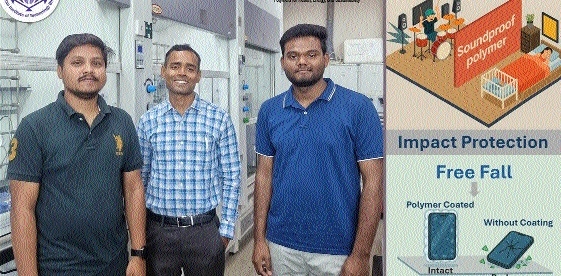
The IIT Bhilai researchers with their engineered smart materials.
Staff Reporter
DURG
A research team at the Department of Chemistry, IIT Bhilai, comprising Swarup Maity, Nishikanta Singh, and Dr Sanjib Banerjee, has developed smart materials for unbreakable and soundproofing devices. These materials are synthesised using a simple, cost-effective, and industry-friendly process.
The innovative material demonstrates exceptional impact resistance, energy dissipation, and self-healing properties, making it suitable for a wide range of applications, including but not limited to its use in the construction of unbreakable and soundproofing devices. This work has been published in Chemical Engineering Journal, a leading journal in the field. The research is supported by SERB, Govt. of India and IIT Bhilai.
It may be noted that smart polymeric materials are revolutionising various industries by offering exceptional flexibility, impact resistance, and energy dissipation. These advanced materials are designed with specialized polymers and chemical interactions, allowing them to absorb and dissipate energyefficiently under dynamic stress.
Drawing inspiration from nature, where resilient mechanisms have evolved over time, polymeric elastomers must be meticulously engineered to maintain strength, flexibility, and the ability to self-heal after damage. The unique properties of these materials, including their ability to autonomously repair and their outstanding vibration-damping performance, make them ideal for applications in critical sectors such as defense, automotive, aerospace, construction, and electronics. The development of high-performance polymeric elastomers is crucial for enhancing the durability and reliability of products exposed to extreme conditions. Their remarkable impact resistance, coupled with energy absorption and dissipation capabilities, opens up possibilities for shock-absorbing packaging, protective coatings, and energy storage systems. Moreover, these elastomers’ ability to self-heal autonomously under ambient conditions ensures long-term functionality and reduced maintenance costs, positioning them as an environmentally friendly alternative to conventional materials.
As industries continue to demand more sustainable and efficient solutions, the need for polymeric elastomers with tunable properties becomes ever more pressing. Future innovations in this field must focus on optimizing materials for scalability, cost-efficiency, and performance. These elastomers hold the potential to provide versatile, high-performance solutions that not only improve product longevity but also reduce environmental impact, making them a cornerstone for next-generation engineering and manufacturing technologies.