OLD BUILDINGS, NEW FIXES Sustainable innovations to keep your home cool
12 Jun 2025 11:03:32
By Krystelle DSouza :
These low-energy, affordable, user-friendly products that people can install without hiring engineers or technicians can tackle the current heat crisis in the country.
IN 2024,India reported over 48,000
cases of heatstroke and 159 heatrelated deaths -astark sign of how
rising temperatures are beginning to
impact everyday life.
But alongside the heat, something
else is gaining momentum: a wave of
climate-consciousinnovation.Agroup
of young minds from across Indian
institutes have come up with a range
ofclever,climate-responsivesolutions
- each designed to cool India’s buildings and move the country towards a
resilient future.
Solar Decathlon India (SDI), an
annual competition for undergraduate and postgraduate students, sees
the coming together of young innovatorswhorejig avant-gardesolutions
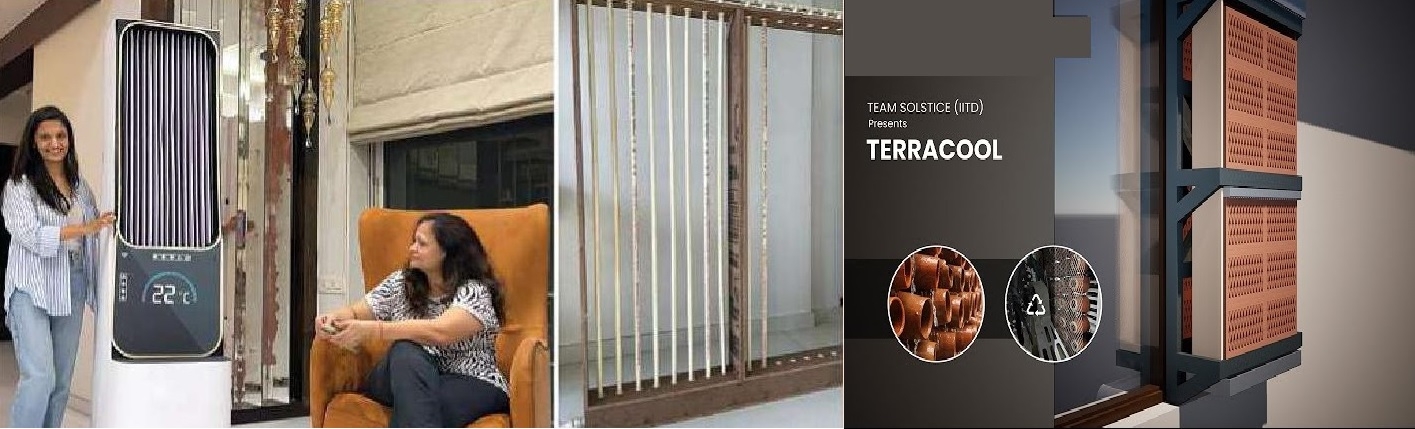
withsimple tweaks- thinkceilingpanels made from mycelium waste, terracotta cone-based coolers, and jali
(lattice) shading devices, all in a bid
to come up with net-zero solutions
for India’s climate crisis.
Commending theirsenseof“agency
and purpose”, PrasadVaidya, director
and spokesperson, Solar Decathlon
India, applauds the eco-consciousliteracy prevalent among these young
minds.
They are not deterred by the
mercurial nature of climate-induced
problems, instead, it only furthers
their resolve.
Having observed the quiet confidence among these students over the
years, as they give form to trailblazing innovations, Prasad says, “What
counts is that they have understood
theproblem.Theyhaveasolution that
may not be perfect, but one that is in
the works; one that they are looking
at turning into a business model.”
Driving energy-efficientcooling to
shape a sustainable India
A 2024 surveyconductedbytheYale
Programme on Climate Change
Communication (YPCCC) revealed
that the Indian outlook towards the
future is coloured with worry.
Where should the starting point for
a mitigation plan begin?
As the adage suggests, it all begins
at home. The organisers of Solar
DecathlonIndia,Alliance foranEnergy
Efficient Economy (AEEE)-India’s
leading policy support and implementationorganisationcatalysing the
responsible use of energy for a climate-resilient and energy secure
future,andIndianInstitute forHuman
Settlements (IIHS), a national knowledge institution that is committed to
theequitable,sustainable,andefficient
transformationofIndia’scities, towns,
and villages, beckons us to turn our
gaze towards our buildings, which
account for three percent of India’s
energy and process-related carbon
dioxide emissions.
Currently, only 10 percent ofIndian
households have air-conditioning.
But, the solution does not lie in scaling this number - this runs the risk of
overburdening power grids. Instead,
couldwelook at shifting the goalposts
from conventional cooling technologies to more sustainable alternatives?
This is exactly the mindset shift
encouraged at SDI, compelling students to come up with low-energy,
affordable,user-friendlyproducts that
peoplecaninstallwithouthiring engineersor technicians.Thepremisehere
is retrofitting.
“The word ‘retrofit’ conjures up
images of significant components of
buildingsbeingremovedandnewstuff
being added. But that’s not what we
do in India. Instead, people are in the
habit of visiting a shop, buying something theyneed,andaskingalocal technician to install it,” reasons Prasad.
He adds that to this end, retrofitting
these technologies essentially means
introducing them in existing residentialstructureswithoutextensivemodifications to the framework of the
building, thus marking a pivotal
change
Innovationswith thepotential toripple into impact
COOALA: Portable Water-Cooled
AC
Pictureawoman hard at work in
her home kitchen, one of the thousands in the metropolitan area where
she lives. As roti afterroti (Indian flatbread)pilehighonto theplate, the temperature rises in proportion. The
kitchen mimics a furnace.
The heat
within is exacerbated by the stove on
which the rotis cook. This is the lived
reality for most women in India.
Atthe SDI Challenge, a team of students led by IES (Indian Education
Society) College of Architecture,
Mumbai, came up witha uniqueidea.
They designed a portable air conditioner called ‘COOALA’.
What made it stand out? It doesn’t
need a pipe going through the window. That means no technician is
required for installation. Plus, it can
be easily rolled from one room to
another. No surprise - it won over the
jury instantly.
The device works on the principle
of temporalheatdissipationwithadual
compressor cycle, thus matching the
cooling performance of a typical oneand-a-half-ton room AC.
Bloom: DIY Passive Cooling Module
The flasher-based dynamiccooling
prototypecouldwellbea template for
how cooling can be achieved in residential spaces withoutrelying on traditional air conditioners.
The brainchild of students from Visvesvaraya
National Institute of Technology
(VNIT) in Nagpur, ‘Bloom’ is a modular, do-it-yourself (DIY) kit capable
of achieving an average temperature
differential of three degrees Celsius
post-installation.
In the long run, the device is
designed tohelpsavemoneyandpower. Bloom’soperational costs are Rs 79
permonth,leading to substantial savings compared to the Rs 1,200 to Rs
2,000 monthly expense of a standard
1-ton, three-star AC unit.
MushCool: Mycelium Ceiling
Panels
Who could have imagined that‘fungi tiles’ could be an antidote to India’s
heat crisis? Research indicates that
mycelium-bound composites are
more energy efficient than conventional building insulation materials
like expanded vermiculite. They possess thermal conductivity comparable to conventional insulating materialslike glasswool and extrudedpolystyrene.
The ‘MushCool’ innovation, which
is ceiling panels made from mycelium, oyster mushroom spores and
organic waste such as sugarcane
bagasse, an agricultural byproduct -
by the students from Bengaluru’s RV
College of Architecture, RV College of
Engineering,andRVUniversity,School
ofDesign andInnovation,wield these
properties ofmycelium.Theresulting
panels are eco-friendly, modular,
affordable, and easy-to retrofit.
Sustaina Shades
Sugarcanebagasse,clay,paperpulp,
aloe vera, lemongrass, and multani
mitti (a type of clay) have a dual vantage.
They arebiodegradableandmost
of them (sugarcane bagasse, clay,
paperpulp and aloevera) haveacooling effect by nature. The ‘Sustaina
Shades’ devisedby the students of the
Sri Venkateshwara College of
Architecture,Hyderabad andB.V.Raju
Institute of Technology, also in
Hyderabad, draws from the intersection of these properties.
These shades are optimal for semiopen community spaces and claim to
reduce indoor temperature by up to
six and a half degrees Celsius.
Terracool: Desiccant Cooling
System
Here’saninnovation that’sbringing
thecoolantpropertiesof terracottaout
of the shadows, ‘Terracool’, a hybrid
wall module combining desiccantbased dehumidification, evaporative
cooling, and solar power.
Designed by the students of the
Indian Institute of Technology Delhi,
this uses desiccant technology to
dehumidify and cool indoor spaces,
reducing indoor temperatures by up
to sevendegreesCelsiuswitha 10percent reduction in humidity.
VAYU: Ceiling Fan Retrofit For
Cooling & Dehumidification
Visceral and confronting is how the
jury would describe the solutions
ideatedbytheyounginnovators.
Take,
for instance, ‘VAYU,’alow-cost, personalised retrofit device that couples
coolinganddehumidification through
a desiccant wheel technology that
helps control humidity and provides
enhanced energy efficiency. Devised
by the students of Manipal School of
Architecture and Planning and
Manipal Institute of Technology,
Karnataka, the device is capable of
operating temperatures between 22-
25degreesCelsiusandreduceshumidity by approximately five percent.
It claims to save 1,500–2,000 kg of
CO2, 1,260 kg from operation, and
250–800 kg from manufacturing, if in
operation for a decade.
EcoChill: Peltier-Based Water
Cooler
In the hot climes of Rajasthan, this
innovation by the students of BITS
(Birla Institute of Technology and
Science), Pilani promises respite to
the people. Unlike conventional ACs
that overcool entire spaces,‘EcoChill’
is remote-controlled, easy to install,
and built on wheels, thus enabling
movement for focused cooling.
The prototype demonstrated a significant temperature reduction from
35 degrees Celsius to 26 degrees
Celsius.
Solar-Responsive Thermal Curtain
Imagineaclimate-proof blanket
made from PVC (polyvinyl chloride)
andsteelrods thatautomaticallyopens
and closes based on solar intensity!
Not only have the students of the
Indian Institute of Technology Delhi
built such a device, but they’ve also
testedit across 10 homesin two cities.
They found energy reductions to be
between 60 percent and 70 percent.
This owes to the multi-layered insulationsystemwithreflective,low-conductivity, and thermal mass
materials.
Coolheart:Terracotta Cone-Based
Cooler
Doyou remember architectMonish
Siripurapu, founder of Ant Studio
design firm, whose air cooling system
receivedUnitedNationsacclaim?Well,
thesameprincipleofevaporativecooling - an ancient technique in which
water is cooled by passing it through
an earthen cone system - is now the
premise of an innovation by the students of Bengaluru’s RV College of
Architecture, RV College of
Engineering, and RV University.
‘Coolheart’ is a compact and modular cooler that uses terracotta cones
combinedwithrefrigerant-basedcooling, capable of providing localised
indoor cooling. The plug-n-play unit
consumes 600-1200watts, resultingin
consistently low energy bills, a great
bet for low-resource residential
settings.
SheetalVayu: Sustainable Jali
Shading Device
Whether it’s the stepwells of
Rajasthan or themosque, palaces and
cenotaphs of ancient India, the jali
weaves a beautiful story through the
history of Indian architecture Sometimes as sun breakers, other
times as shades, the jalis encourage
heat dissipation techniques.
The students of Mumbai’s NMIMS’s Mukesh
Patel School of Technology
Management & Engineering and
NMIMS’s Balwant Sheth School of
Architecture developed a jali-based
shading device for windows, a homage to the classics.
Constructed from sustainable materials, the ‘SheetalVayu’ prototype
showed a reduction of indoor temperatures by two and a half degrees
Celsius with 14.8percent water absorption aided cooling.
Since its inception in 2020, SDI has
growninto theworld’slargestnet-zero
building challenge, with over 8,200
students from 300+ institutions collaborating with 400+ partners in the
building industry.It shows us that climate action doesn’talwaysneedmassive infrastructure or big budgets. All
it takes is an idea, a classroom, and a
commitment towards a sustainable
future. With every prototype, these
younginnovators arestitching together a future that’s cooler, greener, and
within reach.