G7 summit Will emphasise priorities of Global South: Modi
| Date :18-Jun-2025 |
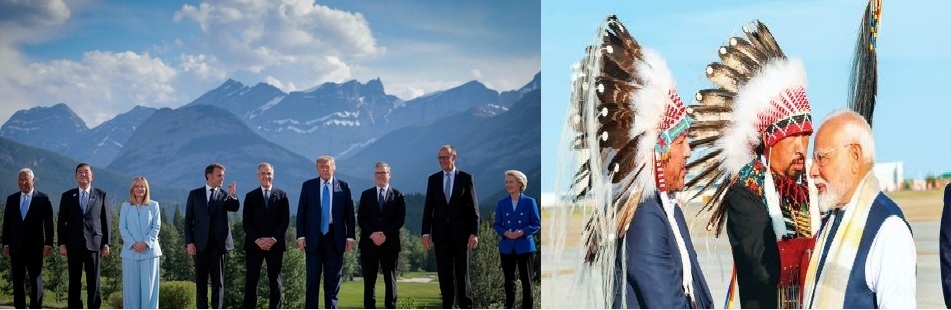
■ By Yoshita Singh :
CALGARY
From left, European Council President Antonio Costa, Japan’s Prime Minister Shigeru Ishiba, Italian Prime Minister Giorgia Meloni, French President Emmanuel Macron, Canada’s Prime Minister Mark Carney, US President Donald Trump, Britain’s Prime Minister Keir Starmer, German Chancellor Friedrich Merz and European Commission President Ursula von der Leyen pose for a family photo during the G7 Summit, in Kananaskis, Alberta, on Monday
PRIME Minister Narendra Modi has
said he will discuss important global issues and emphasise the priorities of the Global South as he meets
world leaders at the G7 Summit in
Canada’s Kananaskis.
Modi arrived here on Monday
evening (local time), his first visit to
Canadainadecade,withdiscussions
with world leaders to be focussed on
crucial globalissues,including energy security, technology and innovation. “Landed inCalgary, Canada, to
take part in the G7 Summit. Will be
meeting various leaders at the
Summit and sharingmy thoughtson
important global issues.Will also be
emphasising the priorities of the
Global South,” Modi said in a post
on X Monday evening.
PM Modi is on a four-day, threenation tour to Cyprus,
Canada and Croatia. He arrived
Monday evening (local time) in
Canada from Cyprus on the second
leg of his visit, at the invitation of
Canadian Prime Minister Mark
Carney.
TheKananaskis gathering onJune
16-17is thePrimeMinister’s6thconsecutive participation in
the G7 Summit.
Prime Minister will also hold several bilateral meetings on the sidelines of the Summit, coming over a
month after India’s Operation
Sindoor that targeted terror infrastructure in Pakistan and Pakistanoccupied Kashmir in retaliation for
the April 22 Pahalgam attacks.
Carney’s invitation to Modi to
attend the G7 Summit signalled the
new Government’s intent to
repair the ties with New Delhi that
plummeted to an all-time low over
the killing of pro-Khalistani separatist Hardeep Singh Nijjar. In
October last year, India recalled its
High Commissioner and five other diplomats after Ottawa
attempted to link them to the
Nijjar case. India also expelled
an equal number of Canadian
diplomats.
India had accused Justin
Trudeau’s Government of
allowing pro-Khalistani elements to operate from
Canadiansoil.Carney,aneconomist and political newcomer,
took charge as Canada’s new
Prime Minister in March following the exitofTrudeau from
the top office.
G7 LEADERS CALL FOR
DE-ESCALATIONBUT INSIST
IRANMUSTNOTGETNUKES:
LEADERSof theGroupofSeven
countries meeting in Canada
signed a joint statement calling for de-escalation of fighting between Israel and Iran
whilereaffirming thatIrancannot be allowed to have a
nuclear bomb. The statement
reads: “We, the leaders of the
G7, reiterate our commitment
to peace and stability in the
MiddleEast.Inthiscontext,we
affirm that Israel has a right to
defend itself. We reiterate our
support for the security of
Israel. “We also affirm the
importance of the protection
of civilians. Iran is the principal source ofregional instability and terror. We have been
consistentlyclear thatIrancan
never have a nuclear weapon.
“We urge that the resolution of the Iranian crisis leads
to a broader de-escalation of
hostilities in the Middle
East, including a ceasefire in
Gaza.
Wewillremain vigilant to the
implications for international
energymarketsandstandready
to coordinate, including with
like-minded partners, to safeguard market stability.
NOW WE ARE SIX: G7
LEADERS TRY TO SALVAGE
THEIR SUMMIT AFTER
TRUMP’S EARLY EXIT: SIX of
the Group of Seven leaders are
trying on the final day of their
Tuesday to show the wealthy
nations’ club still has the clout
to shape world events despite
theearlydepartureofPresident
Donald Trump.
PrimeMinisterMarkCarney
and his counterparts from the
UK,France,Germany,Italy and
Japan will be joined by
UkrainianPresidentVolodymyr
Zelenskyy and NATO chief
Mark Rutte to discuss
Russia’s relentless war on its
neighbour.World leaders had
gathered in Canada with the
specific goal of helping to
defuse a series of pressure
points, only to be disrupted
by a showdown over Iran’s
nuclear programme that could
escalate in dangerous and
uncontrollable ways