BFS a great leap in weather forecast
| Date :02-Jun-2025 |
By Sakshi Jaiswal
RAIPUR
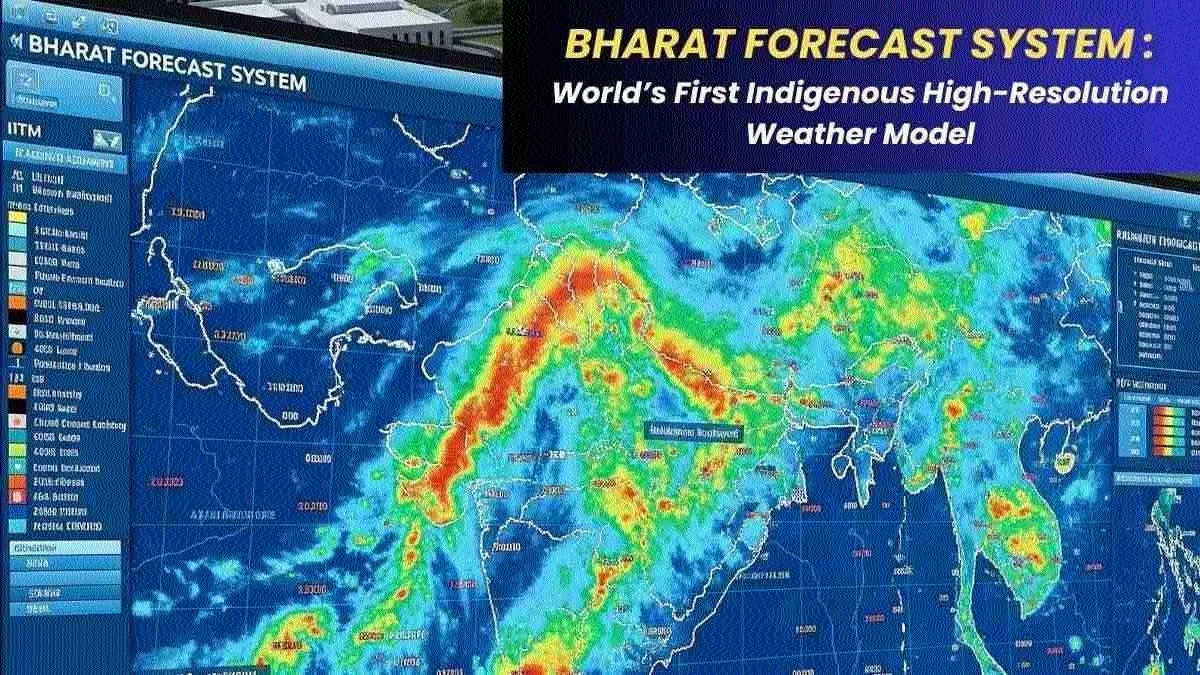
The Ministry of Earth Sciences has launched India’s own weather prediction system, Bharat Forecasting System (BFS). This advanced system, built by the Indian Institute of Tropical Meteorology under the “Make in India” initiative, offers
more accurate and very local weather forecasts. It’s a big step for India’s technology, as it’s the first time such a system was created entirely from scratch.
The India Meteorological Department (IMD) is now using BFS to provide better weather information to everyone, even outperforming systems in developed countries.
Speaking to The Hitavada, Dr Gayatri Vani, senior meteorologist at IMD Raipur, said how BFS is a significant upgrade over its previous model, the Global Forecast System (GFS), which was adapted from foreign models. “The previous model offered a resolution of 12 kilometres,” she said.
“With BFS, we have halved that, it now works on a 6-kilometer resolution, which means we’ve moved from predicting weather at the district level to predicting it at the village level.”
The Bharat Forecasting System operates through numerical weather models, which use ground-based and satellite observations, such as temperature, humidity, wind, and pressure as inputs. These inputs are processed through advanced calculations using supercomputers, generating short and long-term weather forecasts.
A vital component in the BFS development was the incorporation of ARCA, India’s high-performance supercomputer, inaugurated in 2023. With 11.7 petaflops of computing power and 33 petabytes of storage, ARCA enabled Indian scientists to run high-resolution models swiftly and efficiently, something not possible on the previous system, PRATYUSH. “ARCA allowed us to bring this project to life. Without this computing power, building an indigenous model of this scale would have taken much longer,” Dr. Vani added.
The benefits of BFS are already being seen.
According to Dr. Vani, simulations have shown a 30% improvement in forecasting extreme rainfall events, a critical enhancement in an era of increasingly erratic weather. This improvement is expected to significantly strengthen India’s disaster management framework, particularly in issuing early warnings for floods, cyclones, and cloudbursts.
For the agricultural sector, the impact could be transformative. The BFS allows IMD to issue forecasts at panchayat and taluk levels, aiding farmers with timely insights for sowing, irrigation, and harvesting. “This precision in crop-stage forecasting can help reduce crop damage and improve yield,” she noted.
While BFS is not a public-facing platform, its forecasts are used for IMD’s decision-support systems, which distribute user-friendly updates via websites, mobile apps, and media channels. These include advisories on rainfall, temperature variations, and potential extreme weather events, all of which are now more accurate and localized.
Looking ahead, the system will continue to evolve. Future upgrades will focus on the assimilation of more observational data, deeper use of machine learning algorithms, and strengthening BFS’s adaptability to climate variability. “This is not just a scientific achievement,” Dr. Vani emphasized, “but a national milestone. We have not only built something entirely our own but also surpassed the forecasting capabilities of some of the most advanced countries in the world. It’s a proud moment for Indian science.”
With the Bharat Forecasting System, India has not just improved its weather predictions, it has set a new climate for innovation, accuracy, and resilience.