That earthy rain smell we all love? Here’s what’s really behind It
| Date :26-Jun-2025 |
■ By Hanna Paul :
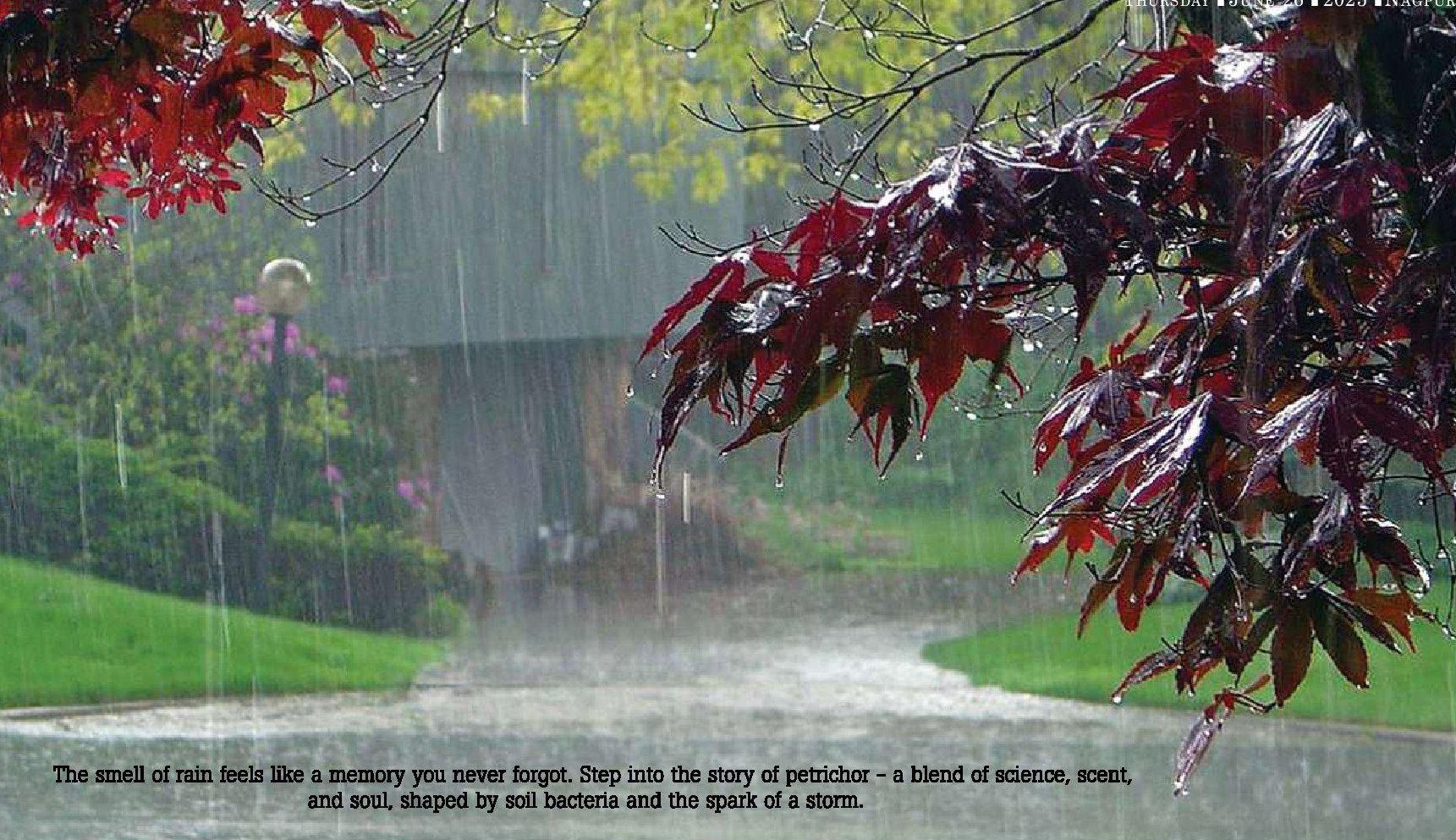
The smell of rain feels like a memory you never forgot. Step into the story of petrichor - a blend of science, scent, and soul, shaped by soil bacteria and the spark of a storm.
Y
OU know that moment right after the
rain stops? The world feels washed, like
someone wiped the sky clean. Leaves
drip softly, puddles ripple with tiny circles,
and the air- cool, damp, alive-carries a smell
that makes you pause without thinking.
You breathe it in, and for a second, everything feels a little lighter, a little quieter. That
familiar, earthy scent is comforting in a way
that’s hard to explain - like your brain knows
rain has come, even before your eyes do.
That smell has a name - and a story. It’s
called petrichor.
Why that first breath after rain feels so
special
Petrichor isn’tjust a scent- it’s a feeling. For
many of us, it carries a quiet nostalgia: childhood puddle-jumping, romantic evenings
under cloudy skies, or cosy afternoons sipping chai as the rain taps on windows. It’s the
smell that announces: the rain has arrived -
even before the first drop fully falls.
The word was first coined in 1964 by two
Australian scientists, Isabel Joy Bear and
Richard Thomas. It comes from the Greek
words petra (stone) and ichor (the blood of
the Gods).
They discovered that during dry spells,
plants release oils that seep into the soil and
rocks.Whenrain finallyreturns, these trapped
oils areliftedinto the air, releasing thatunmistakable earthy aroma.
In a way, it’s the earth exhaling.
The science under the soil
At the heart of petrichor is a tiny but powerful molecule called geosmin. Produced by
soil-dwelling bacteria called Streptomyces,
geosmin is released as these bacteria break
down dead plants and organic matter.
When rain hits the soil, geosmin molecules
hitch a ride on microscopic droplets that
bounce up from the ground and float into the
ai r- straight into our noses.
What’s remarkable is just how sensitive we
are to this scent.Humans can detect geosmin
at concentrations as low as 5 parts per trillion
- like spotting a single grain ofricein an entire
stadium of people. That slightly metallic,
earthy note you get from fresh beetroots?
That’s geosmin too.
What happens when rain hits the ground
Here’s where physics joins the story.
When a raindrop lands, especially on dry
ground, it traps tiny air bubbles beneath its
surface.
These bubbles rise, burst, andlaunch
the geosmin and plant oils into the air in
microscopicsprays. It’slikenature’sownchampagne fizz - only it’s the soil releasing its
hidden fragrances.
In2015, scientists atMITcaptured thisphenomenon using high-speed cameras. They
showed how these tiny bursts release the first
notes of petrichor, often even before the rain
intensifies.
How the sky sets the stage
Before the rain even touches the ground,
the sky itself begins preparing the stage.
Whenlightning strikes,it superheats the air
to nearly 30,000°C - hotter than the surface
of the sun. This extreme heat splits oxygen
and nitrogen molecules, allowing them to
recombine asozone- giving the air that sharp,
electricscent yousometimesnoticejustbefore
a storm.
As wind stirs and pressure drops, it carries
the scent of geosmin and plant oils ahead of
the rain, teasing your senses with the promise of what’s to come. Then thunder rolls,
heighteningyourawareness,makingyou even
moreattuned to that firstbreathofrain-soaked
earth.
Together, lightning, ozone, wind, thunder,
and petrichor create not just a smell - but a
full sensory memory etched in the air.
Why does petrichor make us so happy?
This is where science blurs into feeling.
Our brains are wired to connect scents with
memories and emotions. Petrichor triggers
flashes of childhood, holidays, monsoons,
and quiet joy. It evokes memories of warmth,
safety, and simple pleasures while the world
outside turns misty and green.
Interestingly, the smell of petrichorisn’tthe
same everywhere.Localplants,microbes, soil
types, and humidity give every place its own
signature version.
That’s why the forests of
Idukki don’t smell like the rooftops of
Bengaluru or the deserts ofGujarat.Petrichor
belongs to the land.
Some scientists even suggest our love for
petrichor may be rooted in evolution. Early
humans who could detect approaching rain
were more likely to find water, helping their
survival. Our bodies still respond with relief
and happiness when the rains return.
So when that first drop falls and the scent
rises, you’re not just smelling rain.
You’re smelling survival,memory, and generations of life welcoming the sky’s gift. So
rejoice and rebound in this nature’s wonder
which sends nostalgic signals to the brain
which in turn makes the body rejoice at this
natural phenomenon.