Auction types, market value determine worth of an art work: Milind Limbekar
| Date :29-Jun-2025 |
Staff Reporter :
Short lectures organised
by Vidarbha Sahitya and ‘Sarjana Nirmaan’ appreciated by art and literature enthusiasts
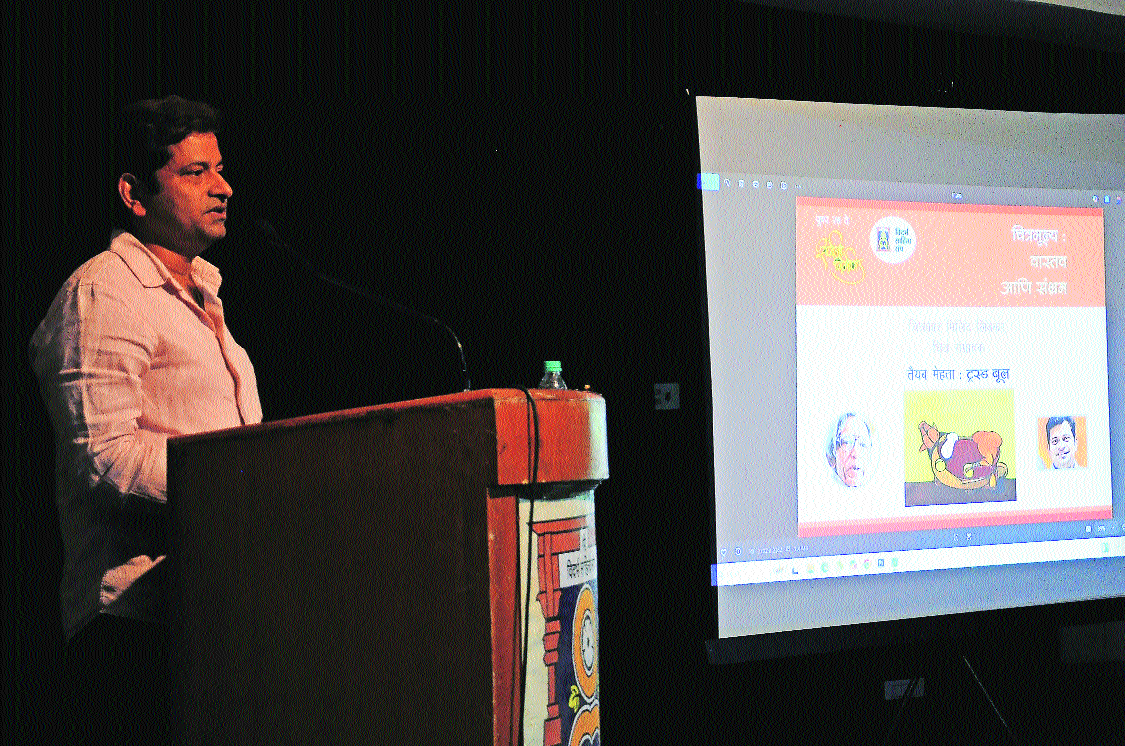
“Paintings by renowned artists are now sold for crores of rupees. How an artist’s work is valued and why such astronomical prices are fetched always intrigues both common art lovers and even those in the field itself”, explained art collector Milind Limbekar. He highlighted the significant role played by auction types, market value, and auctioning agencies in determining a painting’s worth.
He was speaking at a series of three short lectures titled ‘Art Valuation: Reality and Illusion’ jointly organised by Vidarbha Sahitya Sangh and Sarjana Nirmaan.
Limbekar explained the workings of online auctions, where sometimes bidding starts the very moment the auction begins. He
also elaborated on aspects such as gallery systems, auction centres,
GST applicable
to buyers, transport charges, invoicing,
and more.
Limbekar cited Indian organisations such as Saffronart and AstaGuru as examples of institutions involved in sales and auctions of the art works.
Earlier, Limbekar piqued interest of the audience by citing
Tyeb Mehta’s iconic painting ‘Trussed Bull’, which sold for approximately Rs 62 crore. He mentioned that the trauma of Partition deeply impacted Mehta’s psyche, a sentiment evident in the anguish depicted in his works. The ‘Trussed Bull’, symbolising a tied bull being led to slaughter, reflects this pain. He also described Mehta’s Diagonal Series, where he likened diagonal cuts to swords, suggesting violence and grief.
Following this, Vishwanath Sable, Dean of a Fine Arts College, spoke on M F Husain’s ‘Grama Yatra’, which was sold for Rs 118 crore. Husain, a member of the Progressive
Artists’ Group, was known for his experimental and independent approach to art. Sable remarked on Husain’s conscious creation of a distinctive personal style, such as always carrying a large brush and walking barefoot, which played a role in his branding as an artist.
Finally, Chandrakant Channe spoke about Amrita Sher-Gil’s ‘Story Teller’, which sold for around Rs 62 crore.
Channe explained that criticism from Rabindranath Tagore regarding a lack of Indian ethos in her work ironically brought her into the limelight. Sher-Gil’s observational depth is evident in her portrayal of domestic helpers, where one can see the helplessness in their eyes as they rest after their chores. Channe highlighted the many facets of human life expressed in her work, despite her tragically short life. He also recounted how the purchase of her painting for Rs 19 crore reignited criticism from Santiniketan circles associated with Tagore. The programme was ably compered by Prakash Edlabadkar and received an enthusiastic response from art enthusiasts.
Sangh