‘MNLU must now earn a name at global level through its academic excellence’
Date :30-Jun-2025
Staff Reporter :
Union Minister Nitin Gadkari, Chief Minister Devendra Fadnavis also attend event
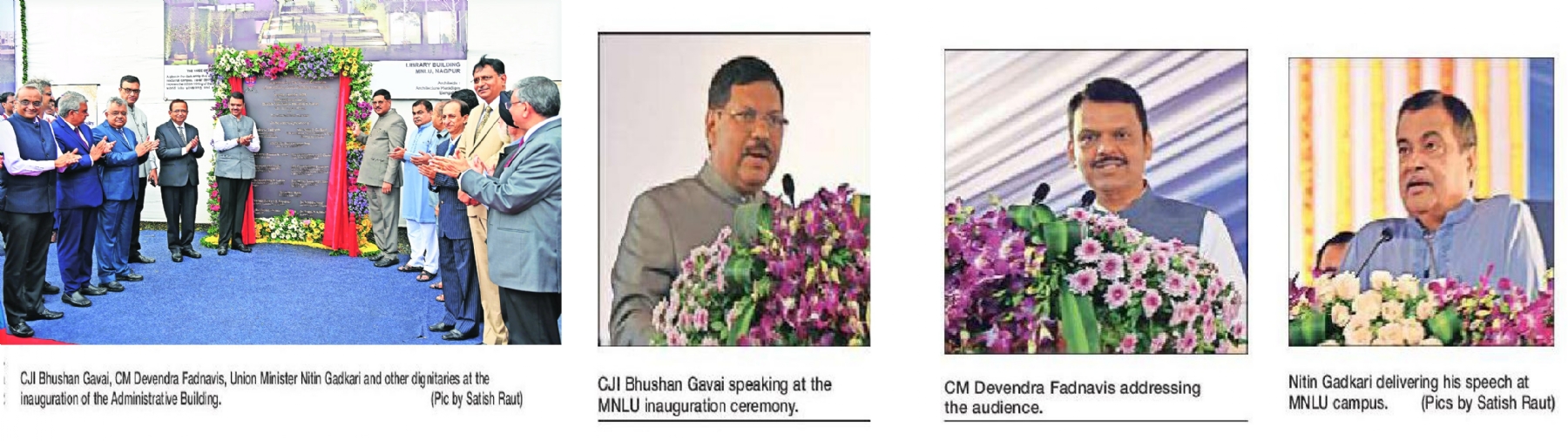
“This university is built with dedication and it must now earn a name at the global level through its academic excellence. At the same time, the teachers must concentrate on honing skills of students as ultimately the university will be known by its faculty,” said Chief Justice of India Bhushan Ramkrishna Gavai as he inaugurated the new administrative building of Maharashtra National Law University (MNLU), Nagpur, on Sunday. Laying the foundation
stone of the university’s library as well, CJI Gavai called the occasion a moment of personal and institutional pride.
Chief Minister Devendra Fadnavis and Union Minister Nitin Gadkari along with galaxy of dignitaries from Bar and Bench graced the function.
Delivering his final speech as Chancellor of the university, CJI Gavai reflected on the journey that led to the creation of MNLU Nagpur.
“What you see today began over a decade ago with just two floors in the Nagpur Bench of the Bombay High Court. The land acquisition required legal intervention in the form of High Court Bar Association vs State of Maharashtra. We drafted the concept document in the summer of 2017 and were supported by solar technology and administrative will,” he recalled.
CJI Gavai thanked all those who contributed to the growth of the institution, especially the successive State Governments. “CM Devendra Fadnavis committed Rs 500 crore to this university in its early stages, and Uddhav Thackeray’s Government continued that support. Guardian Ministers and officials worked tirelessly. Today, this institution stands as a testament to what collective resolve can achieve.”
He expressed satisfaction with the completion of Phase I of the university and said the responsibility of carrying forward its mission now lies with its academic community. “The university must uphold the highest standards in legal education, and I am confident about handing over the mantle to the right hands,” CJI Gavai said.
Designed by internationally renowned architects and powered by solar energy, the new administrative building represents a model for environmentally conscious academic infrastructure.
Other dignitaries present included Justices Dipankar Datta, Prasanna Varale, Atul Chandurkar, Alok Aradhye, Nitin Sambre, Bharati Dangre, and Anil Kilor; former Supreme Court judge Vikas Sirpurkar; Solicitor General Tushar Mehta; Advocate General Dr Birendra Saraf; Vice-Chancellor Vijender Kumar; and Registrar Ragini Kubalkar.
The ceremony concluded with a vote of thanks expressed by Registrar Kubalkar, who expressed her deep gratitude to all those who contributed to the growth and success of MNLU Nagpur, a university now poised to become a leader in global legal education.
This university can set a global benchmark: Nitin Gadkari
Union Minister Nitin Gadkari, in his address, said that Justice Gavai had
championed this institution as his “pet project” even before becoming
Chief Justice. “This building is more than brick and mortar, it is a foundation for future generations. Through constant upgradation of knowledge and world-class learning, this university can set a global benchmark,” he said. Gadkari
also underlined the importance of turning knowledge into national wealth, urging the university to harness the potential of digital innovation and emerging technologies.
IPC, Evidence Act,
CrPC reformed
and Indianised: Devendra Fadnavis
Chief Minister Devendra Fadnavis called the project a “complete circle”, having initiated the plan during his earlier tenure and now witnessing the inauguration during his current term. “Maharashtra is the only state with three National Law Universities, in Mumbai, Chhatrapati Sambhajinagar, and Nagpur. Justice Vikas Sirpurkar played a vital role in the early decision-making process,” he said.
Fadnavis highlighted that Maharashtra had not just built infrastructure, but institutions for the future. “We have made provisions for campuses at Sambhajinagar and Mumbai as well. These three institutions should set global benchmarks in legal education,” he said.
He also touched upon the far-reaching changes in the legal system. “The Indian Penal Code, Evidence Act, and CrPC have all been reformed and Indianised. These updates, combined with technology, will help fast-track justice and increase conviction rates. Students here will learn not only the law but also how to adapt to issues like cyber crime and artificial intelligence,” the CM added.