NMC redesigns traffic islands to streamline movement, improve pedestrian safety
| Date :04-Jun-2025 |
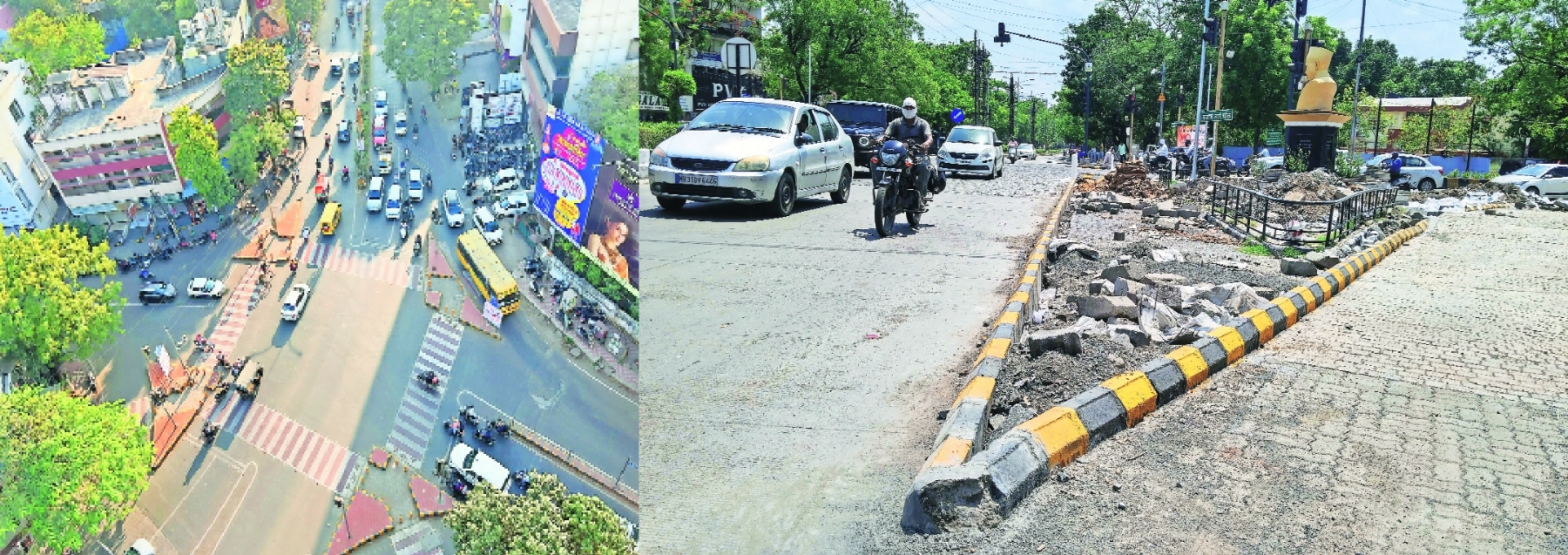
The redesigned traffic islands at Sharaddhanandpeth Square that has improved the traffic flow at the square.
Staff Reporter
In a significant step towards streamlining urban mobility and improving road safety, the Nagpur Municipal Corporation (NMC) has undertaken a city-wide project to redesign and expand traffic islands at 12 major junctions. The project, that is estimated to cost around Rs 1.5 crore, aims to address longstanding concerns about chaotic traffic movement, frequent signal jumping, and unsafe pedestrian crossings at busy city squares.
Until now, smaller traffic islands often left wide gaps on either side, inadvertently encouraging motorists to jump signals or take erratic turns. This not only led to traffic indiscipline but also posed a constant threat to pedestrians attempting to cross roads. The new design, which focuses on maximising safety and efficiency, promises a major shift in how vehicles and pedestrians interact at these critical junctions.
Traffic islandsbeing redesigned at following squares:
- VCA Ground Square
- Agyaram Devi Square
- Dossar Vaishya Square
- Wanjari Nagar Water tank
- Mate Square
- University Liabrary square
- Liberty Square
- Alankar Square
- Laxmi Bhavan Square
- Jadhao Square, Ganespeth
- Ashoka Restaurant, Sadar
- Congress Nagar T-point
“The previous islands were neither efficient for traffic regulation nor friendly to pedestrians,” said Rahul Deshmukh, Deputy Engineer (Civil), NMC. “The new islands are designed with a dual purpose, to curb reckless driving and ensure pedestrian safety, all while maintaining smooth vehicular flow,” he added.
Contrary to popular belief that the redesigned islands will occupy more space and reduce the space on road, Deshpande explained that the new islands are not reducing the carriageway width of the road, just using the excess space that was being used by traffic offenders.
The restructured islands feature extended stop lines and better-aligned turning radii. This reduces the effective crossing distance for vehicles and shortens the time needed to pass through a square. Additionally, the islands are designed to keep one lane open for a free left turn, allowing smoother movement without interrupting other traffic lanes. Importantly, this free left turn is structured to be safe and controlled, minimising abrupt or
high-speed maneuvers.
Pedestrian-friendly elements include refuge areas and clearer demarcation, allowing people to cross in stages rather than all at once. This becomes especially critical during peak hours when traffic is dense and unpredictable.
One of the project’s highlights has been its collaborative approach.
NMC is implementing the redesign in close coordination with city traffic police. Suggestions from Traffic Police Inspectors of each area were incorporated during detailed site visits, ensuring that the changes are grounded in on-the-ground realities rather than being purely theoretical.
The redesigned island at Shraddhanandpeth Square serves as a pilot success story. Initially met with skepticism from local commuters and shopkeepers, the square now
sees more disciplined traffic flow, fewer instances of signal jumping, and safer pedestrian crossings. The improved design has even won over some of its early critics.
As NMC progresses with
modifications at other strategic points in the city, this project marks a thoughtful, data-
driven approach to solving Nagpur’s urban traffic woes.
If results continue on this
trajectory, the redesigned
traffic islands could become a model for other mid-sized Indian cities grappling with similar
challenges.