Train to Kashmir - A dream come true
| Date :05-Jun-2025 |
By Anil Bhatt :
REASI
A TRAIN to the Kashmir valley
through the Shivalik and Pir
Panjalmountainranges ismore
than a century-old ambitious
plan thatis setto turn into reality on Friday when Prime
MinisterNarendraModiflagsoff
aVandeBharattrainfromKatra
to Kashmir.
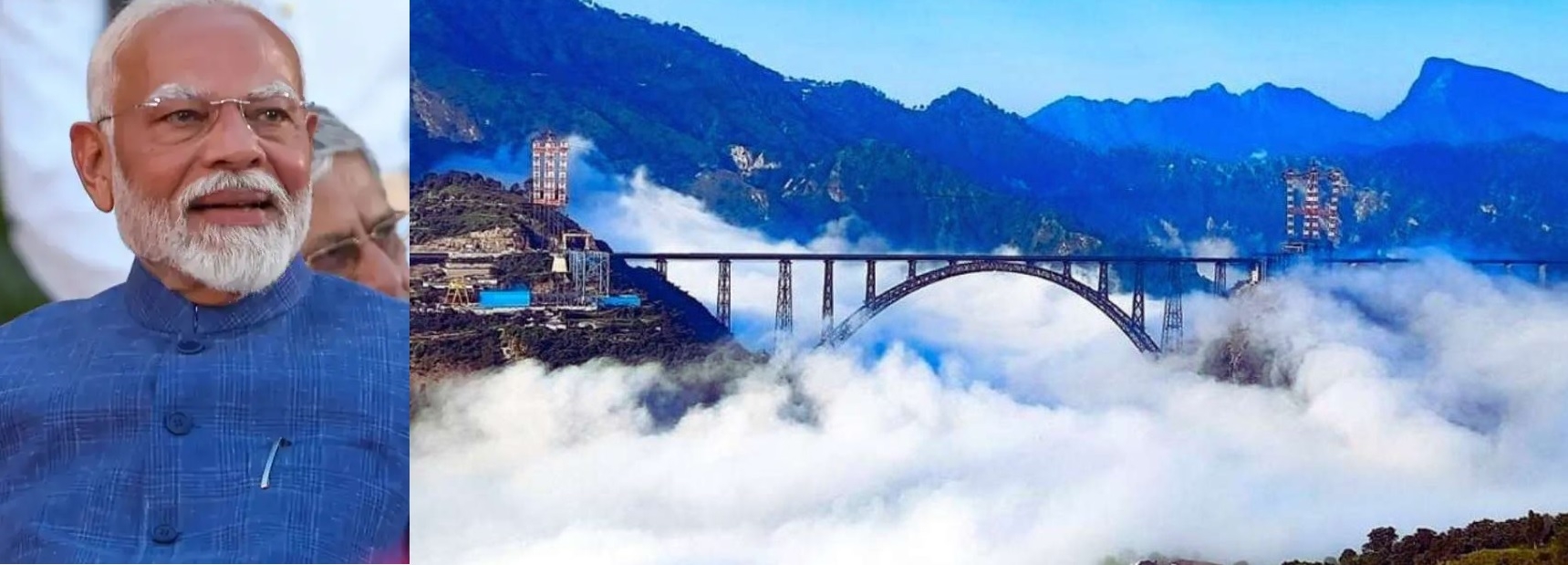
Modiwill alsoinaugurate the
Chenabbridge,whichwillbethe
world’s highest railway arch
bridge.“Whatwasonceavision
proposedinthe19thcenturyby
DogramaharajaPratapSinghis
now transforming into one of
the most significantinfrastructure achievements in independent India’s history,” a senior railway official said.
Vikramaditya Singh, grandsonofMaharajaHariSinghand
son of former Sadr-e-Riyasat
KaranSingh,saidhefeelsproud
thatthe Dogra ruler’s plan conceived over 130 years ago has
finally materialised.
“The railway line project to
the Kashmir Valley was first
envisaged and drawn up duringMaharajaPratapSingh’srule.
It is a matter of great pride not
only forthe people ofJammu &
Kashmirbutfortheentirenation
that this dream will be realised
by our Prime Minister,” Singh,
who has been a legislator in
Jammu and Kashmir, told PTI.
The Dogra ruler had commissioned British engineers to
survey the rugged terrain for a
railway route to Kashmir, an
ambitiousprojectthatremained
unrealised for over a century.
He appointed three British
engineers to prepare and execute detailed reports.However,
two of the three reports prepared in 11 years between 1898
and 1909 were rejected.
According to special documents from the Jammu and
Kashmir archives department,
the idea of a rail link toKashmir
was first proposed on March 1,
1892 by the Maharaja.
Subsequently, in June 1898,
British engineering firm S R
Scott Stratten and Co was
engagedtoconductsurveysand
execute the project.
Thefirstreport, submittedby
D A Adam, recommended an
electricrailwaybetweenJammu
and Kashmirregions, featuring
steamlocomotivesonanarrow
two-feet-six-inch gauge line.
This proposal was rejected due
tothechallengingelevationlevels.
Another proposal, submitted in 1902 by W J Weightman,
suggested a railway line connecting Kashmir from
Abbottabad (now in Pakistan)
alongtheJhelumriver.This,too,
was turned down.
The third proposal, by Wild
Blood,recommendeda railway
alignmentalongtheChenabriver through the Reasi area. This
report was approved.
Later,plansforpoweringelectrictrainsandestablishingpower stations near Udhampur,
Ramsu, and Banihal were also
examinedbutultimatelyrejected.
Following this, British engineer Col D E Bourel was tasked
with submitting a detailed
report on local coal reserves.
Additionally, a report was commissioned fromT D LaTouche,
thethendeputysuperintendent
oftheGeologicalSurveyofIndia,
on the Sangarmarg and
Mehowgala coal mines.
In December 1923, S R Scott
StrattenandCowas re-engaged
to implement the coal extractionproject.However,thedeath
ofMaharajaPratapSinghin1925
and the growing Indian independence movementled to the
project being shelved permanently, the documents said.
The idea was revived nearly
sixdecades later,whenthethen
Prime Minister Indira Gandhi
laid the foundation stone for
the Jammu-UdhampurSrinagarrailway line in1983.At
the time, the project was estimated to cost Rs 50 crore and
was expected to be completed
in five years, officials said.
However, in 13 years, only 11
km of the line could be constructed, which comprised 19
tunnelsand11bridges-atacost
of Rs 300 crore, they said.
It was followed by the broaderUdhampur-Katra-Baramulla
railwayproject, estimatedatRs
2,500 crore,whichsawits foundation stones laid by Prime
MinistersHDDeveGowda and
I K Gujral in 1996 and 1997 at
Udhampur, Qazigund, and
Baramulla.
Construction began in 1997
but faced repeated delays due
to challenging geological, topographical, and weather conditions, significantly inflating
the cost to over Rs 43,800 crore
as of now. Recognising the
strategic importance of the
Udhampur-Srinagar-Baramulla
Railway Line (USBRL), it was
declared a national project in
2002, the officials said.