Reducing wastage must to conserve water: Vishwanath
| Date :07-Jun-2025 |
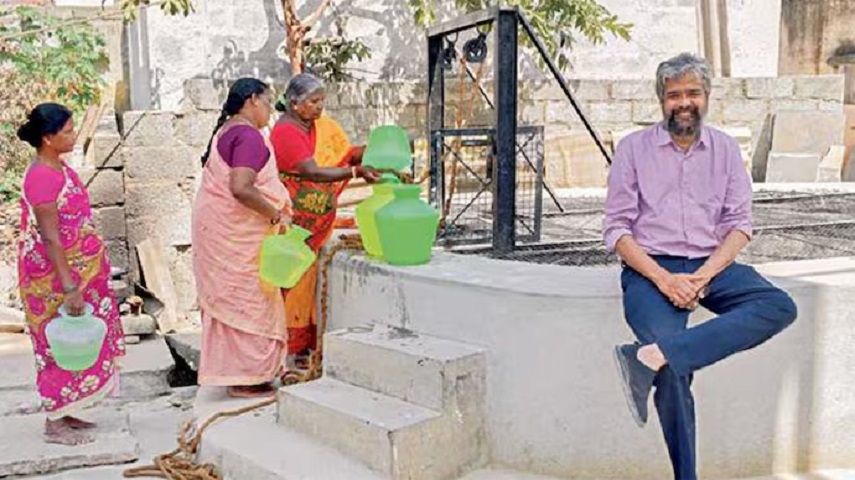
A leading urban planner, S Vishwanath was in city to create awareness on water conservation and minimise waste
By Sagar Mohod :
“Community ownership of resources ensures people's effective participation in any conservation drive. Currently, India is juxtaposed between growing economy and need to feed the over 1 billion populace, along side balancing environment concerns,” said S Vishwanath, Civil Engineer and Urban Planner. On a mission to emphasise the need to conserve water and minimise waste, he was in the city to deliver a talk organised by The Indian Institute of Architects.
Having spent his childhood days in Nagpur, Vishwanath is currently settled in tech capital of the country, Bengaluru.
Today, he is identified as one
of the leading players in managing the mismanaged urban
landscape.
Asked about current scenario during a talk with The Hitavada on Friday, Vishwanath said, “India is steadily moving in the right direction on the front of water conservation.
The battle will be half won unless the society as a
whole does not embrace the idea of doing it self, at least stopping the criminal wastage as it alone can make a large difference. One needs to embrace the concept that we have to return that much amount water back to environment that they have used. Hence, everyone will realise their duty to use only the required amount of water and simply because it is available cheap, one should not indulge it criminal waste of the precious natural resource.” Elaborating further, Vishwanath, pointed out, “Even prosperous western countries track record on the environment front was also poor. What we see today is after the planners’ focus shifted on conservation. In India also, the Atal Jal Bhujal Yojana and Amrut Yojana have changed the ground scenario. Most importantly community participation is bringing about the change.”
Sharing success stories, particularly of the community that was engaged in digging wells, he said, “While focus on water conservation remains in public domain, much light needs to be shed on pollution abatement as he shared successful example of Bengaluru where citizens involvement is getting the result. Every lake has its own group of environmentalists working with public representatives.
They have ensured
that 86 lakes are conserved and protected. Stress needs to be given on reusing the sewage water after through treatment as it automatically ensures conservation. Similarly, Government needs to concentrate on decentralised models, as one project fits all does not work.”
“The Indian Institute of Architects has formed a panel to study hydro geological aspects and prepare a document on how to approach the subject at planning level. Currently, the focus is more in hydrological aspects that hydro geological, one that pertains to recharging the aquifers, which is what needed in India today,” informed Vishwanath.