Turningwaste intofashion
09 Jun 2025 11:19:17
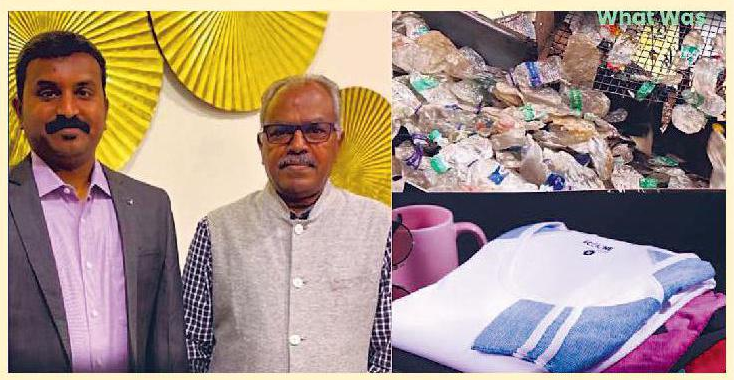
Did you know it takes 30 PET bottles to make a chic blazer? K
Sankar, and his son, Senthil, are helping recycle over 15 lakh PET
bottles and turning them into fashionable clothes.
I
NDIA generates 9.3 million
tonnes (Mt) of plastic waste
annually,accordingtoa2024
study published in the journal
Nature. That is equivalent to
7.75lakhtonnesofplasticwaste
generated daily. To tackle this,
our country has taken several
steps to incentivise and promote awareness about recycling. Several individuals and
organisationsaretakingthisforward by giving discarded plastic a new life.
KSankar,andhisson,Senthil,
for example, are recycling over
15 lakh bottles daily through
their Tamil Nadu-based company, ‘Shree Renga Polymers’,
while pioneering a creative
approach to sustainable fashion through their clothing
brand, ‘EcoLine’.
How do they do it?
To turn plastic waste into
fashionableclothing,thefatherson duo follow a process that
can be broadly divided into five
steps.
Collection and sorting: PET
bottles are collected through a
network of 50,000 ragpickers
across states, including Tamil
Nadu, Andhra Pradesh,
Karnataka, Kerala, and
Puducherry. The bottles are
carefully sorted, and any caps,
wrappers, or contaminants are
removed.
Crushing and flaking: Once
cleaned, the PET bottles are
crushed into small flakes, typically three to eight millimetres
in size. This step reduces the
material to a manageable form
thatcaneasilybeprocessedinto
new products.
Melting and spinning: The
PET flakes are melted at 300°C
using an extruder. The molten
material is then stretched to
form polyester fibre, which is
cooled and transformed into
yarn.
Weaving the fabric:The yarn
is then woven into fabric, formingthefoundationfortheclothing line. This fabric is then tailoredintoproductssuchasjackets, T-shirts, and blazers.
Waterless dyeing:One of the
keyinnovationsatEcoLineisthe
use of dope dye technology.
Insteadofdyeingthefabricafter
it’smade - a traditional process
thatconsumesvastamountsof
water - EcoLine infuses the
colour directly into the polyester fibre during its production.
This unique process eliminates the need for water in
dyeing, making it both sustainable and energy-efficient.
The final products are then
designed, sewn, and ready for
sale.IttakesabouteightPETbottles to make a T-shirt, 20 bottlesforajacket,and30forablazer, Senthil explains. These
clothes are not just sustainable - they are stylish and practical
too,withpricesrangingfromRs
500 to Rs 6,000.
EcoLine’s innovative work
gained significant recognition
in February 2023, when Prime
Minister Narendra Modi wore
one of their blue sadri jackets
in Parliament. Made from 25
recycled PET bottles, the jacket also accompanied the Prime
Minister on his visits to Japan
and Australia.
With an annualrevenue of Rs
12 crore and a steady customer
base across Karnataka, Tamil
Nadu, Maharashtra, Andhra
Pradesh, and Uttar Pradesh,
EcoLine is proving that sustainable fashion can be both
profitable and impactful.