AI plane crashed due to fuelcut off: Preliminary report
13 Jul 2025 11:23:38
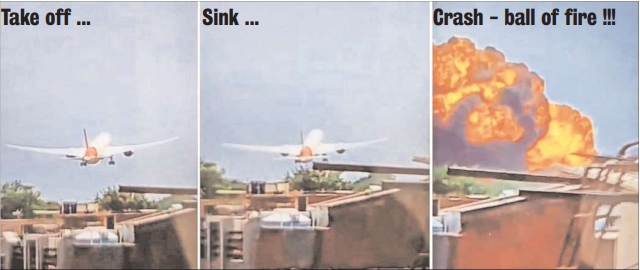
NEW DELHI :
A PRELIMINARY report has
found that the fuel supply to
both engines of Air India flight
AI171 was cut off within a second of each other, causing confusion in the cockpit and the
airplane plummeting back to
ground almost immediately
after taking off.
The 15-page report says that
in the cockpit voice recording,
one unidentified pilot asked
the other why he had cut off
the fuel, which the other denied.
On June 12, the Londonbound Boeing 787 Dreamliner
began to lose thrust almost
immediately after taking off
from the Ahmedabad airport
and ploughed into a medical
college hostel, killing all but
one of the 242 onboard and
another 19 on ground in the
deadliest aviation accident in
a decade.
According to a chronology
laid out in the report by Aircraft
Accident Investigation Bureau,
both fuel control switches -
which are used to turn the
engines off - were moved to the
cutoff position almost immediately after takeoff.
The report however did not
say how this happened or who
did it.
Soon after both fuel cutoff
switches moved from RUN to
CUTOFF, one second apart, a
RAT pump was deployed to supply hydraulic power as both
engines fell below minimum
idle rate.
About 10 seconds later, Engine
1 fuel cutoff switch
moved to its socalled RUN position, followed by
Engine 2 four seconds later.
The
pilots managed to relight both
engines, but only Engine 1
recovers while Engine 2 failed
to build up enough power again
to reverse deceleration.
One of the pilots issued a
“Mayday, Mayday, Mayday” distress call but
before air traffic
controllers could
get a response
about what had
gone wrong, the
plane crashed just outside the
Ahmedabad airport boundary
having grazed some trees before
plunging into a hostel packed
with students.
At the time the aircraft took
off, the co-pilot was flying the
plane, while the captain was
monitoring. The time between
the takeoff and the crash was
only about 30 seconds.
The preliminary report by
AAIB released on Saturday, recommended no action for now
for the operators of Boeing 787-
8 planes.
“The aircraft achieved the
maximum recorded airspeed of 180 Knots IAS at about
08:08:42 UTC (13.38 IST) and
immediately thereafter, the
Engine1 andEngine2 fuelcutoff switches transitionedfrom
RUN to CUTOFF position one
after another with a time gap
of 01 sec,” the report said.
As per thereport, the engine
N1 and N2 began to decrease
from their take-offvaluesas the
fuel supply to the engines was
cut off. “In the cockpit voice
recording, one of the pilots is
heard asking theotherwhydid
he cutoff.
The other pilot
responded that he did not do
so,” it said. Almost immediately after the plane lifted off
the ground, CCTV footage
shows a backup energy source
calledramairturbine(RAT)had
deployed, indicating a loss of
power from the engines.
The report provided only a
limited picture of the interaction between the two pilots in
the flight deck and also did not
say how the switches could
have flipped to thecutoffposition during the flight.
Normally, flipping to cutoff,
whichalmostimmediatelycuts
fuel supply, is often used to
turn engines off once a plane
has arrived at its airport gate
and in certain emergency situations, such as an engine fire.
The report did not indicate
there was any emergency
requiring an engine cutoff.
The report said both fuel
switcheswerefoundin therun
position at the crash site and
that there had been indications of both engines relighting before the low-altitude
crash.Ina statement,AirIndia
said that it “stands in solidarity with the families and those
affected” and “[continues] to
mourn the loss” of those killed
in the accident.
Air India said it was “working closely with stakeholders,
includingregulators”and“continue to fully cooperate with
theAAIB andother authorities
as their investigation progresses.” On its part, Boeing
said: “Our thoughts remain
with the loved ones of the passengers and crew on board Air
India Flight 171, as well as
everyone affected on the
ground in Ahmedabad. We
continue to support theinvestigation and our customers.”
The US National
Transportation Safety Board
noted that there were no recommended actions in the
report aimed at operators of
Boeing 787 jets or the GE
engines.Theill-fated flightwas
commanded by Sumeet
Sabharwal, 56, a veteran with
30 years of experience at Air
India. He had logged 15,638
flyinghours,including8,596on
theBoeing 787.Hewas also an
Air India instructor. His copilotwasCliveKunder, 32,who
had 3,403 hours of total experience, with 1,128 on the
Dreamliner.
Kunder was the pilot flying,
while Sabharwal was the pilot
monitoring.
The crew had passed preflight breathalyser tests and
were seen at the gate onCCTV
before they took off, the report
adds.TheJune 12 accidentwas
India’s worst aviation disaster
inalmost threedecadesand the
industry’sdeadliestin11years,
as well as the first fatal involving a Boeing Dreamliner.
The investigation was conducted with assistance from
the UK’s Air Accident
Investigation Branch and the
US National Transportation
Safety Board.
Aviation experts have said it
is difficult for pilots to inadvertentlymovethe fuelswitches as there is a little mechanical gate built into the switch.
Switches need to be lifted up
over this little gate to shut off
supply.Theyalsoaskedwhy the
report made no reference to
cockpit camera footage.
The AAIB report cited a FAA
airworthiness bulletin from
2018 on the “potential disengagementof fuelcontrolswitch
locking feature” on Boeing
planes including the 737 and
787. The Air India jet was not
inspected for the locking
mechanism fault asitwasnever mandatory and that there
has been no defect reported
pertaining to the fuel control
switch since 2023, it said.
It said the aircraft took off at
08:08:39 UTC (13:38:39 IST)
and at about 08:09:05 UTC
(13:39:05 IST) one of the pilots
transmitted ‘MAYDAY MAYDAY MAYDAY’.
“The ATCO (Air Traffic
Controller) enquiredabout the
call sign.ATCO did not get any
responsebut observed the aircraft crashing outside the airport boundary and activated
the emergency response,” the
report said.Inthereport,AAIB
also said fuel samples taken
from bowsers and tanks used
to refuel the aircraft were tested at the DGCA (Directorate
General of Civil Aviation) Lab
and were found satisfactory