Monsoon Malady Choked weep holes and water seepage on Wardha Road flyover
| Date :16-Jul-2025 |
By Simran Shrivastava :
While heavy rain poured over the city on Tuesday, the weep holes located beneath the bridge deck remained inexplicably dry, no signs of water discharge during active rainfall
“Everyone wants to build flyovers, no one wants to maintain them,” a commuter laments, as clogged weep holes and water-damaged walls mark another monsoon under the double decker flyover on Wardha Road.
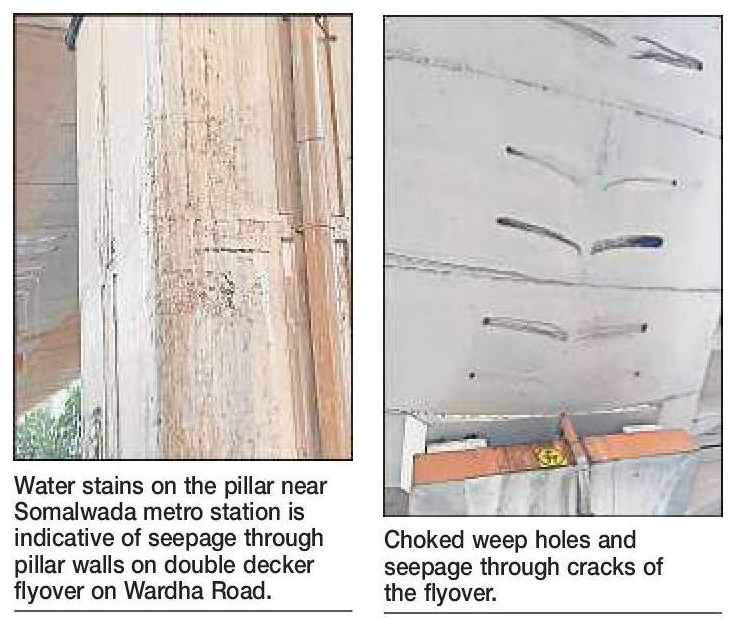
As monsoon clouds gather over the city, the streets below the flyover, near the Somalwada Metro Station area, presents an all-too-familiar scene: water-streaked pillars, stained concrete, and most worrying, long visible cracks. A closer look reveals a quieter danger, structural drainage systems, known as weep holes, designed to keep these mammoth concrete structures healthy, are failing to do their job.
While heavy rain poured over the city on Tuesday, the weep holes located beneath the bridge deck remained inexplicably dry, no signs of water discharge during active rainfall. Instead, rainwater was seen streaking down along the sides of pillars, leaving behind thick trails of dirt, grime, and potentially, structural deterioration. And on the viaduct the all to familiar site, vehicles splashing through water clogged stretch. Such was the stagnant water on upper deck, whenever a vehicle sped by it would splash water onto the adjoining deck.
Civil engineers explain that weep holes serve a critical purpose in bridge and flyover design.
They are small outlets deliberately placed in the concrete structure to allow water, whether from rainfall, condensation, or deck spill over, to drain out of internal cavities. These outlets prevent water stagnation inside the concrete slab, reducing hydrostatic pressure and protecting the internal steel reinforcement from rusting. Functioning weep holes directly contribute to the longevity and safety of a flyover. But when outlets get clogged by debris, silt, or poor maintenance, water begins accumulating inside the structure.
Below the flyover, the visible black stains between the blocked weep holes point towards water finding alternate, unintended escape routes, a clear sign of internal seepage. Worse, the presence of horizontal and vertical cracks between these weep holes, observed during inspection, indicates the possibility of internal water pressure exerting force on the concrete’s outer layer.
Engineers classify hairline cracks as relatively normal in ageing concrete, especially in large structures.
However, long, stained cracks, like the ones seen on this flyover, raise serious concerns. These cracks aren’t just shrinkage cracks. They are accompanied by water stains, which suggest leakage from within the structure.
The stains along the flyover’s pillars, also point to prolonged exposure to water drainage problems, suggesting this issue isn’t recent. If left unchecked, these cracks could widen, eventually leading to concrete spalling, where chunks of concrete break off, exposing rusted reinforcement rods underneath.
Every year, municipal corporation and development authorities claim to undertake pre-monsoon maintenance drives, including cleaning of weep holes and drainage outlets on bridges and flyovers. Yet, the current condition of the flyover suggests otherwise.
“Everyone wants to inaugurate new flyovers, but no one wants to spend on their upkeep. Cracks are visible early signs of internal distress, and ignoring them is like ignoring a patient’s first symptoms,” a commuter expressed worryingly. Locals near the site confirmed that water-logging on the flyover deck is a common occurrence, from random cracks and joints in the structure.