Book reveals Israeli Minister’s covert 1977 talks with Desai, Vajpayee
| Date :20-Jul-2025 |
NEW DELHI :
THEN Israeli Foreign Minister Moshe Dayan came to India in 1977 on a clandestine visit, in disguise and under a false name, to meet Prime Minister Morarji Desai and his counterpart Atal Behari Vajpayee in a failed attempt to establish diplomatic ties between the two countries, says a new book.
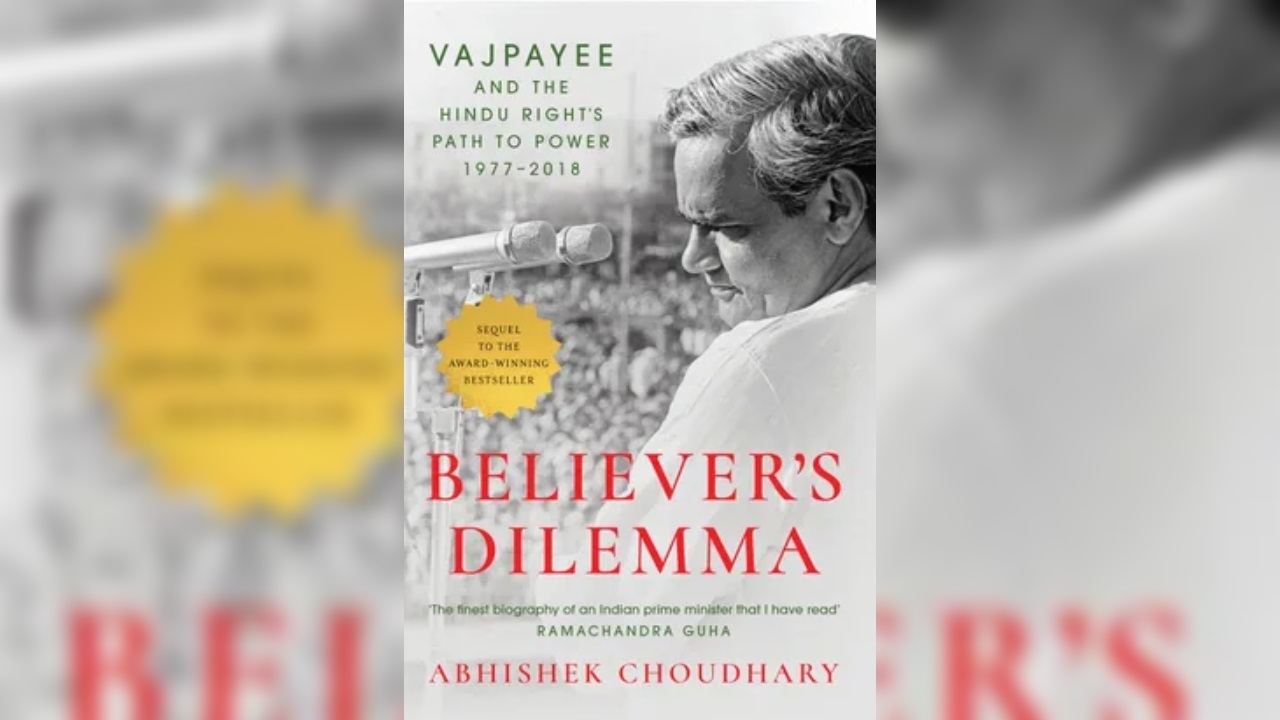
The Israeli Minister failed in his mission and left empty-handed. Visibly annoyed by the outcome, Dayan declined the parting gift of antique Indian silverware offered by his hosts, Abhishek Choudhary writes in “Believer’s Dilemma: Vajpayee and the Hindu Right’s Path to Power”.
He flew out “mocking India’s poverty, cursing its rulers’ moral cowardice”, says the book that uncovers a little-known episode in India-Israel ties.
The “awkward meeting”, the author notes, was a sign that for all its ambitions, the Janata Government did not have the mandate or confidence to revamp India’s foreign
policy.
Dayan’s covert visit to India was “top secret” as Desai feared it would lead to the collapse of the Janata Government if made public.
The meeting, held at a “poorly furnished Government house” in New Delhi, was so discreet that Vajpayee got to know of it only after Dayan landed.
Even foreign secretary Jagat Mehta wasn’t told anything.
“On the afternoon of 14 August, Israeli foreign minister, Moshe Dayan, alighted in New Delhi. He was travelling under a fake name and had disguised himself with dark glasses and a large straw hat. He was put up at a private residence in south Delhi’s Safdarjung Enclave,” reads the book, a sequel to Chaudhary’s award-winning bestseller “Vajpayee: The Ascent of the Hindu Right”.
The purpose of his visit: “to advance talks on establishing diplomatic relations between India and Israel”.
India recognised Israel in 1950 but established full diplomatic relations with the country on January 29, 1992.
“As a founding member of the Non-Aligned Movement, India had some clout among the non-aligned nations. At the very least, Dayan was hoping to receive India’s backing for the Israel-Egypt peace plans in the NAM, neutralizing India’s longstanding support to the Arabs,” the book adds.
“At India’s request, the meeting was kept top secret. No other cabinet minister, not even Foreign Secretary Mehta, got a whiff of it. Morarji Desai thought that if the news of Dayan’s visit became public, the Janata Government would collapse,” it claims.
Janata Party, a political alliance formed in 1977 by various opposition groups, came into power in 1977 defeating Indira Gandhi’s Congress after the Emergency period. Desai, who became the first non-Congress Prime Minister of India, remained in the office for 856 days -- serving till 1979.
Vajpayee, despite his long standing support for formal ties with Israel, appeared visibly uneasy during the meeting with Dayan.
According to Desai -- who shared the episode months later with Indian diplomat I.K. Gujral, then India’s ambassador to the USSR -- Vajpayee was “terrified” about the implications of the encounter and was told “not to worry”.
Desai, however, remained steadfast in rejecting Dayan’s overtures.
While acknowledging that India had recognised Israel in 1950, Desai made it clear that full diplomatic relations could only be considered “only after peace came to the region”.
He reiterated India’s longstanding support for a Palestinian state and resisted even minimal gestures, such as opening an Israeli consulate in Delhi.
“Both Vajpayee and Desai argued that such a step would be misinterpreted, leading to ‘unnecessary complications in diplomatic relations with West Asia’... He (Desai) suggested Dayan meet Vajpayee during the conferences in the US and Europe but refused to risk sending his foreign minister, formally or secretly, to his country,” the book recounts.
Following the establishment of diplomatic relations in 1992, an embassy opened in New Delhi, and the consulate in Mumbai -- operational since 1953 -- became a Consulate-General.
“Believer’s Dilemma”, priced at Rs 999, is described by publishing house PanMacmillan India as a political history of contemporary India covering the crucial period between 1978–2018 -- “a transformative 40-year span that saw the Hindu Right move from the fringes into the corridors of power”.
Book reveals ‘Chenab Formula’ for J&K before Kargil war and other secrets
NEW DELHI,
July 19 (PTI)
WEEKS before the Kargil war erupted between India and Pakistan in 1999, the Atal Behari Vajpayee and Nawaz Sharif governments discussed through back-channel talks a communal division of Jammu & Kashmir along the Chenab river -- the “Chenab Formula” -- as one of the solutions to the Kashmir issue, a new book
has revealed. According to Abhishek Choudhary’s biography “Believer’s Dilemma: Vajpayee and the Hindu Right’s Path to Power”, a series of secret back-channel talks were held between retired Pakistani diplomat and former High Commissioner to India Niaz Naik and Indian interlocutor R K Mishra at a Delhi hotel following Vajpayee’s historic 1999 visit to Pakistan and the Lahore Declaration.
“In the last week of March 1999, Sharif’s emissary Niaz Naik... Secretly checked into a Delhi hotel to pick up the threads with R. K. Mishra. Over the next five days, they discussed their impossible brief on Kashmir: a solution that was not just fair to all three concerned parties (one of them being the Kashmiris) but also practical to implement,” reads the book, which is the sequel to Choudhary’s award-winning bestseller “Vajpayee: The Ascent of the Hindu Right”. With Vajpayee encouraging the duo “to innovate”, Mishra and Naik, after several rounds of trial and error, arrived at an “identifiable geographical boundary” as a border to partition J&K between the two countries -- the “Chenab Formula”.
“(The formula) suggested by Naik, proposed giving areas to the west of the river, all Muslim-majority districts, to Pakistan; the ones to the east, all Hindu-majority, were to be retained by India,” it adds.
The discarded options included: “the LoC as the international border (rejected by Naik), autonomy for Kashmir (rejected by Naik), independence for Kashmir (rejected by Mishra), and a region-wise plebiscite (rejected by Mishra)”.
According to the book, before returning to Islamabad on April 1, Naik met Vajpayee, who sent a discreet message for Nawaz Sharif: “halt infiltration and cross-border shelling during the summer months”.
But that was not to be the case, and even as the secret diplomacy progressed, trouble was brewing. By early May, Indian intelligence and patrol units reported increased aggression along the Line of Control.
Later, alarmed by the situation, Vajpayee dispatched Mishra to Islamabad with a pointed message.
“On 17 May, an agitated R. K. Mishra alighted in Islamabad carrying Vajpayee’s deep hurt. He asked Sharif, point-blank, whether he had known about Kargil while signing the ‘Lahore Declaration’,” the book claims.
The ‘Lahore Declaration’, signed on February 21, 1999, by Vajpayee and Sharif, was a peace agreement between India and Pakistan aimed at improving relations and reducing the risk of nuclear conflict.
Ironically, it was May 17 -- the very day when Vajpayee’s emissary questioned Sharif on Kargil -- when the Pakistani premier received his “first briefing” on the Kargil operation.
“It was a selective briefing by the Kargil clique, presented without detailed maps, aimed to cajole Sharif into providing the Government’s cover for the army’s private crusade,” the book adds.
While Pakistan’s Foreign Minister Sartaj Aziz and other officials were reportedly stunned, Sharif, who was swayed by “flattery” and “selective intelligence”, dismissed their concerns, remarking, “Sartaj Aziz sahib, can we ever take Kashmir through paperwork?”
“With a tactical advantage from the strategic heights in Kargil, he (Sharif) advised the army to ‘take Allah’s name and keep this Operation going, this issue cannot be resolved through buses’,” it claims.
The Kargil War, also known as ‘Operation Vijay’, began in May 1999 and concluded in July with the Indian Army successfully pushing back Pakistani infiltrators from key positions.
On July 26, India declared victory after nearly three months of intense fighting in the icy heights of Ladakh’s Kargil region.
“Believer’s Dilemma”, priced at Rs 999, is described by publishing house PanMacmillan India as a political history of contemporary India covering the crucial period between 1978–2018 -- “a transformative 40-year span that saw the Hindu Right move from the fringes into the corridors of power”.