Ride your luck on city roads Mishaps rise on Ambazari Road as gap on road surface, paver blocks pose risk
| Date :25-Jul-2025 |
By Simran Shrivastava :
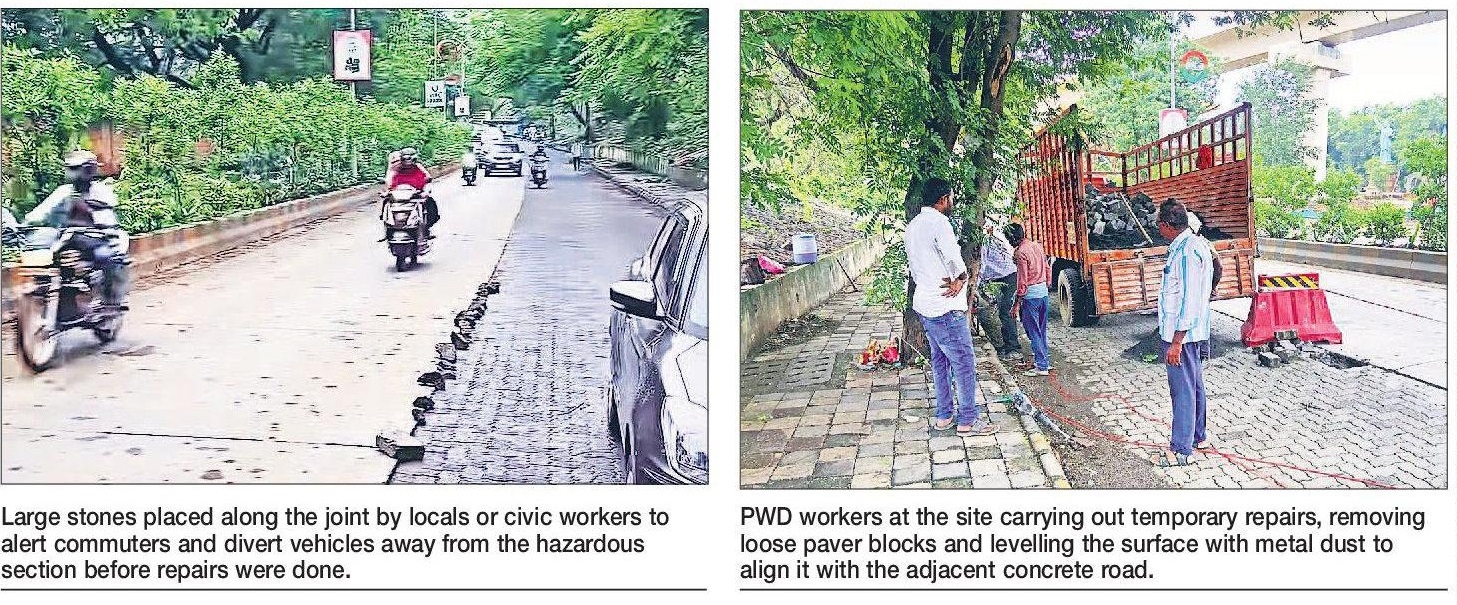
A busy stretch on Ambazari Road had turned into an accident zone earlier this week, after a misaligned and damaged joint between a concrete road and paver blocks caused multiple two-wheeler accidents. Locals, in a desperate bid to avert further incidents, placed large stones along the joint to warn other commuters. The Nagpur Municipal Corporation’s Public Works Department (PWD) has since acted promptly and carried out temporary repairs, but concerns remain about the long-term stability of the patch, especially during monsoon.
The issue stemmed from the uneven junction where a concrete road transitions into interlocking bricks. Continuous rain had worsened a shallow trench that got developed at the joint, leading to tyre slips, sudden jerks, and loss of balance, particularly for two-wheeler riders.
The paver block side had sunk lower than the cemented surface, creating a sharp dip that many commuters failed to spot in time.
A regular rider, Jaydeep Das, highlighted the danger. “There was a visible height difference, and anyone who went near the gap slipped. It was risky, so people started placing big stones there to make others aware.” The stones, placed by residents, forced vehicles to stick to one surface, effectively steering them away from the cracked portion.
The PWD team responded quickly after receiving complaints.
Workers removed the sunken paver blocks, added metallic dust to level the surface, and reinstalled the blocks to align them with the adjacent cemented section. As of now, the surface has been restored, and vehicles are passing without any incident. However, this isn’t the first
time repairs were carried out at the same spot. A PWD supervisor at the site admitted to this being a recurring problem. “We first level the surface with metal dust, then place fresh paver blocks. But due to water seepage from the Ambazari lake, the surface keeps sinking, so we’ve had to repair this same patch two or three times already.”
While this recent repair brings immediate relief, a permanent fix would require resolving the underlying drainage and design issues. Although the road currently looks repaired, commuters who experienced close calls are still cautious. It had rained. My front tyre almost dipped into the trench, and I lost balance. Thankfully I was slow and managed to hold on,” recalled one woman rider.
Another daily commuter said, “They’ve fixed it for now, but during monsoon, it might sink again. Unless the water seepage problem is tackled, this will keep happening.”
According to road safety experts, mixed-surface roads, where cement meets paver blocks, are particularly vulnerable during monsoon unless there is a robust design plan for drainage and flexibility. Without this, joints become weak points, and repeated traffic pressure, combined with water seepage, can cause soil displacement and structural weakening.
Residents also pointed out the lack of signage, reflectors, or lighting around the hazard before it was repaired. “If locals hadn’t put those stones, more people would’ve get hurt. The civic body should have at least put warning signs,” said another commuter.
For now, the trench has been patched and traffic has resumed smoothly. But the underlying causes, poor drainage, weak joint structure, and lack of preventive maintenance, remain unaddressed. If long-term measures aren’t taken soon, the joint could once again sink with the next heavy spell of rain, putting lives at risk, all over again.