Worth our salt!
30 Jul 2025 11:11:52
By Biraj Dixit :
How much is too much?
Big question, isn’t it? Who can describe ‘much’ in universal terms, leave alone ‘too’?
Well, actually WHO can and has.
The World Health Organisation, I mean. It has described as too much…the salt that we Indians eat. “You are in such a pickle,” it has told us Indians. It could have said, “You are in a soup.” No way! The soup is no match for a pickle when it comes to ‘too much’ salt.
So, the thing is, as you already know, we Indians are eating way too much salt. Just like way too much sugar of which we have been warned earlier; way too much oil, which we know in our hearts of hearts that we do; way too much of almost everything. The WHO says, we are adding unnecessary kilos to our weight, fat to our bellies, pressure to our blood and obstructions to our life’s longevity.

A matter of very serious concern…and all because of those pinches of salt that your undecided hand kept on adding.
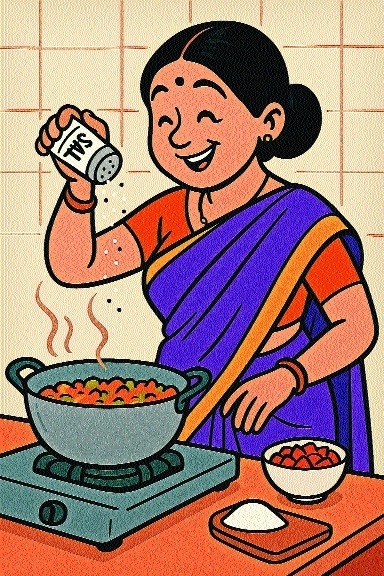
As per WHO recommendation, your salt intake should not exceed 5 grams a day. And the little sprinkle that you make upon your dishes doesn’t seem more than that, does it? Ohhh! Yesss…! WHO says it’s way too much. It is around 12 grams a day. An average Indian consumes 7 grams more salt than the permissible limit. Oops, the gentle sprinkle is not so gentle after all!
Salt, in India, is not just a condiment. It is philosophy of life. We have great reverence for it. Our mothers told us to be like salt – not loud enough to be noticed, but your absence should be acutely missed. Salt, was used as a weapon by our Father of the Nation to bring the British Raj face-to-face with its own cruelty.
“I regard this tax (on salt) to be the most iniquitous of all from the poor man’s standpoint,” Mahatma Gandhi had written to Viceroy Lord Irwin before starting his famous ‘Salt Satyagraha’. Now, its presence in our blood has reached levels iniquitous! For too long, salt has been associated with loyalty – If you are not ‘namak-halal’…then you are…?. It has been included in the national pastime…as in ‘Jale pe…???’
In my particular case, I think the increase is due to my following the age-old wisdom of taking things with a pinch of salt. There were too many things that ought to have been taken with a pinch of salt. Right from promises of your leaders and assurances of your loved ones (including hubby dear), to the inputs of social gossips and presently the MET Department’s predictions, I take everything with a pinch of salt. Given its history, even WHO recommendations are taken, if I may dare say, with a pinch of salt. Perhaps that explains the extra 7 grams of salt.
The WHO has warned of a surge in cases of high blood pressure. And I attributed mine to the many pressures that the world exerts on a poor woman. Never knew it was within me!
The problem with WHO recommendation is that it takes into account only the food on one's plate. The Indian plate, apart from the food, is a platter full of culture and tradition. There are niceties to be taken care of. Soon after our marriage, I remember warning my husband to eat just half of his full meal, when invited by a relative's place for lunch. Why? Asked my dear husband – a Maharashtrian man married into a Gujarati household. “The rest they will force-feed you,” I said. (Force-feed, by the way, in Indian parleys vis-à-vis a son-in-law, is a request-until-complied.) “After all, you are the quintessential, most reverential son-in-law. Traditionally, you are to be served and how!” (The gentleman still finds his exalted position too overbearing at times.)
Then, there are spiritual issues. Like in most parts of India, Gujaratis also have a ‘vrat’, where young girls are made to give up on salt for 5 days so as to….find a good husband! Given the difficulty in finding the rarest of the rare, such a harsh penance is a must. Whether the Lord said ‘Tathastu’ or not after it, is a story for another day but it did help in shedding a few ‘Kilos’.
There are other cultural issues too. For example, WHO would look at a ‘samosa’ – with the prism of just calories - White flour, potato, oil, deep fried!!!! But from an Indian perspective it is ‘Saujanya,’ ‘aadar’, ‘aatithya’ aka courtesy, respect and hospitality. It is the high flavour of life. So much that it has even inspired some literary sloganeering – ‘Jab tak rahega Samose may aloo…’ (Till the time Samosas will have potatos…) This, in reference to eternity.
My office, which represents most offices in India, has a tradition of celebrations. We call it ‘Bulao.’ Nothing innovative about the name as it just means what it says - ‘Call.’ It’s just a call for celebration where we call – among other not-so-healthy things – ‘Samosas’.
Like most of India, we too savour it. Now, imagine if I, scared by the health alarms, call carrots and cucumbers for the celebrations, they might throw me out of office. But if they forgive this anomaly and gobble the carrots and cucumbers, they are most likely to do so with a pinch of salt, quite literally.
I may be very wrong in holding this generally acknowledged and absolutely lived-by belief that healthy food often bestows upon you only health. For the rest of so many delicate matters, one often takes recourse to not-so-healthy delicacies.
The Brits, given their food choices, may have felt that ‘dangling a carrot’ does the trick. But to an Indian, you cannot dangle a carrot when you want to achieve the goal for which that phrase is meant.
It would take you nowhere. Carrots are for rabbits. For the curry-loving Indians, it has to be something truly spicy. And when it comes to spice, Indian delicacies are hardly delicate. They ought to be properly peppered with a good amount of spices and of course salt. These days it can also be a bottle of… along with the unhealthiest assortments to absolutely…and kind of literally – kill it.
Why, even the master chefs on YouTube videos and TV programmes, while going at length describing the amount of the ingredients used in a particular dish leave salt untouched. “….and salt as per taste,” they say. Whose taste, you may ask. Not WHO’s for sure.
John Piper’s words best describe the Indian predicament – “People don’t enjoy salt, they enjoy what is salted. We are the salt of earth, we do not exist for ourselves.”
The WHO, on the contrary, is of the opinion that the too-peppered Indian cuisine needs a bit of tempering if the Indian nation is to stay healthy. It wants the Indian cuisine to be worth its salt. They say, the cure of all ailments is salt water -- sweat, tears or sea. It’s time to eat less and sweat more. Tears will flow when you stop your hand from that generous sprinkle but when health is the concern, no point being at sea.
n