Gilgit-Baltistan rises against Pak’s land grabs
| Date :06-Jul-2025 |
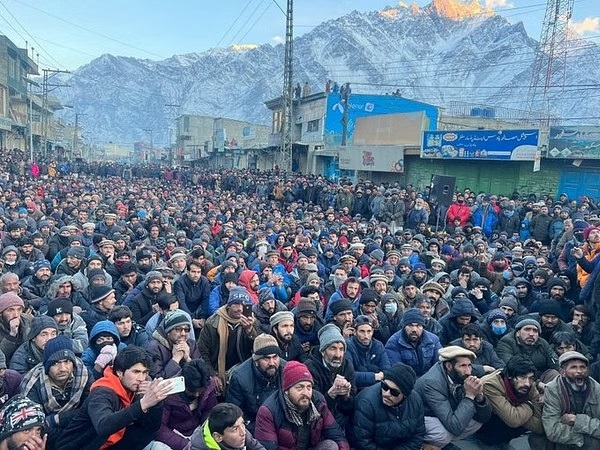
People in Gilgit-Baltistan region protest the controversial Land Reforms Act 2025 passed by the GB Assembly on May 21.
NEW DELHI :
For over a month, the region has been on the boil with civil unrest over Land Reforms Act 2025. People stand not just against the law, but also against decades of dispossession, neglect, occupation.
PAKISTAN may have entered a fragile ceasefire with India in May, but its problems are far from over. For over a month, the Gilgit-Baltistan (GB) region, part of the Pakistan-occupied Kashmir (PoK), has been on the boil with civil unrest and acute clashes between the people and the State. Predictably, much like the hostilities with India that ensued after the blood-curdling Pahalgam terrorist attack of April, this crisis too is of Pakistan’s own making.
The escalating protests in Gilgit-Baltistan are a response to the controversial Land Reforms Act 2025, passed by the GB Assembly on May 21 amid an Opposition walkout and civil society resistance.
As the mountains of GB echo with cries of resistance, the people stand not just against a law, but decades of dispossession, neglect, and occupation.
The Act, hailed by the Government as a landmark in regional land governance and justice, claims to dismantle the Nautore Rules 1978, which classified all land as either held in individual ownership or by the Khalsa Sarkar, that is, State land. Therefore, on the surface, the Act promises to transfer the land back to the people by declaring them as the common owners of all wastelands, forests, pastures, mountains, rivers, glaciers, and so on, in tune with indigenous customs and ancestral territories.
However, the rhetoric conceals a sophisticated mechanism that empowers the State, via bureaucracy,
to decide on land distribution and potentially, as is being stressed by the people, enable land grabs, resource exploitation, and increased military-federal control.
For context, the Act has introduced the tripartite classification of ‘common impartible land’, ‘common partible land’, and ‘government land’, and has provided for the creation of District Land Apportionment Boards (DLABs), headed by the Deputy Commissioner, to practically demarcate the land into the categories. Further, the DLABs are to submit their plan and recommendations to the Gilgit Baltistan Land Appropriation Board (GBLAB), wherein the Chief Minister will make final decisions.
The Opposition has not only highlighted the limited space granted to people’s representatives in this framework and the excess control given to the bureaucratic-federal structure but also the suspicious deployment of the vague ‘Government land’.
This categorisation does not make a distinction between disputed and genuine governmental property and the Kafkaesque dispute resolution framework outlined in the Act is blatantly skewed in favour of the bureaucracy.
Besides, the two most contentious aspects of the Act are the allocation of 10 per cent of common lands to the State in the name of developmental activities and the 15-day eviction notice for ‘unlawful occupants’. Naturally, the latter raises extreme apprehensions among locals who have been living in the region for decades but may not have proper documentation as administratively required to prove their claim, thereby potentially dispossessing and displacing them.
To make matters worse, the Pakistani State’s usurpation of GB’s land and resources for economic and strategic gains at the expense of the people has been a consistent lament of the locals. In fact, over the decades, the State has even opened up GB’s land to be bought over by people from different parts of the country, systemically altering the indigenous demography of the place.
For Pakistan, the geographical location of Gilgit Baltistan, which borders China’s Xinjiang province, Afghanistan’s Wakhan Corridor, and India’s Jammu and Kashmir, makes it an indispensable strategic resource.
The region is critical for the China-Pakistan Economic Corridor (CPEC), as all routes connecting China to Pakistan, including the Karakoram Highway, pass through it. This has led to increased Chinese infrastructural and military presence in the past years, which has been another major point of people’s contention in GB.
Earlier this month, people protesting against exploitative trade policies of Pakistan blocked the Karakoram Highway for days, leading to a major halt of activities.