Bilaspur scholars unveil India’s 1st quantum-secured defence device
08 Jul 2025 20:14:31
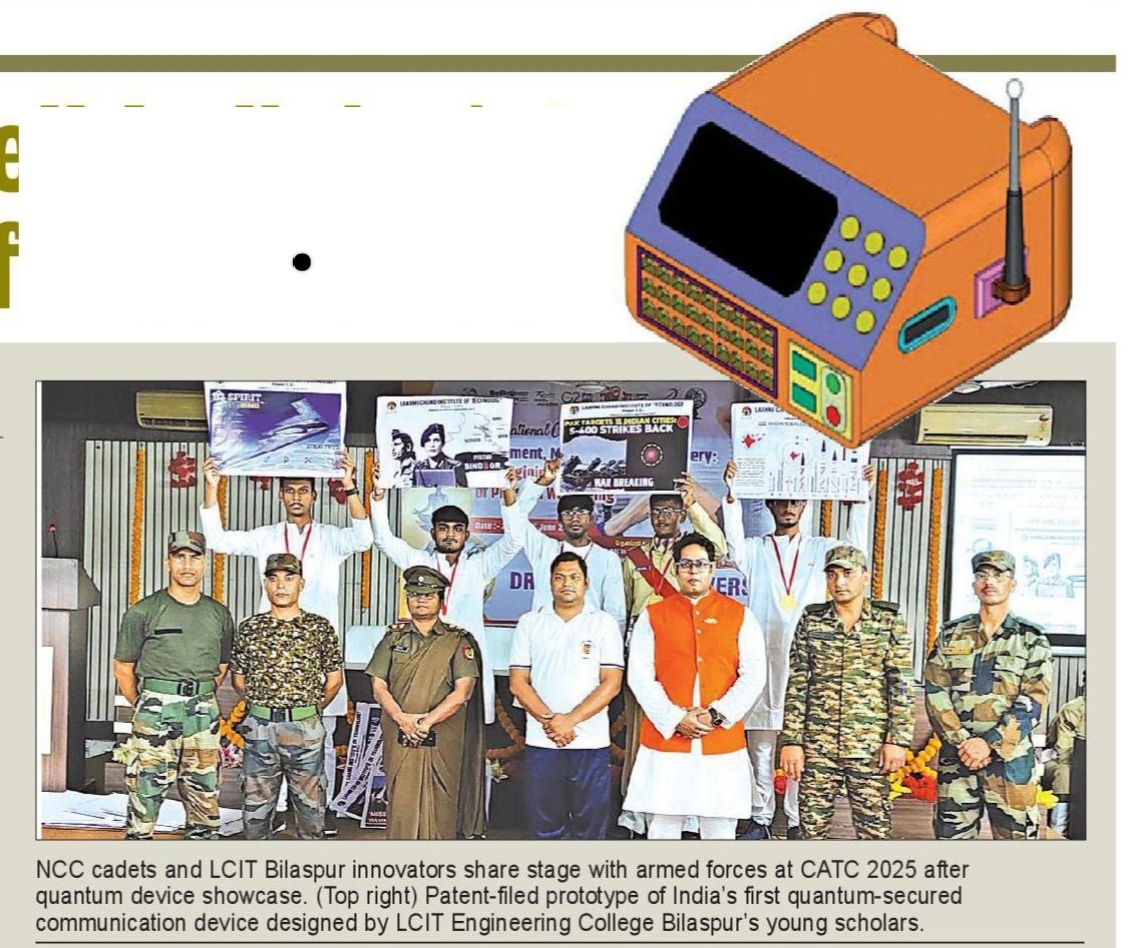
- Satellite-grade prototype unveiled amid rising cyber warfare threats
- Patent filed for battlefield-ready quantum encryption system
- NCC honours LCIT team for innovation in national security
■ By Mukesh S Singh
BILASPUR/RAIPUR,
IN A RARE convergence of military precision
and academic brilliance, a group of engineer-
ing scholars from LCIT Engineering College,
Bilaspur, has achieved a national milestone by
designing a fully functional Quantum
Cryptography-Based Secure Communication
Device - specifically engineered for defence
and battlefield communication.
This breakthrough project, developed under
the mentorship of Professor Amit Awasthi, has
already been filed for patent protection with
the Government of India and presented before
defence experts and NCC units at a national
camp. Speaking exclusively to ‘The Hitavada’,
Prof. Amit Awasthi shared, “In the present era
of high-tech warfare where satellite-guided
missile systems, drones and cyber-attacks are
shaping the future of defence, India needs
quantum-resilient solutions. Our device lever-
ages the principles of quantum key distribu-
tion (QKD) to ensure communication security
even against future quantum computer
attacks.” Backed by extensive research and a
recently published international journal paper,
the project was showcased during the
Combined Annual Training Camp (CATC) of
the National Cadet Corps (NCC) on July 4,
2025. The demonstration drew an audience of
over 600 NCC cadets and several defence
l...
officials, including Lt. Col. Lokesh Deva of the
7 CG Battalion, who praised the innovation and
personally felicitated the student team.
The core
team, working under the project name Avishkar,
comprises scholars Adarsh Dande, Harsh
Thawait, Basu Kaushal, Ayushman Jangde, and
Pratik Srivastava. The project blends academ-
ic rigour with tactical readiness, employing
QKD protocols such as BB84 and E91 to enable
secure military-grade encryption that is inher-
ently immune to interception or hacking.
According to the project’s research document
published in the International Research Journal
of Modernization in Engineering, Technology
and Science (IRJMETS), the device uses super-
conducting photon detectors and telecom-
grade fibre optics to transmit encrypted keys
at a rate of 1 Mbps over 150 km via fibre and
50 km in free-space satellite links. The system
also includes NATO-grade compatibility for
interoperability with allied forces.
“Today, traditional encryption like RSA or
AES stands vulnerable to quantum algorithms
like Shor’s. Our approach doesn’t just aim to
delay an attack - it renders it fundamentally
impossible,” said Prof. Awasthi. “The future is
not about faster encryption but unbreakable
ones.” Interestingly, the device integrates post-
quantum cryptographic algorithms with real-
time threat monitoring, quantum digital sig-
natures, zero-trust authentication, and AI-driv-
en anomaly detection, making it a
next-generation communication backbone for
India’s command-and-control systems.
The scholars also pointed out the looming
threat posed by platforms like Starlink, which
can potentially expose national data to foreign
surveillance. “With India’s first quantum com-
puter by QpiAI launched in April 2025, it’s time
we create parallel indigenous security archi-
tectures,” said scholar Harsh Thawait. In recog-
nition of their innovation, the LCIT Avishkar
team was felicitated at the NCC event with gold
medals and certificates of excellence. Prof.
Awasthi was personally commended by NCC
leadership for his visionary approach and tech-
nical guidance that bridges the gap between
classroom theories and frontline defence needs.
The design registration (Application No. 463037-
001) is currently under technical examination
at India’s Intellectual Property Office. The nov-
elty lies in the tamper-proof casing and mod-
ular construction of the communication device,
as detailed in patent visuals and documents
made exclusively available to this newspaper.