India will never compromise on farmers’ interests, I’m ready to pay heavy price: PM
Date :08-Aug-2025
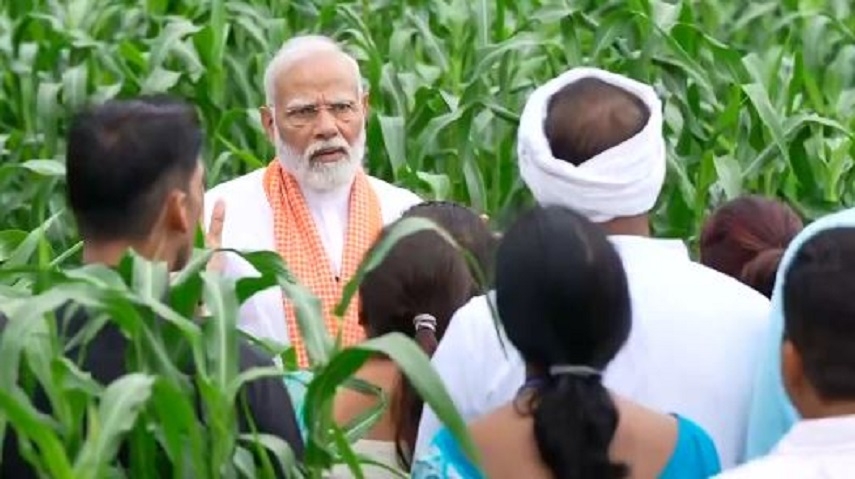
NEW DELHI :
IN A subtle message directed at US President Donald Trump, Prime Minister Narendra Modi said on Thursday that India will never compromise on the interests of its farmers, fishermen and dairy sector, and declared he was prepared to bear a significant personal
cost if necessary.
The statement came a day after Trump ratcheted up tariffs on Indian goods to 50 per cent, even as the two nations discuss a bilateral trade deal. The trade deal has been stuck over the US demand for greater access to India’s agricultural and dairy market.
The US wants reduced tariffs on products like corn, soybeans, apples, almonds and ethanol, as well as increased access for US dairy products. New Delhi is, however, resisting these demands as these will have a direct bearing on farmers. “Hamare liye apne kisaanon ka hit sarvoch prathamikta hai. Bharat apne kisaanon, pashu-paalakon aur macchuaare bhai-bahanon ke hiton ke saath kabhi bhi samjhuata nahin karega. (For us, the interests of farmers are our top priority. India will never compromise on
the interests of its farmers, dairy farmers and fishermen),” Modi said. He was addressing a global conference to mark the birth centenary of late agri-scientist M S Swaminathan, the architect of India’s Green Revolution.
To protect farmers’ interests, the Prime Minister said he was ready to personally pay a huge price.
“Main jaanta hoon ki vyaktigat roop se mujhe bahut badi keemat chukaanee padegi. Lekin main iske liye taiyaar hoon. (I know that I will personally have to pay a heavy price. But I am ready for it),” Modi said. India today is ready (to pay the price) for the fishermen and dairy farmers, he stressed.
The US has further hiked the trade tariffs on Indian goods to put pressure on India to reduce its dependency on Russia for crude oil.
On the occasion, Modi also released a commemorative coin and stamp in honour of the legendary scientist. Outlining his vision for Indian agriculture, the Prime Minister emphasised the need to ensure nutritional security, crop diversification and development of climate-resilient crop varieties and technology integration. He called for developing drought-tolerant, heat-resistant,
and flood-adaptive crops while pushing for AI and machine learning integration in agricultural systems.
The Prime Minister suggested that real-time decision support systems could be made accessible in every district to forecast crop yields, monitor pests, and guide farming practices.
Modi called for increased research on crop rotation and soil-specific suitability and further stressed the need to develop affordable soil testing tools and effective nutrient management techniques.
He also talked about the need to intensify efforts towards solar-powered micro-irrigation and stated that drip systems and precision irrigation must be made more widespread and effective. Stating that the Government has always considered the strength of farmers as the foundation of national progress, Modi highlighted that several schemes like PM-KISAN, PM Fasal Bima Yojana, PM Krishi Sinchai Yojana, PM Kisan Sampada Yojana, creation of 10,000 Farmer Producer Organisations (FPOs) and recent PM Dhan Dhanya Yojana for the all-around development of the farm and allied sector.
“The policies formulated in recent years were not merely about assistance, but about instilling confidence among farmers,” he said, reiterating the Government’s continuous efforts to increase farmers’ income, reduce production cost, and create new sources of revenue.
Modi said financial support to cooperatives and self-help groups has given fresh momentum to the rural economy.
The e-NAM platform has made it easier for farmers to sell their produce.
The event honoured Swaminathan, whom Modi described as a visionary whose contributions transcended any single era. The Prime Minister recalled Swaminathan’s prescient focus on forgotten crops like millets and his early warnings about chemical overuse in farming. “Dr Swaminathan believed the solutions to climate change and nutritional challenges lie in the very crops that have been forgotten,” Modi said, underlining how the scientist’s work anticipated today’s climate adaptation priorities.
Modi also recalled that years ago, Swaminathan had suggested transferring the genetic qualities of mangroves into rice, which would help make crops more climate-resilient. He emphasised that “today, as climate adaptation becomes a global priority, it is evident how far-sighted Swaminathan’s thinking truly was.”
While Swaminathan worked to boost grain production, Modi said he was equally concerned about the environment and soil health. He introduced the concept of the Evergreen Revolution to balance both objectives and address emerging challenges.
Swaminathan proposed the idea of Bio-Villages to empower rural communities and farmers, besides promoting innovative ideas such as ‘Community Seed Banks and Opportunity Crops.’
Union Minister Shivraj Singh Chouhan, Niti Aayog member Ramesh Chand; MS Swaminathan Research Foundation Chairperson Soumya Swaminathan were among others present at the event.
Farmers praise PM Modi’s stand
NEW DELHI,
Aug 7 (ANI)
FARMERS from different parts of the country have welcomed Prime Minister Narendra Modi’s strong assertion that the interest of farmers remains his Government’s top priority, praising his initiatives and expressing their faith in his leadership.
Reacting to PM Modi’s remarks, farmers from various States expressed their support.
A farmer from Uttar Pradesh’s Aligarh told ANI, “PM Modi has done so much for the benefit of the farmers, including Kisan Samman Nidhi, Dairy loans and other benefits. What PM Modi has done for the farmers, no one could ever do. We want him to remain the Prime Minister in future as well...” Another farmer said, “PM Modi has given a lot of schemes for the farmers, including Kisan Samman Nidhi,
Credit Cards for farmers... All the farmers are standing with PM Modi,
and we will keep standing with him...”
“PM Modi has said that he is standing for the farmers and will support us in every situation. The rates of crops have improved. He is doing a very good job. PM Modi has always been with us...” a farmer from Haryana told ANI.
From Jaipur, a farmer said, “We are standing with the Prime Minister and the country. What do we have to do with America?.. The condition of the farmers has improved after PM Modi came to power. The Government is doing a good job for the farmers...”
PM Modi’s remarks come in the wake of the Trump administration’s move to double tariffs on Indian goods to 50 per cent.
During trade negotiations, the US had pushed for greater access to India’s agricultural market, especially corn, soybeans, and cotton. However, India has resisted opening the agricultural sector and dairy products, due to concerns about domestic livelihoods and potential impacts on farmers.
You are going to see so much secondary sanctions: Trump
NEW YORK,
Aug 7 (PTI)
US President Donald Trump has said India is “very close” to China in terms of its purchases of Russian oil and will pay tariffs of 50 per cent as he indicated that “you are going to see so much secondary sanctions”.
“.... As you know, we put a 50-per cent tariff on India on oil. They are the second largest, they are very close to China in terms of the purchase of oil from Russia,” Trump said in the Oval Office on Wednesday.
Trump signed an executive order “Addressing Threats to the US by the Government of the Russian Federation” early on Wednesday, slapping an additional 25-per cent tariff on India for New Delhi’s purchases of oil from
Russia. This took the total levies imposed on India to 50 per cent, among the highest that Washington has imposed on any country, after the Trump administration had announced 25-per cent tariffs on India last week that come into effect from August 7. The additional 25-per cent duty will come into effect after 21 days or August 27. At the White House event, Trump was flanked by Apple CEO Tim Cook, Vice President J D Vance, Secretary of the Treasury Scott Besant and Secretary of Commerce Howard Lutnick as the technology giant announced that it will invest USD 600 billion in the United States over the next four years. Trump was asked several questions about his decision to impose an additional tariff on India. To a question that if he reaches a deal with Ukraine and Russia, would he drop the additional tariffs on India, Trump said, “We will determine that later but right now, they are paying a 50-per cent tariff.”
Trump was then told that Indian officials have said there are other countries like China that are buying Russian oil, to which he said, “It is okay.” On why was he singling India out for these additional tariffs, the US President said “it has only been eight hours, so let us see what happens over the next.... You are going to see a lot more. You are going to see so much secondary sanctions.”
The United States has imposed this additional tariff or penalty for Russian imports only on India, while other buyers, such as China and Turkiye, have so far escaped such measures. The 30-per cent tariff on China and 15 \per cent on Turkiye is lower than India’s 50 per cent. Asked about the additional penalties on India and whether he has any similar plans to enact more tariffs on China for its purchases, Trump said, “Could happen, could happen. Depends on how we do. Could happen.”
On another question on possible tariffs on China for its purchases of Russian oil, he said, “It may happen, I do not know, I cannot tell you yet. We did it with India. We are doing it probably with a couple of others. One of them could be China.”
Ministry of External Affairs (MEA) said in a statement that it is “extremely unfortunate” that the US should choose to impose additional tariffs on India for actions that several other countries are also taking in their own national interest.
“We have already made clear our position on these issues, including the fact that our imports are based on market factors and done with the overall objective of ensuring the energy security of 1.4 billion people of India,” the MEA said. statement said, adding that the US has in recent days targeted India’s oil imports from Russia.
“We reiterate that these actions are unfair, unjustified and unreasonable. India will take all actions necessary to protect its national interests,” it said.
In the executive order, Trump said he has determined that “it is necessary and appropriate to impose an additional ad valorem duty on imports of articles of India, which is directly or indirectly importing Russian Federation oil”.
“I find that the Government of India is currently directly or indirectly importing Russian Federation oil. Accordingly, and as consistent with applicable law, articles of India imported into the customs territory of the United States shall be subject to an additional ad valorem rate of duty of 25 per cent,” Trump said in the executive order.
He also announced that the US will be putting a tariff of approximately 100 per cent on chips and semiconductors coming into the country. “But if you are building in the United States of America, there is no charge.... If you have made a commitment to build, or if you are in the process of building, as many are, there is no tariff.”
India buys about 88 per cent of its crude oil, which is converted into fuels like petrol and diesel, from overseas. Russian oil made up for hardly 0.2 per cent of all crude oil that India imported till 2021. After Moscow invaded Ukraine, Russian oil was available at a discount to international benchmarks due to western sanctions, and was quickly lapped up by Indian refiners. Russia is now India’s largest oil supplier.
In July, India imported about five million (50 lakh) barrels of oil a day, of which 1.6 million (16 lakh) came from Russia.
After the new levy, India will attract the highest tariff of 50 per cent along with Brazil. After this, India’s competitors will be much better placed in the US market as their duty is lower -- Myanmar (40 per cent), Thailand and Cambodia (both 36 per cent), Bangladesh (35 per cent), Indonesia (32 per cent), China and Sri Lanka (both 30 per cent), Malaysia (25 per cent), the Philippines and Vietnam (both 20 per cent).
The announcement comes at a time when a team from Washington is scheduled to visit India from August 25 for the sixth round of negotiations for the proposed bilateral trade agreement (BTA).