Revolutionalising travel: Mizoram’s Bairabi–Sairang rail line
10 Sep 2025 11:30:29
By Ashish Rajput
Aizawl
PM Modi to inaugurate the Bairabi-Sairang rail project on Sept 23
ROLLING green hills, mist-filled valleys and endless bamboo forests have made Mizoram a jewel of the North-East, but also kept it cut off from the rest of the country. Reaching the State capital, Aizawl, meant a five-hour road journey on narrow highways which turn dangerous in monsoons.
Long considered as one of India’s distant States, Mizoram is set to experience a transformative leap in connectivity and development. After 78 years of Independence, the State has finally been linked with the national railway network through the Bairabi–Sairang new line railway project at its State capital Aizawl. This project is a milestone promising to integrate Mizoram closely with the mainstream of India’s economic and social growth.
The newly-built Bairabi–Sairang rail line, stretching 51.38 km and costing over Rs 8,071 crore, has accommodated Mizoram into the national railway map. With 45 tunnels and 153 bridges, including India’s second tallest Pier Bridge at 114 meters which is taller than the Qutub Minar, the project is an engineering marvel. But more importantly, it is already transforming life, economy and opportunity in Mizoram.
Prime Minister Narendra Modi will inaugurate the Bairabi-Sairang rail project in Aizawl, Mizoram on September 23.
The rail line has curtailed travel time drastically as what used to be a seven-hour road journey between Aizawl and Silchar can now be completed in just three hours by train. In this project, passenger trains are designed to run at up to 100 kmph for a safer, faster and more reliable journey.
Students can reach universities more easily, patients can get to advanced hospitals without delay and traders can move goods without fear of landslides.
Economists predict that better connectivity alone could raise Mizoram’s GDP growth by 2–3 per cent annually, translating into an additional Rs 500 crore each year for the State’s economy. The new rail line also positions Mizoram as a trade gateway. Connected to the rest of India and located near Myanmar’s Sittwe Port, Mizoram could play a key role in India’s Act East Policy, serving as a corridor for trade with Southeast Asia. Experts believe this region could handle $10–12 billion worth of trade in the coming decade.
The most immediate impact is on agriculture. Farmers who grow bamboo, chillies, oranges, ginger and pineapples now have a cheaper, faster way to get their produce to larger markets. Post-harvest losses, which were as high as 25–30 per cent due to slow road transport, are expected to fall by half.
The cost of transporting goods is also dropping sharply. Road transport used to cost Rs 15–20 per kg. With rail, it is expected to fall by 30–40 per cent.
The rail line is also creating jobs.
Thousands of people worked during the construction phase and in the future, experts expect 3,000–5,000 indirect jobs annually in logistics, tourism, hospitality, and retail.
Beyond economics, the rail line is bringing Mizoram closer to the national mainstream. Isolation in the past created a sense of distance, both physical and psychological. Now, with trains running daily, that gap feels smaller.
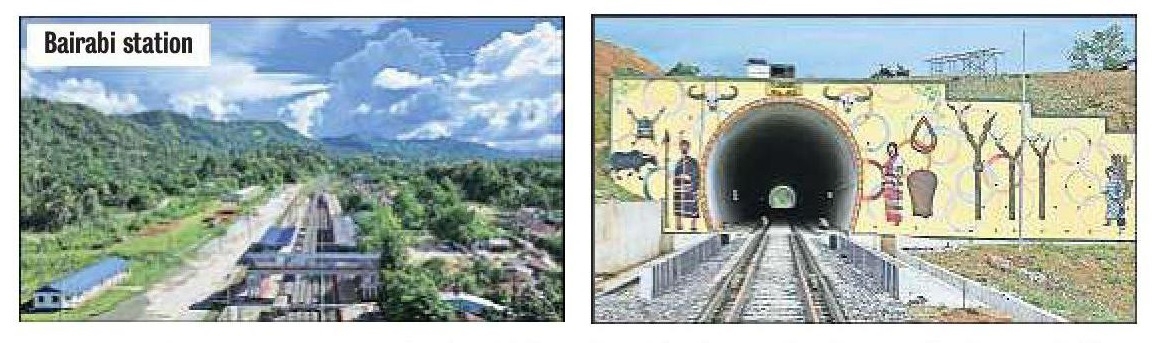
Almost half the line passes through deep cuttings, some up to 65 metres deep, with extensive landslide protection measures to ensure uninterrupted operations even during Mizoram’s heavy monsoons. To enrich the journey, tunnel faces are adorned with cultural motifs and murals depicting Mizoram’s festivals, traditions and natural beauty, turning travel into an immersive cultural experience.
Constructing the line through Mizoram’s steep hills came at a high cost financially, technically and tragically, as shown in the 2023 bridge collapse that claimed 26 lives. Yet, engineers worked to minimise ecological damage by using long tunnels and elevated viaducts, reducing deforestation and protecting habitats.
The Bairabi–Sairang rail line is more than steel tracks and bridges. It is a symbol of change, connecting Mizoram’s hills with the heart of India and linking its economy with the wider world.