Gateway to India’s ancient wisdom Digitisation of manuscripts will help curb intellectual piracy: PM
| Date :13-Sep-2025 |
NEW DELHI :
PRIME Minister Narendra Modi said on Friday that digitisation of India’s ancient manuscripts will help curb “intellectual piracy”, adding that the information sourced to the country’s traditional knowledge system has been copied and patented by others.
Addressing the International Conference on Gyan Bharatam on the theme ‘Reclaiming India’s Knowledge Legacy through Manuscript Heritage’ at Vigyan Bhavan here, the Prime Minister said the exercise is an extension of the country’s resolve to forge ahead with the concept of “swadeshi” and “aatmanirbhar Bharat”.
India is now proudly presenting before the world its heritage of ancient knowledge preserved in its manuscripts for centuries, he said.
Modi complimented private organisations for working with the Government in its goal to digitise these manuscripts spread across the country, and said over 10 lakh of them have been digitised so far.
He said India is working with other countries like Thailand, Vietnam and Mongolia, with whom it has enjoyed cultural ties and which are home to such manuscripts.
This event is witness to the renaissance of India’s golden past, he said, asserting that its knowledge tradition is this rich because it rests on the
(Contd from front page)
pillars of preservation, innovation, addition and adaptation.
The Prime Minister said India has the world’s largest collection of about one crore manuscripts.
Modi said, “Throughout history, crores of manuscripts were destroyed, but the ones that remain show how devoted our ancestors were to knowledge, science and learning.”
He said India is a living stream with its cultural identity, consciousness and soul, and its history is not merely about the rise and fall of dynasties.
“India’s manuscripts contain footprints of the development journey of the entire humanity,” he said. Modi described the country’s manuscripts as a “treasure trove” and “pride of the nation”, and asserted that in these ancient texts, “we find the lines of perennial flow of Indian ethos”.
The Prime Minister also launched the ‘Gyan Bharatam’ portal, a dedicated digital platform to accelerate manuscript digitisation, preservation and public access.
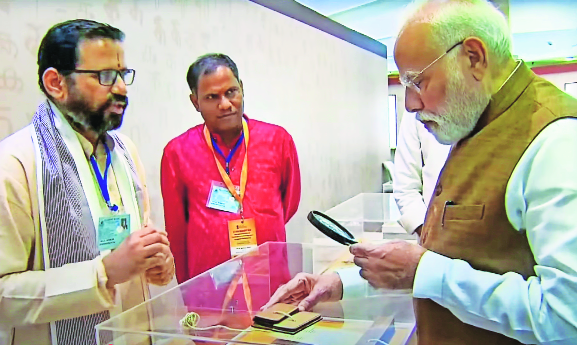
Soon after his arrival, he first visited the exhibition hosted at the venue, showcasing some of the rare Indian manuscripts.
Centuries-old and rarest of the rare manuscripts of Kautilya’s Arthashashtra and Sundar Kanda of Valmiki Ramayana, both on palm leaves, are part of the display. “Both manuscripts, about 500 years old, as per our records, are housed at the Oriental Research Institute (ORI), Mysore, and their original versions have been taken out of our safe custody, especially for this occasion,” Krishna Nagasampige, research scholar at ORI and a participant at the conference, told PTI. A few manuscripts drawn from the Oriental Institute of the Maharaja Sayajirao University of Baroda and another institution in Ahmedabad, Gujarat, and the Bhandarkar Oriental Research Institute (BORI) in Pune have also been showcased.
Modi also saw presentations made by different working groups constituted under the Gyan Bharatam Mission at the Plenary Hall. Eight groups have been set up under different verticals, including critical areas such as manuscript conservation, digitisation technologies, metadata standards, legal frameworks, cultural diplomacy and decipherment of ancient scripts.