‘30% of donated corneas remain unutilised, Govt contribution needed to improve ratio’
15 Sep 2025 11:37:25
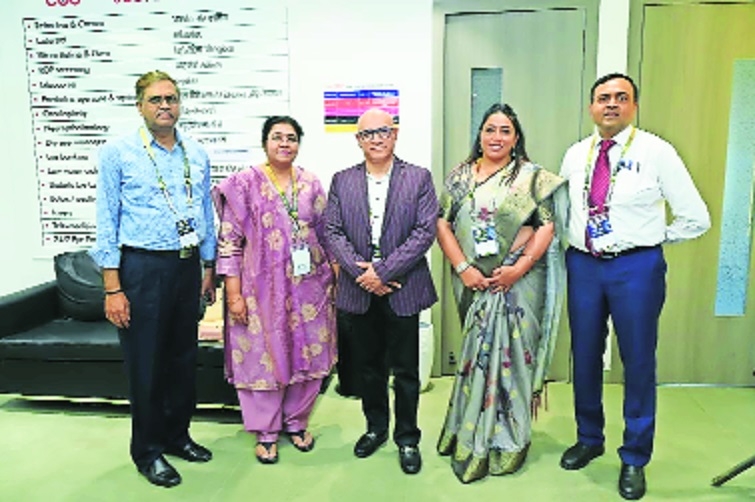
K Hariharan, Supriya Hirwe, Dr Gopal Arora, Bindiya Bhatia,
Dr Rakesh Shah at ABO Eye Institute.
By Vikas Vaidya :
Already, India is facing the issue of less number of eye donations and to add to the problems, of the donated eyes, 30% corneas are to be discarded. The ratio of eye donations and the needy doesn’t match. To reduce the percentage of discarded corneas, the eye banks and doctors have to act faster, expressed the some technicians working in various eye banks. They are the backbones of eye banks who run the show. Leading experts of the field spoke to ‘The Hitavada’ in Nagpur at ABO Eye Institute during national conference of the Eye Bank Association of India (EBAI), centered on Cornea and Eye Banking.
K Hariharan -LVPEI, Hyderabad; Supriya Hirwe, MGRC, Sahiyara Eye Bank, Thane and Bindiya Bhatia from All India Institute of Medical Sciences, Rishikesh spoke at length on the issues of eye banks. According to Hariharan and Hirwe, the Government is not participating in the whole process of eye donations.
They are not even providing grants. Hirwe said, “For example, we organise various programmes of awareness during the fortnight of eye donation held between August 25 and September 8 every year. This is organised only at the institutions’ level where Governments hardly participate. The eye donations can be increased if the awareness is aggressively done and
certain things are made mandatory.”
Hariharan explained, “Corneas are discarded by eye banks for several reasons. They include poor tissue quality, and medical reasons, such as positive blood serology for infectious diseases like HIV or Hepatitis B, hepatitis C, or other health conditions of the donors. Secondly, in some cases, the process of retrieving corneas gets delayed. If the corneas are not retrieved within 6 hours then they are discarded.”
According to Bindiya Bhatia, a trend is coming where the discarded corneas are used for other purposes, they are used for practicals where students can study them. The cornea-like tissues (CLTs) are used for research or wound healing. Technicians are responsible for taking initial care of corneas in eye banks.
They have to clean, retrieve actual cornea skillfully to be transplanted in the corneal blind person.
Of the total 51,249 eye donations this year, only 27,579 were utilised. Rest are to be discarded. Most private eye banks are becoming non-functional sans adequate funds.
Dr Rakesh Shah, Treasurer of Eye Bank Association of India said, “We don’t have centralised policy. If the Government comes up with the policy then import and export of eyes from one state to other is possible. If some states have surplus eyes (cornea) donated, they can be transported to the other states where there are a lot of recipients waiting to get sight. At this juncture transportation of eyes is not allowed from one state to other state. In developed countries there is a flexible policy. Indian Government must give a thought to it.”