Down the memory lane Nagpur Book Club revives a century of Akashvani
Date :15-Sep-2025
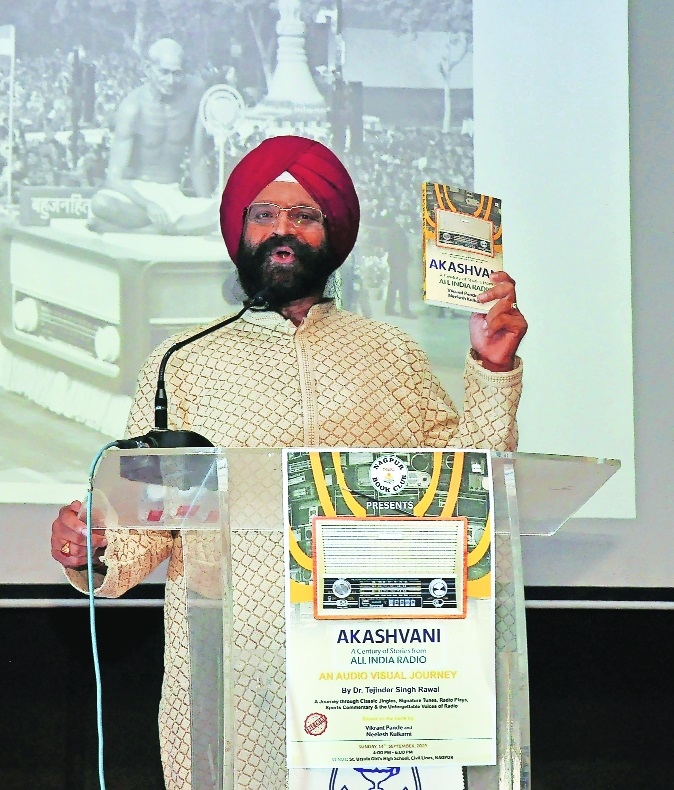
Dr Tejinder Singh Rawal
amusing the audience with the stories of AIR. (Pic: Anil Futane)
Staff Reporter :
The evening traced the listening culture that emerged, how scarcity of film songs drove audiences to Radio Ceylon, how Ameen Sayani’s conversational style immortalised ‘Binaca Geet Mala’, and how ‘Vividh Bharati’ revolutionised home entertainment with drama, interviews, and ‘Aap Ki Farmaish’.
The Nagpur Book Club (NBC) hosted a rare and imaginative evening with ‘Akashvani: A Century of Stories’ from All India Radio (AIR), turning the book into a live radio style performance that brought both history and nostalgia to life at St Ursula High School on Sunday.
The event was compered by Dr Tejinder Singh Rawal, who blended Hindustani-English warmth with historical anecdotes, audio cues, and miniature performances. With RJ Tejal’s vibrant compering and Dr Rawal at the helm, the ninety minute programme never lost its rhythm or intimacy.
Proceedings began with the familiar Akashvani station ID and a brisk timeline of Indian broadcasting, from Tagore’s coining of “Akashvani” in 1938 to the voices that carried India’s sporting triumphs into homes.
Dr Rawal traced the listening culture that emerged, how scarcity of film songs drove audiences to Radio Ceylon, how Ameen Sayani’s conversational style immortalised ‘Binaca Geet Mala’, and how ‘Vividh Bharati’ revolutionised home entertainment with drama, interviews, and ‘Aap Ki Farmaish’. He reminded the audience of the enduring power of the spoken word, poetry readings, Manto’s radio plays, and evocative radio drama.
Musicians Mohhnish Zade, Harmeet Lamba, Kovid
Sontakke, Renu Singh, Sonal Hikare, and Dilip Mandvia recreated the magic of the airwaves with capsules from ‘Hawa Mahal’, ‘Binaca Geet Mala’, ‘Aaj ke Fankar’, ‘Jai Mala’, and ‘Aap Ki Farmaish’. Between performances, Dr Rawal inserted charming radio lore, signature jingles, the Jhumri Telaiya legend, and AIR’s pioneering news and pronunciation standards.
Special pride was reserved for Nagpur’s own voices: Broadcaster Kishan Sharma, theatre icon Purushottam Darvekar, and Marathi “Ghazal Samrat” Suresh Bhat. The evening was framed by remarks from Manoj Jain, Production Officer at Doordarshan, and graced by guest of honour Pratima Rathi. Rohit Tokhi introduced NBC’s mission, while Amarjit Singh, Kavita Jogi, Dr Suhas Deotale, Varun and volunteers ensured seamless production.
Interactive flourishes, postcard call outs, a Sayani-style quiz, and archival visuals kept the audience engaged until the hall stood together for Vande Mataram. Dr Rawal closed with a resonant reminder: “Akashvani was the friend that never needed a screen, only our ears and imagination.”
Sports on radio: A living legacy
A dedicated section paid tribute to the voices that carried India’s sporting triumphs into homes. From the elegant early English commentaries of B C Talyarkhan and Vizzy, to Ravi Chaturvedi’s inventive Hindi lexicon, radio created a theatre of sport long before television. Jasdev Singh’s unmatched clarity made Republic Day parades and hockey finals feel immediate and vivid. The segment celebrated radio’s ability to transform the crackle of commentary into shared national pride.